


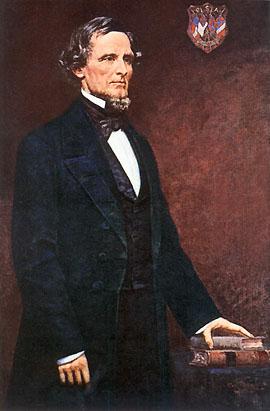
The Confederate government was first organized starting on February 4, 1861 at Montgomery, Alabama when representatives from six of the seven original states to secede met to establish a temporary government (the last of the seven, Texas, was late). They decided to form a provisional government to hold power for one year before the adoption of a formal constitution for the new confederation of states. Jefferson Davis of Mississippi was chosen to be the first President of the Confederacy with Alexander H. Stephens of Georgia as his Vice-President. When the Constitution of the Confederate States was adopted their terms were extended to six years and six additional southern political leaders were chosen for the first Cabinet. Montgomery, Alabama was chosen as the nation's temporary capital. Following the secession of Virginia the capital was moved to Richmond, where it remained until the end of the war in 1865 when it was briefly set up in Danville, Virginia.
The Confederate Cabinet
The first Cabinet to work with President Davis included:
-Robert Toombs of Georgia, Secretary of State
-Stephen R. Mallory* of Florida, Secretary of the Navy
-Judah P. Benjamin* of Louisiana, Attorney General
-Leroy P. Walker of Alabama, Secretary of War
-John Reagan* of Texas, Postmaster General
-Christopher G. Memminger of South Carolina, Secretary of the Treasury
*cabinet members who served throughout the war
The original Confederate cabinet aimed to have all southern states represented, but the great problems faced by the south necessitated many changes. It is also noteworthy that the first Confederate cabinet included three foreign-born secretaries: Memminger from Germany, Mallory from the British West Indies and Benjamin who was also born a British subject in the Danish West Indies. Benjamin was also the first Jew to serve in an American cabinet and throughout his career he was Attorney General, Secretary of State and Secretary of War.
The Confederate Constitution
The Constitution of the Confederacy, adopted in March of 1861 was based largely on that of the United States. However, there were six significant differences: 1) The term of the President and Vice-President was six years and the President could not succeed himself. 2) Cabinet members had Senate seats and could debate but not vote. 3) The foreign slave trade was prohibited but slavery was legal. 4) Congress could not make any appropriations for internal improvements, levy protective tariffs or give bounties. 5) A 2/3 vote of both houses was required to admit a new state into the Confederacy or to make appropriations not requested by the heads of departments through the office of the President. 6) The President could veto single items on appropriations bills.
Confederate Diplomacy
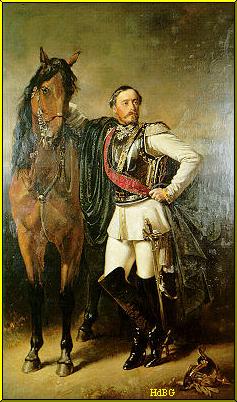
The Confederacy had hoped for peaceful secession from the United States, but the Lincoln administration refused to allow it and so the war would not be won until the US was forced to recognize Confederate independence. Confederate agents were sent abroad and worked extensively in Canada and Mexico. The nations most likely to come to the aid of the south were France, which was setting up a restored monarchy in Mexico, and Great Britain which needed southern raw materials and didn't care for industrial competition from the United States. Ultimately, several countries around the world, including the British Empire, the French Empire, The Kingdom of the Netherlands, The Kingdom of Spain and the Empire of Brazil recognized the Confederacy as a belligerent, but not as a nation. The only foreign ruler to formally recognize the Confederacy was Duke Ernst II of Saxe-Coburg-Gotha, brother-in-law of Britain's Queen Victoria. Emperor Napoleon III offered to arrange a peace summit but the US refused and warned that they would regard any effort by a foreign power to mediate peace as an act of war. In 1865 the Confederates tried to hold peace negotiations with Lincoln, but these proved pointless as Lincoln refused to recognize the right of secession, the legality of the Confederate government or that any of her leaders were anything more than treasonous rebels worthy of death. The closest the South ever came to foreign recognition was during the "Trent Affair" when war almost broke out between the US and Great Britain. However, after Lincoln issued the so-called "Emancipation Proclamation" portraying the war as a crusade against slavery there was not much chance of any European power intervening for the south.