 |
|
|
|
|
|
|
|
|
|
|
|
|
|
|
|
|
|
|
|
|
|
|
|
|
|
 |
|
 |
|
|
|
|
|
|
 |
|
|
 |
|
|
The Bonnie Blue Flag was especially popular before and in the early days of the war. Based on the Lone Star flag of Texas the obvious symbolism was that of the single state, removed from the Union and standing alone, sovereign and independent. Although the flag tended to be seen less as the war went on it did inspire a very popular patriotic tune of the same name. |
|
|
|
|
 |
|
 |
|
|
|
|
The Stars and Bars was the first national flag of the Confederacy. Designed by Nocola Marschall, it was based on the design of the Austrian flag with stars added for new Confederate states. The flag which flew over Ft Sumter had 7 stars for the 7 original states. It flew from 1861 to 1862 but continued to be seen all throughout the war. |
|
|
|
 |
|
|
 |
|
|
|
|
|
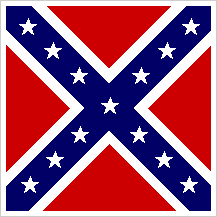
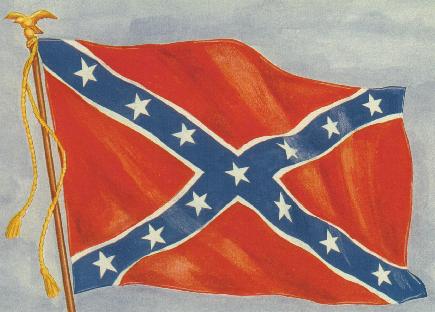
Because the "Stars & Bars" was so easily mistaken for the U.S. flag Confederates of the Army of Northern Virginia carried this battleflag throughout most of the war. In the west, troops used a rectangular version or a totally unique design. |
|
The Stainless Banner was the second official national flag of the Confederacy, intended to be a unique design that would not be confused with the US flag. It was much longer than normal dominated by a white field symbolic of the purity of the southern cause. First used to cover the coffin of Stonewall Jackson it flew from 1863-1865. |
|
|
|
 |
|
 |
|
|
|
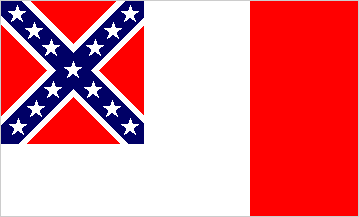
The Third National Flag was adopted only a short time before the fall of Richmond and General Lee's surrender in 1865 and so was never around to acquire a nickname. Many had complained that the previous "Stainless Banner" was too easily mistaken for a flag of truce when hanging limp, or sometimes for the British White Ensign when flown at sea. The red stripe was added to correct this problem. The South also used a longer version of the battle flag as the Confederate naval jack. Today this is the most recognized Confederate symbol, known as "the Rebel Flag". |
|
|
|
 |
|
 |
|
|
|
|
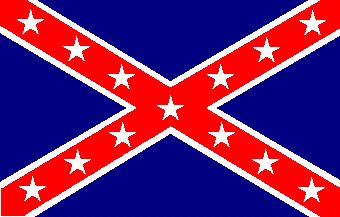
Trans-Mississippi Department Flag |
|
|