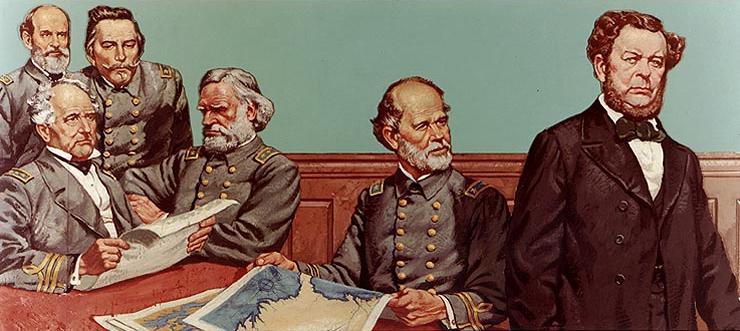
Since the Confederates could never hope to match the Union ship for ship, due to an almost total lack of industry, the Confederate Navy proved the old saying that necessity is the mother of invention. To make the most of their minimal resources, the Confederacy focused on new technologies and innovative weapons. One of the first of these was the CSS Virginia, formerly the Union frigate Merrimac, which was the first armored warship in North America. In 1862 the Union ship Monitor engaged the Merrimac at Hampton Roads in the first battle between ironclad warships, instantly making all wooden fleets in the world obsolete.
For her part, the United States Navy opened the war by immediately clamping down a blockade on the southern coastline to starve the south into submission and to infiltrate the Mississippi and major southern rivers to disrupt their lines of supply and communication. As a result, Confederate naval strategy was focused on defending ports, defending rivers and relying on blockade runners to smuggle in the manufactured goods the south depended on. The ironclad was built with the original intention to lift the blockade, but was checked by Union ironclads and so became a river defense vessel. In Charleston, South Carolina the Confederate effort to hit the Union blockade resulted in the CSS H.L. Hunley, a primitive submarine. Although the sub did not survive her attack on the USS Housatonic she did go down in naval history as the first submarine to sink an enemy vessel.
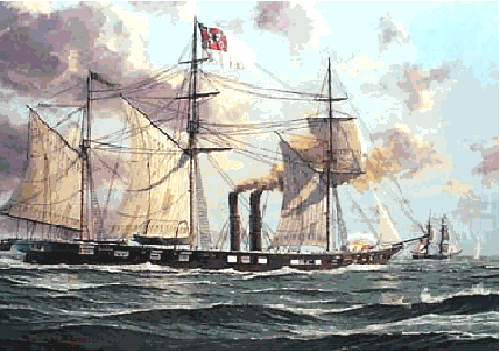
Aside from ironclads and submarines, the south was also a world leader in the development and use of torpedo boats and naval mines. The Confederates also operated commerce raiders, built in England and armed at sea which hunting Union merchant shipping, disrupting their commerce and forcing them to divert warships from blockade duty to hunt down these raiders. The first of these was the CSS Sumter, but the most successful and famous was the CSS Alabama. Other famous commerce raiders included the CSS Florida and the CSS Shenandoah.
In the end, the Confederate Navy failed to defend the waterways of the south. However, given the odds against them, and everyone at the time understood that a conventional victory was simply impossible, they did manage to achieve miraculous results against a vastly superior foe. At best the Confederates could win a stalemate, yet there were some spectacular victories for the southern navy such as Drewry's Bluff, Galveston or the awesome voyage of the Alabama. It is also a little known fact that the first day of the battle of Hampton Roads, in which the Merrimac sank the ships Congress, Cumberland and ran the Minnesota aground was actually the costliest day in the history of the U.S. Navy prior to the Japanese attack on Pearl Harbor. Considering what the Confederates had to work with, their accomplishments were nothing short of marvellous. Not only had they taken a huge toll on Union shipping and made them pay a high price for control of the south's waterways, but they also pioneered in the areas of armored warships, naval mines, submarines and torpedoes. It is no wonder that the Confederate Navy won such a gallant reputation around the world.

CSNavy.org
CSN on Wikipedia
CSS H. L. Hunley
Captain Isaac N. Brown
Captain John T. Wood