 |
|
|
|
|
|
|
|
|
|
|
|
|
|
|
|
|
|
|
|
|
|
|
|
|
|
|
| The Battle of Chickamauga |
|
|
 |
|
|
| Any southerner must sadly admit that in the so-called western theatre of the War Between the States (meaning the region west of Virginia to the Mississippi River) the Union side was mostly victorious. The Confederates had some near wins and some stalemates but at the end of the day it was the Union army and navy that gained control of Kentucky, Tennessee and the Mississippi River with probably the most painful losses for the Confederacy being at the early battle of Shiloh wherein the south lost the initiative, their best chance and their best general and at the siege of Vicksburg wherein the south lost the so-called Gibraltar of the Confederacy. However, in the entire history of the war the south can proudly point to at least one stunning victory in the western theatre, a smashing success that was a triumph no matter how one looks at it and a battle which was a defeat for the Union so complete that it was only one step away from becoming a route. That battle has put a touch of pride in every southern heart since at the mere mention of its name and that name was the battle of Chickamauga. |
|
| Prior to the battle the Union forces under General William S. Rosecrans had driven the Confederate Army of Tennessee under General Braxton Bragg across the state to the vital city of Chattanooga, an important rail hub, industrial center and inland port. The Confederates had been in a state of near mutiny against the abrasive General Bragg who seemed to have a habit of achieving stalemates at best and snatching defeat from the jaws of victory at worst. However, Bragg was a close friend of President Jefferson Davis who thought quite highly of the Mexican War hero and he kept Bragg in command even when his senior officers were all opposed to him. However, when General Bragg abandoned Chattanooga after September 8, 1863 even Jefferson Davis became worried enough to advocate some drastic action to save the situation. His first thought was for General Lee to go to Georgia to take command temporarily but Lee resisted such a measure, preferring to launch his own offensive in Virginia on the belief that this would relieve the pressure on Bragg. Few, if any, Confederates realized just how massively outnumbered they were by the north which had more than enough troops to deploy on all fronts simultaneously. |
|
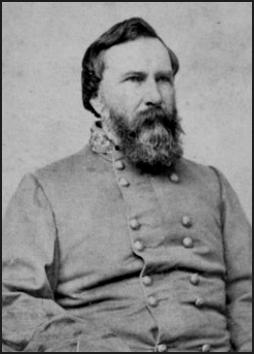
| Davis did finally insist however that Bragg at least be heavily reinforced by troops from the Army of Northern Virginia. The result was one of the great strategic movements of the war and the best illustration of the Confederate method (born of necessity) of moving troops from one area to another to meet threats by the more massive Union armies. The Confederate High Command decided to temporarily transfer the First Corps of the Army of Northern Virginia under Lieutenant General James Longstreet to the Army of Tennessee and the rickety southern rail system was buzzing with activity as thousands of boys in grey were shipped west to assist General Bragg at this vital juncture. General Joseph E. Johnston, overall Confederate commander of the western department, also contributed a division from the hard pressed force in Mississippi to aid in this crucial operation. The southerners assembled in the northwest corner of Georgia while General Rosecrans prepared to move against them. |
|
|
|
 |
|
|
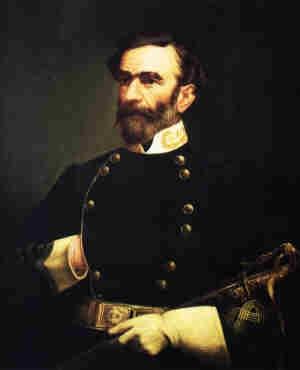
General Braxton Bragg, co Army of Tennessee |
|
|
| The opposing commanders were alike in some ways but probably had more differences than similarities. General Rosecrans was an Ohioan and zealous Catholic convert who won fame for his victories at Corinth and Stones River. He often had strained relations with his subordinates but was known to easily forgive and put matters behind him as much as he was for his short temper. He was also a rather careful and methodical commander which often infuriated his superiors in Washington who always wanted quick and aggressive action. Confederate General Braxton Bragg also had a hard time getting along with his subordinates but had a loyal friend in President Davis. Celebrated for his role in the Mexican War he had been praised for his early performance in the west at Shiloh and was given command of the Army of the Mississippi after Davis fired General Beauregard. Bragg renamed the force the Army of Tennessee and embarked on an offensive to retake that state and advance into Kentucky. He did so but won few friends along the way for his iron fisted discipline and hostile attitude with his subordinates. Had victories ensued these flaws in personality might have been overlooked but Bragg only seemed to break even or lose ground. His tendency to micromanage meant he often lost sight of the larger strategic picture and by the time of Chickamauga it was clear that he owed his continued position only to his friendship with the President. |
|
| In some ways the two generals were viewed in this way; Rosecrans was often accused of employing strategies that could not work and yet somehow did while Bragg was blamed for having made all the right preparations for victory and still managing to lose or only break even. Rosecrans had pushed Bragg out of Kentucky and across Tennessee and finally captured the vital rail junction of Chattanooga. With the Confederates falling back into Georgia Old Rosy believed that, having just abandoned so strategic a location they must be on very hard times and fleeing in demoralized retreat. In this estimation he was to be proven entirely wrong as General Bragg was already planning a counter attack to hit the units of the Union army coming after him one at a time with the added benefit of knowing that help was on the way. Whereas Rosecrans thought Bragg had retreated much farther south to Dalton, Rome or even all the way to Atlanta, in reality the Confederates were only twenty miles away and prepared to strike. The Confederates helped convince Rosecrans that they were on the ropes by sending out troops pretending to be deserters to be captured by the Yankees. It was standard procedure to gain intelligence from deserters and these men all spread the story that Bragg was in retreat and ripe for destruction. |
|
| Rosecrans, therefore, moved to cut off the Confederates and dispatched the XX Corps under Major General Alexander McCook to march across Lookout Mountain and take the rail head at Resaca, Georgia with his cavalry while XXI Corps under Major General Thomas Crittenden moved south from Chattanooga in pursuit of the main Confederate body with Major General George H. Thomas and his XIV Corps moving on LaFayette, Georgia where Bragg actually was encamped. On September 10, 1863 Major General James Negley, a divisional commander under Thomas, ran into Major General Thomas C. Hindman and his Confederate division at the battle of Davis Cross Roads near Pigeon Mountain. The Yankees were thrown back and forced to retreat to Lookout Mountain. With the three main Union corps separated, Bragg decided to focus on hitting Crittenden first and ordered General Leonidas Polk to take his corps and attack the lead division under Crittenden, commanded by Brigadier General Thomas Wood on September 13. However, Polk did not press the attack when he observed that Crittenden had his whole corps concentrated and his divisions were not so strung out as Bragg had believed. Bragg was infuriated and again blamed his subordinates for not moving quickly and allowing the enemy time to assemble. |
|
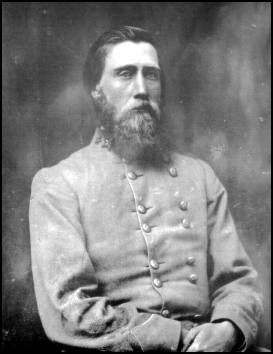
| It was now clear that the Confederates were not retreating but were gaining strength and making a stand. Rosecrans realized the danger and ordered McCook and Thomas to link up with Crittenden and danger there certainly was for the troops of Lieutenant General James Longstreet were arriving from Virginia and that rarest of occurrences in the War Between the States was about to become a reality: the rebels would have the Yanks outnumbered for a change. General Bragg, still hoping for a change to deal the Union forces a crippling blow, assembled an attack force consisting of the divisions of Bushrod Johnson, John Bell Hood (both from Longstreet), William Walker and Simon Bolivar Buckner to strike at Crittenden and cut him off from Chattanooga. In doing so they would have to cross a stream that would give its name to the ensuing battle: Chickamauga Creek, an old Cherokee word meaning River of Blood. In the next few days the creek would live up to its name as the bloodiest two days in American history unfolded around it. |
|
|
|
 |
|
 |
|
|
|
|
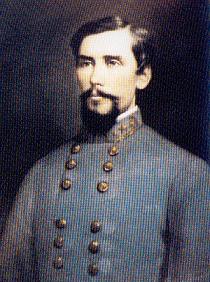
General Patrick Cleburne |
|
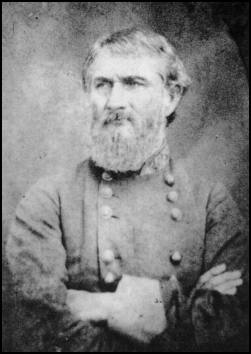
General Leonidas Polk |
|
| The advance began on September 18 but a combination of rough terrain and Union cavalry (armed with the new repeating carbines it must be remembered) harassment meant that little progress was made and it was left to the next day for the main battle to commence. The battle of Chickamauga opened on September 19 when Union General Thomas sent two divisions under John Brannan and Absalom Baird on a reconnaissance in force of the Chickamauga and they stumbled into the Confederate cavalry corps under General Nathan Bedford Forrest. The boys in blue fought hard but just as they were making progress against Forrest they were hit by southern infantry under General States Rights Gist from William H. T. Walker and his corps. Walker brought up another division under St John Liddell which repelled Baird at which point Thomas was forced to pull his troops back to a defensive position. By afternoon a federal division under Horatio Van Cleve was marched north to reinforce the Union line and soon came under heavy attack which pushed back the center of the blue line. Concerted counter attacks by the divisions of Brannan and James Negley in the center and Philip Sheridan and Thomas Wood on the right managed to stem the gray onslaught and restore the situation. On the left, Confederates under Major General Patrick Cleburne, an Irish immigrant and veteran of the British army known as the Stonewall of the West, made some progress but was halted after heavy fighting by federal divisions under Richard W. Johnson and Baird. Nightfall brought an end to the fighting but it was slow in coming as opposing forces kept shooting by firing their weapons toward the sound of musketry and the sight of muzzle flashes. In the darkness and dense woods this sometimes meant Union and Confederate forces alike sometimes fired on their own comrades by mistake. |
|
| After see-sawing back and forth the fighting came to a close as Rosecrans prepared a solid defensive line and General Bragg began reorganizing his reinforced army for a massive assault the following day. To accomplish this, Bragg formed his army into two massive wings. The first, or right wing, commanded by Lieutenant General Leonidas Polk would consist of two corps under generals D.H. Hill and William Walker supported by a division under Benjamin Cheatham. The left wing, under Lieutenant General James Longstreet had two corps commanded by generals Simon Bolivar Buckner and John Bell Hood. Also on hand were two corps of cavalry commanded by generals Joseph Wheeler and Nathan Bedford Forrest. In total the Confederate Army of Tennessee now had about 70,000 men to deal with the nearly 57,000 man Army of the Cumberland under Rosecrans. Old Rosy entrusted the federal left flank to General George H. Thomas, the right flank to Alexander McCook and held Crittenden in reserve. Bragg stuck to his original strategy of an attack on the Union left led by the former Episcopal bishop of Louisiana Lieutenant General Leonidas Polk. |
|
| The fighting renewed at 9:30am on September 20, 1863 when Polk sent the division of General John C. Breckenridge (former US Vice President) to flank General Thomas and seize the LaFayette Road. However, at the outset, things did not go well for the Confederates. By 10:15 the attack had been driven back by Negley and Brannan but by that time another attack by General Cleburne had already been underway for a quarter of an hour yet this one, also, was to no avail. At 11:00 the boys in blue repelled attacks by the two brigades of Liddell and Union General Steedman thwarted a flanking effort by the Confederate cavalry under General Forrest. Things has certainly not developed as the Confederates had hoped. All morning every Confederate attack on the Union left had been repulsed; so far the plan for echelon attacks had failed at every point. While both sides continued sniping at each other from a distance, General Bragg decided to scrap his original plan and ordered General Longstreet to take his half of the army and hit the Yankees with all the strength he could muster. |
|
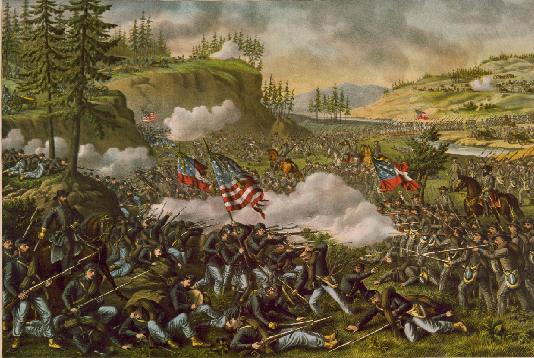
| Longstreet got underway at 11:30am and came crashing forward with 23,000 men. On the Union left, the hard pressed Thomas had been calling for any reinforcements Rosecrans could spare. The federal commander, in his devotion to detail, was shifting troops and noticed what appeared to be a gap in his line. He quickly ordered the first division of the reserve corps to close up the gap and link up the rest of the line. The only problem was that such a gap did not exist. The trees and brush were simply so thick the boys in blue could not be seen, however, when Woods moved his division out a very real and very dangerous opening in the Union lines was created and at precisely the point that was about to be hit by the recently assembled corps under the hard hitting, battle scarred Texan John Bell Hood. With his arm still in a sling after being mauled by artillery shrapnel at Gettysburg, Hood led his Confederates charging through the gap and fanning out to roll up the federal line. The Union troops were stunned but tried to fight back. General Hood was shot in the leg and was carried to the rear by his Texas troops but almost everywhere the gray tide seemed unstoppable. |
|
|
 |
|
 |
|
|
General James Longstreet |
|
General John Bell Hood |
|
| Union generals Sheridan and Davis saw their commands sent reeling thanks to General Hindman and his Confederates on the southern end of the line. Rosecrans desperately tried to organize counter attacks but it was to no avail as in quick order the entire Union right wing simply collapsed as fully half of the Army of the Cumberland fled back toward Chattanooga. Confederates seemed to be everywhere and when his own headquarters was overrun General Rosecrans himself abandoned the field giving up the fight as hopeless. For someone as cautious and methodical as Rosecrans it was simply too much to take. All morning the fight seemed to be going his way, the Union troops were holding their own and then one mistaken troop movement opened the floodgates for the gray tidal wave and most of his army simply came apart. It was undoubtedly the most total and devastating defeat ever suffered by a Union army in the western theater of the war. On the Confederate side, General Longstreet, usually a cautious man himself, was on fire with the success of his troops and saw the chance to deal a blow so devastating on the federals that they might not ever be able to recover. He sent word back to General Bragg that the enemy was flying before him and requested reinforcements to keep up the pressure and continue the pursuit until the remnants were destroyed. However, General Bragg refused to give Longstreet any additional support, pointing out that the other wing of the army had suffered considerably in the failed attacks made all morning and were already having so hard a time that no reinforcements could be spared. Longstreet would have to make do with what he had. |
|
|
 |
|
|
| Oddly enough, the only thing that saved the Union army from total annihilation was a southerner, the Unionist Virginian George H. Thomas. With the Union center destroyed, the right flank in headlong flight it was only the cool determination of General Thomas that staved off disaster. He stood his ground and took command of what was left of the Union army and set up a defensive position anchored on Snodgrass Hill and Horseshoe Ridge. For his determined stand he would be known forever after by his nickname, The Rock of Chickamauga. Thomas brought up what reinforcements were available and fought off heavy Confederate attacks which bought precious time for the rest of the Union army to get away, calm down and reassemble. The afternoon fighting over Snodgrass Hill was some of the most ferocious of the war as the troops in gray tried again and again to dislodge their Yankee foes. However, though pressed to the limit, Thomas and his federals held on and kept their ground. It was a brave and admirable stand, but even such courage was not enough to bring victory in the face of defeat but merely lessened the blow of that defeat somewhat. As the day drew to a close Thomas moved his men out and joined the retreat to Chattanooga via Rossville, leaving the field to the victorious Confederates. |
|
| Despite the victory though, the southern camp was not entirely in a happy condition. One third of the Union army had been sent reeling along with four divisional commanders, two corps commanders and Rosecrans himself and Forrest and Longstreet wanted to renew the attack the following day and press on to take Chattanooga while the enemy was still dazed and disorganized. General Bragg, however, was himself rather aghast at the losses the Confederates had suffered. The fighting at Chickamauga had cost the south 20,000 men, killed, wounded or missing or more than 30% of his effective strength. Additionally, ten Confederate generals had been killed or wounded including the fire breathing General Hood who only barely survived the amputation of his leg at the hip. Half of the horses who served the southern artillery were dead and to the consternation of his subordinates General Bragg overruled any hot pursuit of the beaten federals. The hot blooded General Forrest was disgusted and sarcastically wondered why Bragg bothered fighting battles at all when he failed to follow them up with the decisive blow. |
|
| A strategic gain was denied to the south but there was no denying that the battle had been a tactical victory of the highest order. The Union army which had for so long dominated the western theatre was dealt a smashing defeat in one of the costliest battles of the war. Chickamauga creek ran red with the blood of the worst two days of battle in American history. The battered and beaten Yankees fell back to Chattanooga to lick their wounds and were eventually besieged by Bragg. That siege would not end well for the south and it was always easier for the north to recover from a loss than it was for the south, but all the time that has since passed has not erased the pride that surges in every patriotic southern heart at the mere mention of the name Chickamauga. |
|