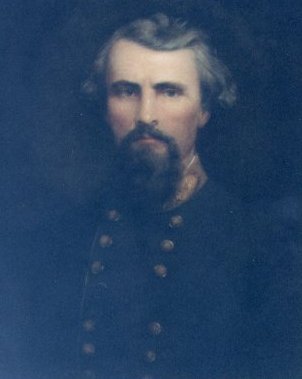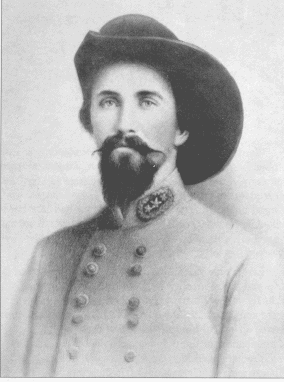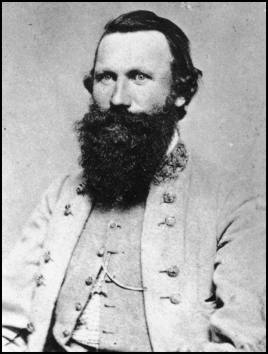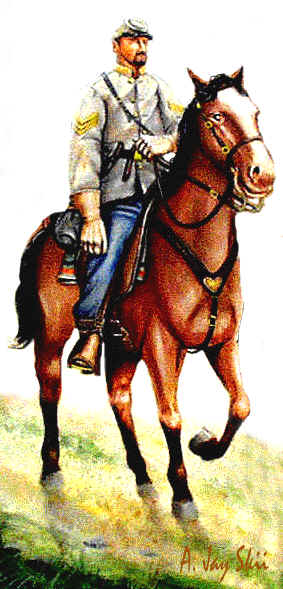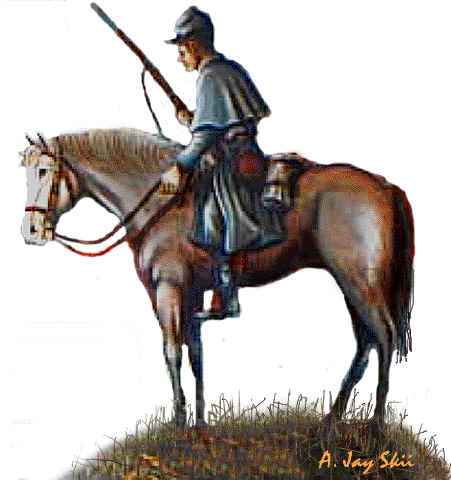


The most legendary names in cavalry history were the names of the Confederates like J.E.B. Stuart. Mosby, Morgan, Wheeler, Marmaduke, Shelby and of course, the "Wizard of the Saddle" Nathan Bedford Forrest. The first great display of Confederate cavalry came during the Peninsula Campaign of 1862 when JEB Stuart started out on a reconissance raid and ended up riding all the way around McClellan's entire Union army, gaining valuable information, destroying vital supplies and embarassing the northerners. Later, Stuart repeated the audacious move again after the battle of Anteitam. Despite dropping the ball during the Gettysburg campaign, Stuart remained Lee's "eyes and ears" and the dominant cavalry commander in the east until his death at the Battle of Yellow Tavern in 1864. However, he was replaced by the able General Wade Hampton who never lost a cavalry battle in his military career.
In the "Western Theater" the Confederate cavalry proved just as skillful and daring as in the east. General John Hunt Morgan led a stunning raid behind Union lines that reached all the way into Ohio, the farthest north any troops attacking from the Confederacy ever reached. Morgan was succeeded by such men as Nathan Bedford Forrest, hailed by many as the greatest cavalryman of the war and "Fighting Joe" Wheeler. Lee considered Forrest and Wheeler the best horsemen the Confederacy had. The exploits of Forrest are so immense as to be almost the stuff of legend and Wheeler was instrumental in opposing Sherman's march on Atlanta.
Cavalry also naturally played a major role in the far west of the Trans-Mississippi Department. Probably the best cavalrymen in this area was General Joseph O. Shelby who led his "Iron Brigade" of Missouri cavalry on the longest cavalry raid of the war, going all around the state of Missouri. This action cost the Union forces 1,000 men and $2 million in supplies and assorted property destroyed. Shelby also participated in Sterling Price's massive cavalry raid into Missouri in 1864. By that time, the strength of Confederate forces in the Trans-Mississippi had been so reduced that cavalry raids were about the only offensive action that could be taken.
There were also numerous smaller unit actions by the Confederate cavalry that became legendary under the direction of extremely skillful commanders. The best known was undoubtedly Colonel John S. Mosby, known as the "Grey Ghost" who made his little corner of Northern Virginia totally unihabitable for Union forces. Thwarting all of their efforts to defeat or capture him, the Yankees finally deemed him unbeatable and simply avoided the whole area for the rest of the war. In the far west there was Brigadier General Stand Watie, the highest ranking Indian of the war who led his Cherokee Confederates in brilliant raids around Oklahoma and Kansas. The bold Stand Watie was also the last Confederate general to finally surrender. When the Confederates invaded New Mexico, it was with an entirely cavalry army and the battle of Valverde saw the only charge of lancers in the entire conflict. In fact, the very last battle of the war was fought and won by the "Cavalry of the West" commanded by Texas Ranger "RIP" Ford at Palmeto Ranch. It is also worth mentioning that Texas was the only state to provide more cavalry than infantry regiments and it was the 8th Texas Cavalry, better known as Terry's Texas Rangers, which was hailed as the very best cavalry outfit of the war, north or south.
From minor skirmishes and partisan harassment to daring raids and major battles (such as Yellow Tavern, the largest cavalry battle of the war) all through the conflict the Confederate horsemen dominated their Union enemies. To be fair, the Yankees did get better with time, but they could never hope to match the bold accomplishments of their southern counterparts. The war also proved the worth and value of cavalry and the horse soldiers would continue to be the backbone of the army, fighting on up to World War I some famous examples being the U.S. 7th Cavalry in the Indian Wars, Teddy Roosevelt's Rough Riders in the Spanish War as well as the pursuit of the Mexican bandit Pancho Villa where a young cavalryman named George E. Patton first gained recognition. Yet, whenever the greatest cavalrymen of history are remembered the list will be dominated by Confederates like JEB Stuart, Forrest, Morgan, Mosby and others who were adored by their countrymen and feared by their enemies.