
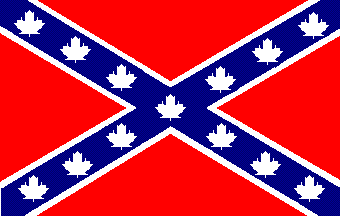

Following the "Trent Affair" the Canadian militia began to expand and more British troops were sent to Canada in the event of war with the United States. In 1863 a group of Confederates siezed the Union ship Chesapeake and took refuge in Halifax, Nova Scotia. The U.S. Navy reacted quickly to recover the ship, entering Canadian waters and taking off two Canadians in the process. The most daring involvement came in October of 1864 when Confederates operating out of Canada raided the town of St Albans, Vermont, about 15 miles from the border. Canadian troops arrested the 20-odd Confederates after the raid but refused to extradite them and eventually let them go.
Veteran Confederate soldier and sailor John Yates Beall, after being exchanged in May of 1864 went to Canada to continue his harassment of the Union military. Working with veteran statesman Jacob Thompson, in charge of secret operations in Canada, Beall hatched a plan to liberate the Union prison on Johnson Island where he himself had previously been held. He planned to then use these forces to challenge Union control of Lake Erie. He recruited his forces and came up with an elaborate plan, but the Yankees found out about the operation and Beall was captured. Unjustly branded as a spy and pirate he was later executed, an act which is said to have prompted the assassination of President Lincoln by John Wilkes Boothe.
Even after the end of the conflict, the Civil War continued to effect Canada. Irish veterans of the Union army banded together to launch the "Fenian Raids", an effort to hold Canada hostage in exchange for the British surrender of Ireland. Due to the massive military buildup in Canada during the war, the raids were a resounding failure. The prospect of a civil war over states' rights also prompted the liberal and conservative leaders of Canada to band together to form a more centralized government which resulted in the formal foundation of the Dominion of Canada (the name 'Kingdom of Canada' was dropped for fear of angering the republican United States). Canada also provided a friendly haven for many Confederates who had no desire to live under Yankee rule after their country had been occupied. One of the most famous of these was Captain John Taylor Wood of the Confederate navy who became a successful businessman in Nova Scotia. It is also a little-known fact that William Hatcher Barnett, the last survivor of Pickett's charge, died and is buried in Bottrell, Alberta.

Canadian-Confederate Friendship Society
Wikipedia Article on Canada in the Civil War
Canadians in the American Civil War
Book: Dixie & The Dominion
Canada and the Confederacy (one of my pages)
.