
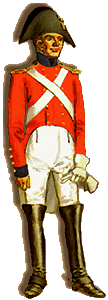
The next major conflict, the War of 1812, is extremely important both because another attempt by the United States to conquer Canada was thwarted and because the heroic successes of the Canadian militia started the spread of a specifically Canadian patriotism. The Americans, as evidenced during the Revolutionary War, had long coveted Canada and planned a three-pronged invasion. General Hull was to attack from Detroit, General Van Rensselaer's "Army of the Center" was to attack up the Niagra River and General Dearborn was to conquer Montreal. The Yanks had the forces defending Canada outnumbered in every way but brains and determination. The great General Sir Isaac Brock, "the Hero of Upper Canada" tricked Hull into surrendering Detroit without a fight and took control of Michigan, he then moved east where he thwarted General Van Rensselaer at Queenston Heights where he died in battle. Generals Dearborn, Hampton and Wilkinson had no better luck in the third invasion. The Americans briefly took and burned Toronto but were soundly defeated and driven back across the border thanks in part to the French Canadians who had no desire to be ruled by the anti-Catholic United States and the local United Empire Loyalists who had fled America following the revolution for their refusal to betray their rightful king. Their feelings toward the "Great Republic" had not changed over time.
Secure as a nation and confident in Canada's ability to defend herself there was a new sense of pride among Canadians after the War of 1812. During the American Civil War there was a military build-up when it seemed that United States aggression might spill over the northern border, especially during the "Trent Crisis" when two Confederate envoys were kidnapped from a British ship. Following that near-conflict real bloodshed did erupt when Irish veterans of the US Army invaded Canada in the insane scheme to hold the country "hostage" in exchange for a mass British withdrawl from Ireland. British and Canadian troops promptly crushed the incursions. In 1870 the western rebellions of Louis Riel were similarly put down without much difficulty and in Quebec Canada sent her first soldiers to fight overseas when loyal Catholics volunteered to join the Pontifical Zouaves in defense of Pope Pius IX when Italian nationalists invaded the Papal States. The war in South Africa met with some disapproval in French Canada, but nonetheless Canadian troops participated bravely in that conflict as well.
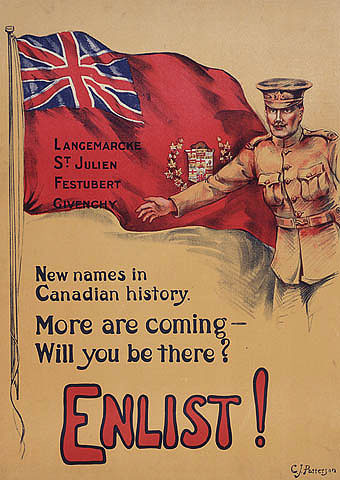
During World War I Canada was quick to send troops overseas to join the Allied war effort along with the other member nations of the British Empire. The Canadian Corps fought with great distinction at the Battle of Vimy Ridge and the Canadian pilot Billy Bishop became the highest scoring "ace" of the English-speaking allies with 72 victories to his credit. By World War II Canada had become a fully self-governing dominion and declared war on Germany separately for the first time. Canada was Britain's most important ally and the Royal Canadian Navy and merchant marine was vital to the success of the battle of the Atlantic and keeping Britain alive during the blitz and U-boat blockade when the British Empire stood alone against Nazi Germany. The 1st Canadian division fought in the invasion of Italy and were instrumental in the Normandy invasion on D-Day. The Canadian forces landed at Juno Beach, encountering the strongest resistance other than Omaha and though they suffered 50% casualties the Canadians advanced farther and faster than either the British or Americans supporting them.
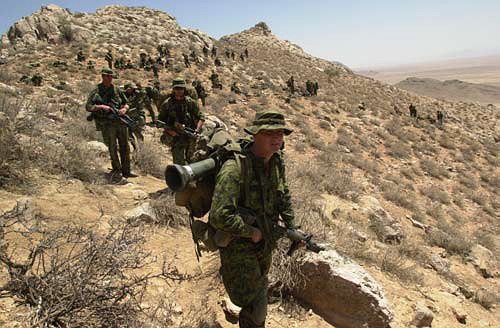
Since World War II Canada has cooperated with NATO during the Cold War and sent troops to Korea as part of the 1st Commonwealth Division. Canadians have recently been involved in many peace-keeping missions around the world, which is only fitting since it was a Canadian, Lester B. Pearson, who invented it. Canadian forces also participated in the First Gulf War against Iraq and the liberation of Taliban-ruled Afghanistan after the 9-11 attacks in the US.