

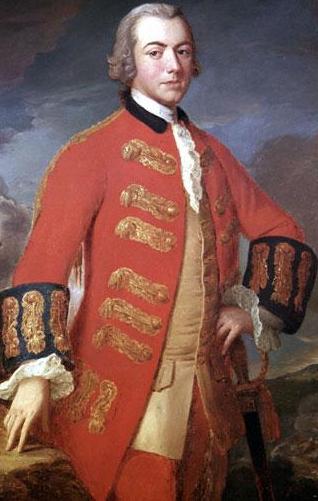


In 1751 Clinton went to England and gained a position in the famous and elite Coldstream Guards regiment. He later served with the Grenadier Guards and was aid-de-camp to the Duke of Brunswick during the Seven Years War. He was elected to the British House of Commons and when violence broke out in 1775 at the siege of Boston he was sent with William Howe and John Burgoyne and additional British troops to restore law and order. He fought at the bloody victory at Bunker Hill and served capably in the string of British victories that chased George Washington across Long Island. The flanking movement he executed at Brooklyn under cover of darkness succeeded brilliantly and his talent and leadership earned him promotion to lieutenant general and a knighthood. Following the surrender of General Burgoyne at Saratoga in 1778 Clinton replaced General Howe as the Commander-in-Chief of Crown forces in North America.
Sir Henry Clinton proved to be a difficult but brilliant commander. He was aware of his weakness when it came to "people skills" but he knew the business of warfare and as a strategist was second to none on the continent. After the death of his wife he suffered from depression that tended to make him sensitive to criticism but he had the ability to look at the big picture and learn from his mistakes. After an embarassing defeat in South Carolina he realized that occupying territory meant very little but that it was the destruction of the rebel armies that mattered most. In coming to this conclusion he had basically grasped Washington's entire strategy for victory. General Clinton has been acclaimed by many historians as having the best overall grasp of the situation in America than any other officer.
Clinton was more than a match for Washington in the north and weakened by the fact that Spain, Holland and France had joined the war against Britain, he had to do more with less. Yet, Clinton more than managed. He led the attack on Charleston, South Carolina that was one of the most stunning victories of the entire war, capturing or destroying the entire southern rebel army. He left the Earl of Cornwallis in command in the south while he returned north to keep close watch on Washington. However, Clinton always seemed to have difficulty with his subordinates such as Cornwallis and naval commander Arbuthnot. Cornwallis led a victorious campaign through the south but was bottled up by the French navy at Yorktown and forced to surrender. Clinton had dispatched reinforcements, but they had arrived too late. Although Clinton had been against much of what Cornwallis had done in the south, many unfairly blamed Clinton for the defeat.
In 1782 General Clinton was replaced by Lt. General Sir Guy Carleton, the Governor General of Canada as the supreme commander in North America. Clinton went to England where he again served in the House of Commons before being appointed Governor of the vital British base at Gibraltar. He died there at his post in 1795.