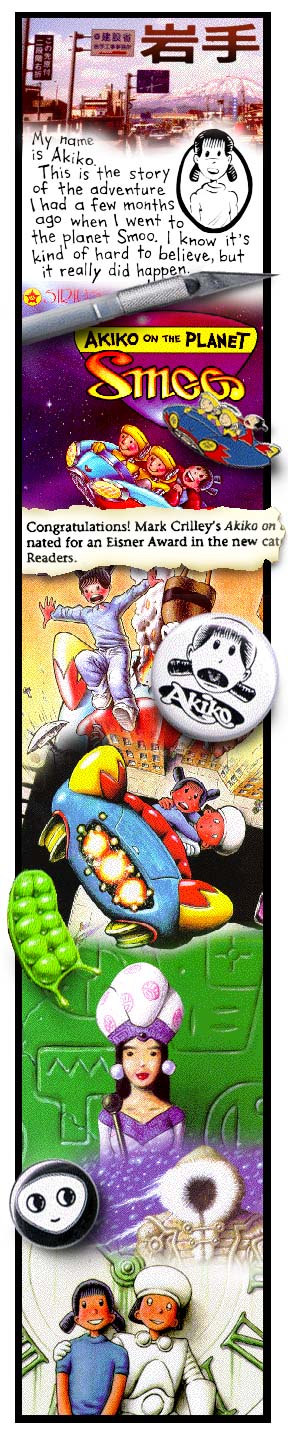
The first sketches of Akiko were drawn back in the fall of 1992, when I was in the middle of a 2-year stint working as an English teacher in the northern Japanese city of Morioka. I'd hit upon the idea of writing and illustrating my own comics about a year earlier, when I rather casually began writing a tale called "The Beast that Ate Morioka," a monster-movie parody, and took it into class as a teaching tool. It was well received by students and made my job a lot more interesting, so I kept at it. Completing that story and illustrating another (a Japanese folk tale called "Momotaro"), I felt I was ready to try my hand at something that could really be published.
For many years I'd wanted to do a story in the tradition of the Wizard of Oz, an epic-scale work that would feature a child being swept off into some wonderful imaginary world. Using "Alice in Wonderland" as a model, I came up with the title "Akiko on the Planet Smoo." It seemed straightforward enough to me at the time: "Akiko," a common name for Japanese girls, would be my stand-in for Alice, and "the Planet Smoo" would serve as my Wonderland. Little did I know that the title would later come under more serious scrutiny, as people tried to guess who the "real" Akiko was, and to what extent I was trying to make a reference to the "Shmoo," of L'il Abner fame.
In the case of "Akiko," there is no special significance to this name other than the fact that I like the way it sounds and thought it would be easy for people to pronounce. How wrong I was! Most Americans instinctively pronounce the name as "uh-KEE-ko," perhaps because a number of similar Spanish names are pronounced this way, as in "Anita" and "Alfredo." (The Japanese pronunciation is closer to "AH-kee-ko," and follows the stress pattern of names like "Anabelle" and "Abigail.")
As for the similarity to the "Shmoo," it is an unfortunate coincidence that having never heard of that character, I allowed myself to settle on a planet name that differs by only one letter. The real origin of "Smoo" is the word "smoosh," as I imagined a planet that looked as if it had been smooshed into a nearly-flat disc. Thankfully, we seem to have reached a point now where almost no one confuses the two names.
Armed with a working title and a lead character, I set to work fashioning the first page of "Akiko on the Planet Smoo."
I chose the thickest paper I could find, a bristol-like paper I found in a spiral-bound sketchpad at a local office supply shop, and used Pigma ink pens (the brand I still use today). But the most important departure in method was the decison to use zipatone, which I had never used before up until this point.
For those of you unfamiliar with this soon-to-be-extinct graphics tool, it is a mass-produced transparent adhesive film covered with various patterns which can be applied to artwork to produce greytones. I mainly used the simple 10% (light grey) 30% (medium grey) and 50% (dark grey) screens covered with millions of tiny dots that become visible only upon very close inspection. From a distance the dots read as various shades of smooth, unvaried grey.
The most common method of applying zipatone involves placing a portion of the adhesive film over the desired section of the paper, Spuckler's shirt for example, and cutting away with an Exacto-Blade (an artist's knife) the portions of the film that need to be removed. If this sounds time consuming, believe me it is! There is a certain joy to the hands-on technique of zipatone, though, and I'm probably not the only artist to bemoan the fact that it is now very hard to find, even in the best-stocked art stores.
The lettering style I chose for the word balloons was something I'd developed over a number of years, loosely based on simple typewriter letters, but deliberately cartoony-looking to convey a fun atmosphere. I opted for a child-like scrawl for Akiko's narration, so that readers might hear a child's voice in their heads as they read it. The big, thick borders of each panel seemed a natural choice to me, as I felt any substantial drawing deserved a strong, solid border to support it. All of these stylistic decisions -- indeed all the decisions regarding the story -- were made without any regard for what was popular in the world of comics at that time. To be honest, even now I'd fail a test of what was hot and what wasn't in the comics industry circa 1992.
Blissfully unaware of what it took to write a commercially successful comic, I set the simplistic plot of Akiko on the Planet Smoo in motion.
