| Holy Grail Info |
 |
 |
| '5-4 BC Gabriel announces to Mary of forthcoming Jesus 1-3 BC Birth of Christ AD 30 Christ Last Supper AD 30 Crucifixtion of Christ, Lanced by Longinus, Blood collected by Joseph of Arimathea Ad 30-32 Joseph of Arimathea leaves the Holy Land with Grail bound for England 35-50 Joseph of Arimathea founds first Christain Church in Glastonbury on southwest England 70-72 Joseph of Arimathea and his son travel to Sarras with a shield for King Mordrain 82 Joseph of Arimathea died, burried at Glastonbury 500-550 King Arthur and his court 540-550 Bubonic Plague 580 Death of Peredur of York "Sir Percaval" 717 Vision to hermit regarding the Holy Grail 1111-1118 Huges De Payan founded the Knights Templar 1307 Pope Clement V orders all Knight Templars to be emprisioned 1308 England arrests its Tempars, Scotlands King Robert the Bruce protects Tempars 1210 Second inquisition 1398 Prince Henry Sinclair sails to Nova Scotia' (www.the-spa.com/kirk.burkinsgrtimln.html) -Drew Cleaver |
| Grail Timeline |
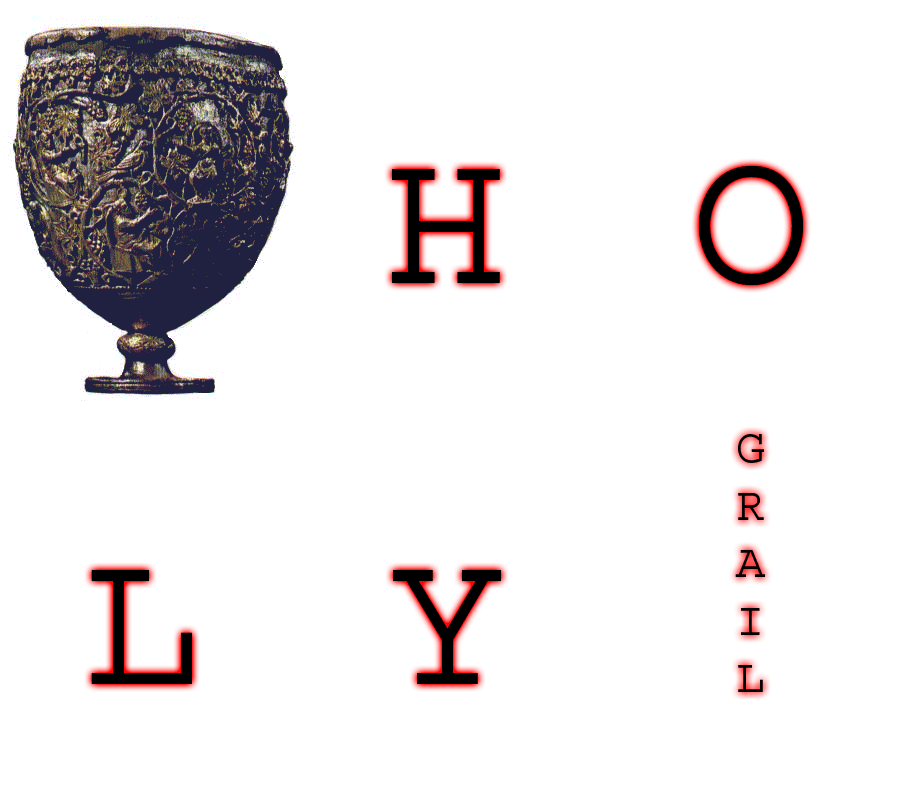
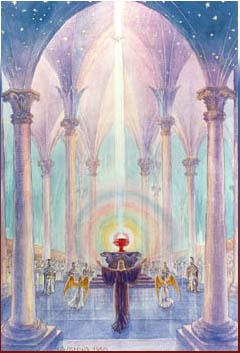
| The Holy Grail is believed to be the cup that Jesus drank from at the last supper. Supposedly anyone who drinks from the Grail is possessed with a great liveliness. Throughout ancient stories, knights and other nobles are commonly seen on a quest for the Holy Grail, in hope to bring lucious life to themselves. The story of the Holy Grail can be closely tied to other ancient myths and legends. The Grail is always closely connected to Perceval and King Arthur, but all three are not originally tied at all. Historians are not sure if the Perceval story is a myth or not, but some say it could be taken as the story of simpleton. Although, in every version of the story it is still connected to tales of Arthur which is then connected to stories of the Grail. Basically the story of the Holy Grail cannot be connected to any proven factual records. Most tales speaking of the Grail were written from 1180-1240. After about the 13th century there was nothing added to the legend of the Holy Grail. Most of the stories were written in French, but some have been found in German, Norwegian, English, Portuguese, and Italian. Most that are not in French are either translations or crafted romance stories. Professors in Europe have separated the romances into two different categories, ones that are directly related to the quest, and ones that are mostly about the history of the Grail. Both of the categories are based on the early writings of the Grail. The first accounts of the Holy Grail are closely connected to the story of Joseph of Arimathea. After he was sent to prison by the Jews, Jesus brought him the the vessel and amazingly lived for 42 years until Vespasian released him. The Grail then appeared in Britain after being brought there by Joseph or his son, also named Joseph. After Joseph died Perceval was successful on his quest for the Grail and held it until he died. The Grail then vanishes. One version suggests that two angels that remained neutral when Lucifer broke away from God. It was then given to Titurel, becoming the first Grail king. It was kept safe in the castle, Munsalvaesche. The origin of the story of the Holy Grail is not certain, but historians are divided into views of where the story originated. Some say that there are Celtic and Oriental parts of the story, but it is undisputable that the story is mostly Christian. There are many oriental stories that seem to be similar to the story of the Grail, some including the Sun Table of the Ethiopeans, and the Persian Cup. This brings some people to believe that they had something to do with the Grail. The reason some believe that there are Celtic origins in the story of the Grail is because Perceval appears in many Celtic stories, and is often times referred to as Celtic. -Steve Sadowsky Published by Drew Cleaver |