This is copied from
http://www.howstuffworks.com/singing-fish.htm
How Singing Fish Work
Lately it seems that every time you turn
around, there's a fish singing a song to you! Boogie Bass, Big Mouth Billy
Bass, Rocky Rainbow Trout and other variations have become enormously popular
as novelties and gag gifts. You've probably seen one at a store in the mall, at
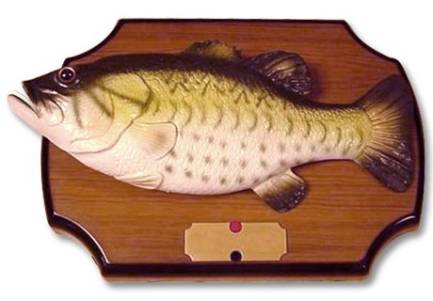
the flea market or on television. Looking deceptively like a normal stuffed
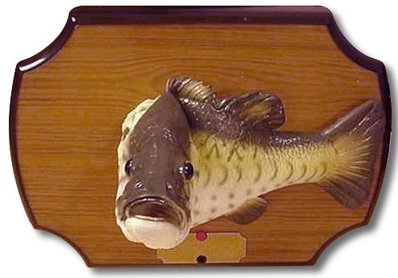
fish mounted on a plaque, it is actually a robot that begins to sing and move
when someone walks up to it. As the fish swings his head out from the plaque,
he lip-syncs to a prerecorded 30-second clip of a popular song or spits out a
savvy one-liner. For the unsuspecting viewer, a singing mounted fish can be
quite a humorous surprise, which seems to be the key to its charm.
|
|
A Note to Our
International Readers
If you live
outside of the United States, you are probably unfamiliar with the singing fish
we are discussing in this article. You may, in fact, think it is the most
ridiculous thing you have ever seen! Like the Pet Rock of the early 1980s, the
singing fish is a fad -- in true American fashion!
In the U.S. there is no escaping the singing
fish right now. Sales are brisk, with many dealers routinely selling out. And
it really is a neat little piece of engineering and creativity! In this
edition of How Stuff Works,
we will open up one of these fish and take a look inside. What makes him sing?
How does he move? How does he know when someone is standing in front of him? We
will answer all of these questions as we explore the robotic mechanism that
brings these fish to life!
|
|
Inside the Fish
The singing fish is actually a very simple robot. It has its own power supply,
it senses its environment and acts autonomously on what it senses, it moves in
fairly complex patterns (a singing fish is actually more complicated than some
of the pick-and-place robots that you find in factories), and it vocalizes --
in other words, it meets all of the qualifications of a robot!
|
|
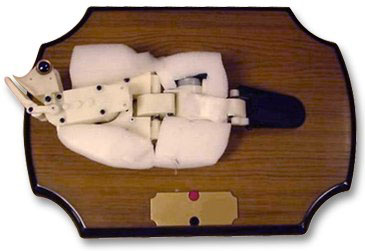
In the following pictures, we have removed
the latex rubber outer layer to look at the underlying mechanism. What you find
is a surprisingly complicated articulated plastic framework driven by three
small DC motors:
|
|
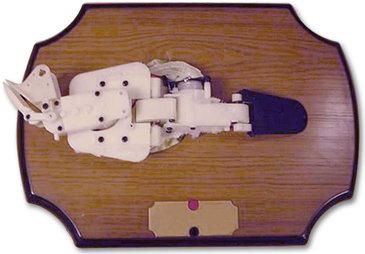
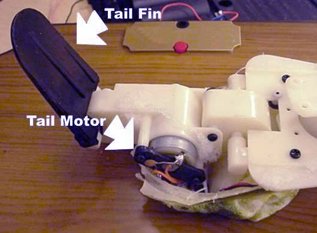
The fish's skeleton has three moving parts:
- The tail, which flaps back and forth (in the photo above the tail
is the black piece on the right)
- The body, which swings out and away from the plaque
- The mouth, which moves up and down to simulate singing
Here is a close-up of one of
the motors:
|
|
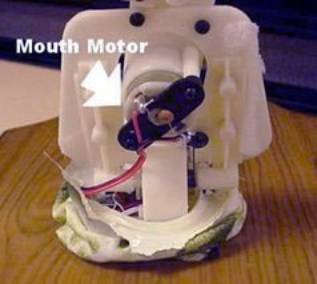
When
power is supplied to the motor, the lower jaw opens. As soon as the motor stops,
a spring causes the jaw to close. By starting and stopping the motor
repeatedly, the jaw opens and shuts, making it appear as if the fish is
singing. All three of the motors work in this way -- applying power to them
moves the associated body part in one direction, and the spring moves it back.
|
|
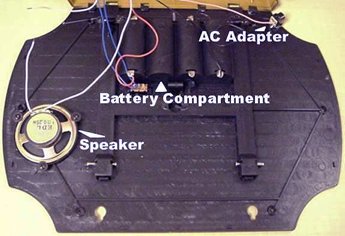
Inside the Plaque
Inside the plaque there are five different components that control the fish:
- A printed circuit board containing the controller chip as well as
the motor and sound amplifiers
- A speaker
- A photocell to detect movement
- A battery pack
- An on-off switch
The photos below show these
components in detail. Here is the logic board -- the "brain" of the
fish:
|
|
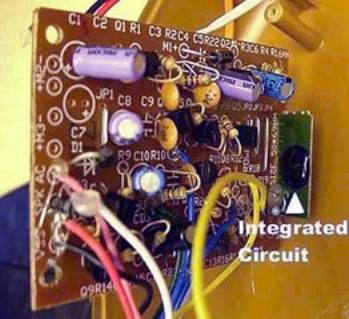
The
circuit board contains an integrated circuit (IC) that controls the motors and
also contains the songs in a digitized format (see How CDs Work for information on digital
music storage). There is one minute of music on the chip, although it is not
the highest quality. There are probably 8,000 samples per second at 8 bits per
sample stored on the chip, or almost half a megabyte of data! The chip
synchronizes the movements of the mouth, tail and body to the beats of the
music. It does this by sending carefully timed, short bursts of power to the
electric motors. The transistors that you see on the circuit board amplify the
chip's signals so there is enough power to drive the motors (or the speaker).
|
|
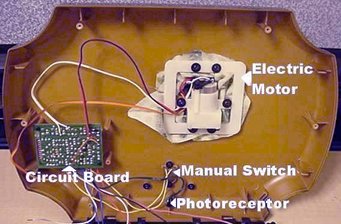
Whenever
a person or object passes in front of the fish, light is blocked from hitting
the photoreceptor. The photoreceptor then sends a trigger to the IC telling it
to begin. Also wired into the circuit board is a manual pushbutton switch,
located just above the photoreceptor. This switch does not cut power directly
-- instead it sends a signal to the chip. If you try to turn the fish off in
the middle of a song, the fish will actually complete the song before turning
off!
|
|
It
is true that a singing fish doesn't do anything useful, but even so it is a
pretty amazing piece of technology!
This Hack is provided from
|
Boogie Bass Hack |
Full Details (Boogie
Bass version, Billy Bass
version) of the hack are now available, including schematics and
sourcecode.
During the
summer of 1999 I was living in Hanover, New Hampshire, with my friends Ben Guaraldi and Lauryn Zipse. One
quiet sunny morning I woke up late and walked into the living room to find Ben
dozing on the couch. At the sound of my entrance, he opened one eye and we
looked at each other for a moment, each still experiencing post-sleep stupor.
In an uncommon epiphany, it was suddenly clear to me that I could communicate
to Ben the entire contents of my just-barely-awake mind with one single word:
Pork!
Yes, indeed, the other white
meat. Try it. Even if you don't dig on swine.
Pork!
pork
pork?
pork
pork.
pooooork.
Clearly, a whole world of human
experience can be expressed with this one simple word. Even if you don't agree,
Ben did. So, on that quiet sunny morning in Hanover, we had a whole
conversation using only the word pork.
As time
passed we became ever more impressed with the dynamic range of the p-word. And
we began to get creative about how we communicated it. For example, Ben
recently sent me a package of Pork Shake-N-Bake (unwrapped, with the address
label and postage stuck directly to the back).
Then, while shopping at the local
CVS, I stumbled upon the Boogie Bass.
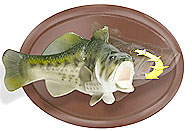
For those
of you who are new to all this, Boogie Bass is one of several "talking
fish" toys that have cropped up over the last few months. It looks like a
life-size stuffed fish, complete with wall-hanging plaque. On the front is a
small black button, which when pushed causes the fish to "come to
life" and to talk to you. I am serious.
As you can
see from the description
of talking fish on HowStuffWorks.com,
the Boogie Bass is nothing short of a little animatronic wonder. Now who's put
two and two together? Pork. Bass. Talking Bass. Christmas was fast
approaching, and I as yet did not have a gift for Ben.
|
|
|
||
|
|
In case
you haven't gotten it yet, these two ingredients should complete the picture:
- The ISD 1420P solid-state
"chipcorder" voice record/playback chip. Stores 20 seconds of
telephone-quality voice. Nonvolatile, in-system-recordable. 28 pin DIP.
Available from JDR Microdevices for about
$9. Particularly well-suited for storing "special" messages
inside talking Bass.
- The ATMEL AT89S8252
microcontroller. 8051 core. 8kB of serial-downloadable flash program
storage. 2kB of data storage EEPROM. 40 pin DIP. Available from JDR for
abut $7. Particularly well suited for storing "special"
head/tail/mouth movements inside talking Bass.
After
removing the six screws that hold the back of the Bass' "plaque"
(each cleverly hidden beneath a rubber mounting foot), I discovered that the
inside of the plaque is mostly air. Plenty of room for adding some
"special" circuitry. Clearly we would not want to destroy the
existing circuit. We can hijack its power drivers for the motors. And besides,
the messages it comes with are pretty hilarious. Especially after you have
heard them over 100 times.
A little
investigation with an oscilloscope revealed that the control of the Bass'
head/tail/mouth is extremely simple: energize the corresponding motor, and the
head turns out, the tail extends, or the mouth opens. De-energize the motor,
and the corresponding body part returns (by a spring) to its "rest"
state. We've got binary actuators here folks. And it was clear that we could
tie in to the gate inputs of the motor drivers with some simple diode-or
circuitry.
Here are
some photos of the innards of the Bass, after the addition of
"special" mode:


As you can see, there are three circuit boards involved. The
one in the upper left (the green one) is the original board. The little one
just below it holds some switches and things that make up a control panel for
the "special" mode. The big one on the right holds the ISD1420, the
AT89S8252, and an audio amplifier.
Controls
have been added to the rear of the modified Bass to facilitate switching
between "normal" and "special" modes:

There is a toggle switch for changing modes, along with a
trimpot for adjusting the volume in special mode, an LED for feedback (very
useful during software development), and four DIP switches for setting the
"special" sub-mode. There are currently five such sub-modes:
Record
This is the mode for recording a
new message, up to 20 seconds long. Only one "special" message is
supported at a time. When the button on the front is pushed and held in, any
sound will be recorded until the button is let out (or 20 seconds is reached, whichever
happens first). New "special" messages can be re-recorded as often as
you like, and doing so will erase the existing "special" message (and
reset all head/tail/mouth movements).
Record Mouth
In this mode the movement of the
mouth can be recorded. Press and release the button on the front to start
playback of the "special" message, along with any existing recorded
tail and head movements. While the message is playing, press and hold the
button to open the mouth. Release to close it. The mouth movements recorded
here will be played back subsequently whenever the message is played in Play,
Record Head, or Record Tail modes. It can be difficult to get the
timing right, so it helps to have a digital stopwatch on hand. And you can of
course re-record the movements as many times as you like (re-recording the
movement does not erase the current audio or movements of the other body
parts).
Record Head
This mode allows you to program
the movement of the head (either flat against the plaque or turned to face
you). Operation is similar to Record Mouth mode.
Record Tail
This mode is for recording tail
movements. Operation is similar to Record Mouth mode.
Play
When the button is pushed and
released in this mode the currently stored message is played back, along with any
recorded head/tail/mouth movements.
The front
of the fish is unchanged, except for the addition of a small hole for the
microphone:

|
|
|
||
|
|
After I
got the circuits built and debugged it only took a few minutes to record my
message: Five seconds of silence, during which the tail flops around a bit; the
head moves out and pauses for half a second; the Bass says "Pork!";
the head moves back in and then five more seconds of silence with tail
flopping.
I wrapped
the fish in its original packaging, with the mode switch left at
"special" and with the batteries inserted. Ben's reaction when he
pressed that button was as priceless as you can imagine. Which is quite
priceless if you know Ben.

|
|
|
|
|
|