


|
|
|
Last Updated - 4Mar01 The need to communicate between distant computers led to the use of the existing phone network for data transmission. Most phone lines were designed to transmit analogue information - voices, while the computers and their devices work in digital form - pulses. So, in order to use an analogue medium, a converter between the two systems is needed. This converter is the 'modem', which performs MOdulation and DEModulation of transmitted data. It accepts serial binary pulses from a device, modulates some property (amplitude, frequency, or phase) of an analogue signal in order to send the signal in an analogue medium, and performs the opposite process, enabling the analogue information to arrive as digital pulses at the computer or device on the other side of connection. PCs have always provided the means to communicate with the outside world - via a serial communications port - but up until the 1990s, it was a facility that was little used. The ability to access bulletin boards and to communicate via fax tempted did attract some domestic users but in general, a modem was considered as a luxury item that could be justified only by business users. The tremendous increase in the popularity of the Internet has changed all that in recent years and nowadays the ability to access the World Wide Web and to communicate via email is regarded as essential by many PC users. Modems Modems come in two types, internal, fitting into an expansion slot inside the PC’s system case or external, connected to the PC via one of its serial ports (COM1 or COM2). Early modems were asynchronous devices, operating at slow rates of up to 18000bit/s in FSK modulation, using two frequencies for transmission and another two for receiving. Asynchronous data is not accompanied by any clock, and the transmitting and receiving modems know only the nominal data rate. To prevent slipping of the data relative to the modems' clocks, this data is always grouped in very short blocks (characters) with framing bits (start and stop bits). The most common code used for this is the seven-bit ASCII code with even parity. Synchronous modems operate at rates up to 56 Kbit/s in audio lines, using synchronous data. Synchronous data is accompanied by a clock signal and is almost always grouped in blocks. It is the responsibility of the data source to assemble those blocks with framing codes and any extra bits needed for error detecting and/or correcting according to one of many different protocols (BISYNC, SDLC, HDLC, etc.). The data source and destination expect the modem to be transparent to this type of data, conversely, the modem can ignore the blocking of the data. The usual modulation methods are the phase modulation and integrated phase and amplitude. Modulation Data communication means moving digital information from one place to another through communication channels. These digital information signals have the shape of square waves and the meaning of '0' and '1'. If such digital signals were transmitted on analogue media the square waves of the digital signals would be distorted by the analogue media. The receiver which receives these distorted signals will be unable to interpret accurately the incoming signals. The solution is to convert these digital signals into analogue signals so that the communication channels can carry the information from one place to another reliably. The technique which enables this conversion is called 'modulation'. Modulation is a technique of modifying some basic analogue signal in a known way in order to encode information in that basic signal. Any measurable property of an analogue signal can be used to transmit information by changing this property in some known manner and then detecting those changes at the receiver end. The signal that is modulated is called the carrier signal, because it carries the digital information from one end of the communication channel to the other end.
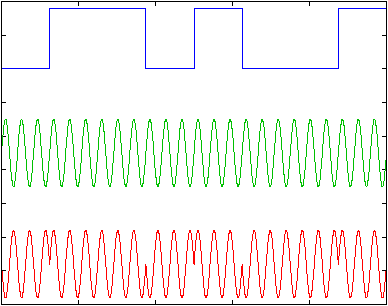
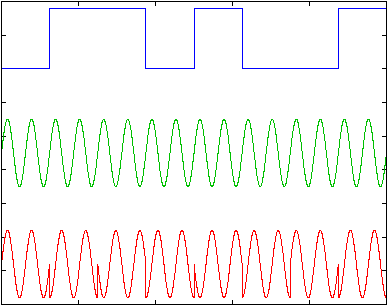
With Frequency Modulation, the frequency of the carrier signal is changed according to the data. The transmitter sends different frequencies for a '1' than for a '0'. This technique is also called FSK - frequency shift keying. Its disadvantages are that the rate of frequency changes is limited by the bandwidth of the line, and that distortion caused by the lines makes the detection even harder than amplitude modulation. Today this technique is used in low rate asynchronous modems up to 1200 baud only.
This technique, in order to detect the phase of each symbol, requires phase synchronisation between the receiver's and transmitter's phase. This complicates the receiver's design.
Quadrature Amplitude Modulation (QAM) allows the transmission of data using both the phase shift of PM and the signal magnitude of AM at the same time. The more phase shifts and magnitude levels used, the more data the technique can be used to transmit. However, multibit technology eventually runs out of steam. As the number of tones and phases increases, the more difficult it becomes to differentiate between similar combinations. The PSTN was designed for voice communications - by artificially limiting the sound spectrum to just those frequencies relevant to human speech, network engineers found they could reduce the bandwidth needed per call - and while this works well for voice, it imposes limits on data communications. According to Shannon's Law, the limitations of the PSTN impose a maximum theoretical data transmission limit of 35 Kbit/s for a wholly analogue-based connection. Speed
The first of many bottlenecks in the stream of data is at the UART (Universal Asynchronous Receiver/Transmitter), the chip which controls the connection between the serial port and the PC’s bus system. PCI bus systems operate in blocks of 32 bits, while serial cables transmit bits in single file. The UART has to take all the traffic coming at it full speed and funnel it down into the serial port without causing gridlock. The older INS 8250-B and INS 16450 UARTs cannot keep up with the transmission speeds modern modems are capable of. Only a newer 16550 UART guarantees communication at speeds of 28.8 Kbit/s without data loss. The next obstacle to overcome is the telephone line itself. It is a mistake to think the phone system is all digital; many analogue elements remain. Not even all exchanges are digital. Lines into the home are typically still analogue and susceptible to all the problems associated with this medium. The main problem is limited bandwidth, which is the amount of information that can be fitted on a line. Another is line noise. Various standards have been developed to overcome the problem of line noise. One modem sends signals to the other it wants to connect with, to see how that modem wants to communicate and to assess the condition of the line. The two modems then send messages back and forth, agreeing a common mode of operation in a process known as handshaking. The speed at which the modem will communicate is effectively limited by the slowest component in the chain. If the phone connection is poor or full of line noise, the rates will drop until a reliable link can be maintained. A modem capable of 33.6 Kbit/s will have to drop to 14.4 Kbit/s if communicating with a 14.4 Kbit/s modem. The culmination of the handshaking process is an agreed standard which includes a common speed, an error correction format and a rate of compression. The modem divides the data into packets, chopping it into easily digestible chunks. It adds more data to the packet to mark where each one begins and ends. It adds parity bits or checksums to determine whether the data received in the packet is the same as that sent, and whether the decompression formula has been correctly applied. If a packet is incorrectly received, the receiving modem will need to ask the transmitting modem to resend it. There also needs to be confirmation on the amount of data being sent, so the connection is not dropped before the last of the data has got through, or kept waiting for non-existent data to be received. The entire handshaking operation is controlled from within the modem. The connection can be dropped many times before it is finally established and the process can take as long as 30 seconds over analogue lines. Note that there is a common misunderstanding of the reported connect speed message (for example, 'connected at 115200') that users see when they establish a dial-up network connection. This relates to the DTE (Data Terminal Equipment) speed, the speed of the connection between the PC and the modem, not to the speed at which the modems are communicating. The latter, known as the DCE (Data Communications Equipment) speed, is agreed during the handshaking procedure. Serial
ports The original PC serial interface used the INS8250-B UART chip. This could receive and transmit data at speeds of up to 56 Kbit/s and, in the days of 4.77MHz bus speeds and serial printers, was perfectly adequate. When the IBM-AT came along a new UART was required because of the increase in bus speed and the fact that the bus was now 16 bits wide. This new UART was known as the INS 16450 and its CPU read and write cycles were over five times faster than its 8-bit predecessor. In an AT/ISA-bus machine, all serial data transfers are handled by the CPU and each byte must pass through the CPU registers to get to memory or disk. This means that access times must be fast enough to avoid read overrun errors and transmission latency at higher bit rates. In fact when the IBM PC-AT came out, the performance of the INS16450 was adequate because the speed at which data was routinely transmitted through the serial port was significantly less than is possible with modern modems. To understand the limitations of the INS 16450, it is necessary to recognise how the serial port interrupts the CPU which has to finish its current task, or service a higher-priority interrupt, before servicing the UART. This delay is the bus latency time associated with servicing the UART interrupt request. If the CPU cannot service the UART before the next data byte is received (by the UART from the serial port), data will be lost, with consequent retransmissions and an inevitable impact on throughput. This condition is known as overrun error. At low bit rates the AT system is fast enough to read each byte from the UART receiver before the next byte is received. The higher the bit rate at the serial port, the higher the strain on the system to transfer each byte from the UART before the next is received. Higher bit rates cause the CPU to spend increasing amounts of time servicing the UART, thus making the whole system run inefficiently. To attack this problem, National Semiconductor developed the NS16550A UART. The 16550 overcomes the previous problems by including First In First Out (FIFO) buffers on the receiver and transmitter, which dramatically improve performance on modem transfer speeds of 9.6 Kbit/s or higher. The size of the receiver FIFO ensures that as many as 16 bytes are ready to transfer when the CPU services the UART receiver interrupt. The receiver can request transfer at FIFO thresholds of one, four, eight, 16 bytes full. This allows software to modify the FIFO threshold according to its current task and ensures that the CPU doesn’t continually waste time switching context for only a couple of bytes of data received. The transmitter FIFO ensures that as many as 16 bytes can be transferred when the CPU services the UART transmit interrupt. This reduces the time lost by the CPU in context switching. However, since a time lag in servicing an asynchronous transmitter usually has no penalty, CPU latency is of no concern when transmitting, although ultimate throughput may suffer. Fax
modems Fax-modems exploit the intelligence of the PC at their disposal to do things standalone fax machines can’t. For instance, faxes can be scheduled to be sent when the phone rates are cheaper. Also, since the data they receive is in digital form, it is immediately available on the PC for editing or retouching before printing. One of the common features in fax software is a cover-sheet facility which allows the definition of a fax cover-sheet. There’s often a quick-fax facility, too, which allows a single page fax to be created without the hassle of loading a word processor. Group 3 fax/modems provide various levels of processing based upon their service class. Class 1 devices perform basic handshaking and data conversion and are the most flexible, because much of the work is done by the computer's CPU. Class 2 devices establish and end the call and perform error checking. There are a variety of de facto Class 2 implementations and one Class 2.0 standard. As PCs have become more powerful, future service classes with more features are unlikely. One problem with scanned images and received faxes is that they hog large amounts of disk space. Some bundled fax software includes an optical character recognition facility (OCR) which allows received faxes or scanned images to be converted from bitmap format to normal text. This not only reduces document sizes but also allows them to be edited in a word processor. Voice
modems Such multi-purpose modems perform as anything from a simple answering machine (recording messages on the hard disk) to a complete voicemail system with hundreds of boxes, message forwarding, and fax retrieval service. Incoming data or fax calls are automatically directed to the appropriate software module and voice calls passed through to the answering machine/voicemail software. Standards V.22bis, V.32 and V.32bis were early standards specifying speeds of 2.4 Kbit/s, 9.6 Kbit/s and 14.4 Kbit/s respectively. The V.34 standard was introduced towards the end of 1994, supporting 28.8 Kbit/s, and is now considered the minimum acceptable standard. V.34 modems are able to drop their speed to communicate with slower modems and interrogate the line, adjusting their speed up or down according to the prevailing line conditions. In 1996 the V.34 standard was upgraded to V.34+, which allows for data transfer speeds of up to 33.6 Kbit/s, is backwards compatible with all previous standards, and adapts to line conditions to eke out the greatest usable amount of bandwidth. The table below shows uncompressed data throughput rates for the various modem types. Data compression can increase throughput by a factor of 2 or 3. However, because graphic images on web pages are already compressed, the real multiplier for web browsing generally works out to around 1.5 to 2x the listed rates. Two figures are shown for V.90 modems because the wide variation in connect speeds.
Other important V dot standards include V.17 which allows connection to Group III fax machines, which are ordinary standalone fax machines, V.42 which is a worldwide error correction standard designed to cope with garbled data caused by interference on phone lines, and V.42bis which is a data compression protocol. The MNP (Microm Networking Protocol) standards go from MNP Class 1 to MNP Class 10. They do not stand alone, but operate in conjunction with other modem standards. MNP 1 is half-duplex. MNP Classes 2 to 4 deal with error control and can transmit data error-free by resending blocks of data that become corrupted in transmission. MNP Classes 5 to 10 address various modem operating parameters. MPN Class 5 is an advanced data compression protocol which can compress data by a factor of two, effectively doubling the speed of data transfer. MNP Class 10 is Microcom's proprietary error-control protocol. It provides a set of ‘adverse channel enhancements’ which help modems cope with bad phone connections by making multiple attempts to make a connection, and adjust both the size of the data packets and the speed of the transfer according to the condition of the line. The most common MNP protocols are numbers 2 to 5, with 10 also often included. LAPM (Link Access Protocol for Modems), one of the two protocols specified by V.42 used for detection and correction of errors on a communications link between two modems, has largely superseded MNP. V.42bis is an algorithm used by modems to compress data by a theoretical ratio of 8:1. In the real world, however, a ratio of 2.5:1 is typical. MNP 4 error correction and MNP 5 compression are used as fallbacks if a remote modem doesn't support LAPM or V.42bis. The Hayes AT Command Set was developed by Hayes, the modem manufacturer, and is now a universal standard. Each command line must start with the two-character attention code AT (or at). The command set is simply a series of instructions for automatically dialling numbers, controlling the telephone connection and telling the computer what it is doing. FTPs (file transfer protocols) were developed to help prevent errors when transferring files before standards were introduced. Zmodem is still widely used for file transfer over the serial port. If the received data doesn't match the information used to check the quality of data, the system notifies the sender that an error has occurred and asks for a retransmission. This is the protocol used to download a file to a computer from another computer on the Internet. BABT (British Approvals Boards of Telecommunications) is an important standard, since modems that are not ‘BABT approved’ are not legal for use in Britain. 56
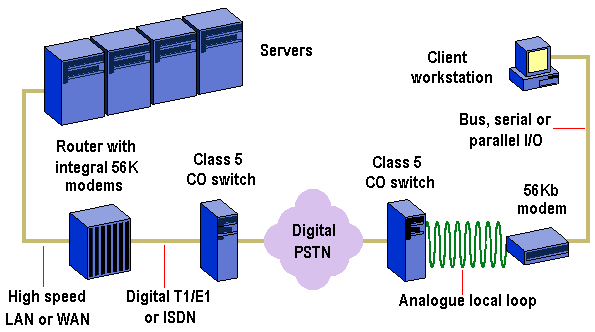
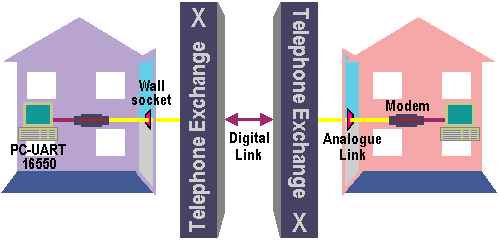
Kbit/s Most telephone central offices (CO), or exchanges, in this and almost every other country around the world are digital, and so are the connections between COs. All ISPs have digital lines linking them to the telephone network (in Europe, either E1 or ISDN lines). But the lines to most homes and offices are still analogue, which is a bugbear when it comes to data exchange: they have limited bandwidth and suffer from line noise (mostly static). They were designed to transfer telephone conversations rather than digital data, so even after compression there is only so much data that can be squeezed onto them. Thus the fatuity that digital data from a PC has to be converted to analogue (by a modem) and back to digital (by the phone company) before it hits the network.
The reason it's not possible to upload at 56K is simply because the analogue lines are not good enough. There are innumerable possible obstacles to prevent a clear signal getting through, such as in-house wiring anomalies, varying wiring distances (between 1-6Km) and splices. It is still theoretically possible to achieve a 33.6 Kbit/s data transfer rate upstream, and work is being carried out to perfect a standard that will increase this by a further 20 to 30%. Another problem created by sending a signal from an analogue line to a digital line is the quantisation noise produced by the analogue-to-digital (ADC) conversion. The digital-to-analogue conversion (DAC) can be thought of as representing each eight bits, as one of 256 voltages - a translation done 8000 times a second. By sampling this signal at the same rate, the 56 Kbit/s modem can in theory pass 64 Kbit/s (8000x8) without loss. This simplified description omits other losses which limit the speed to 56 Kbit/s. There is also some confusion as to the possible need to upgrade the PC serial port to cope with 56 Kbit/s operation. These days this usually uses the 16550 UART chip, itself once an upgrade to cope with faster modems. It is rated at 115 Kbit/s but 56 Kbit/s modems can overload it because they compress and decompress data on the fly. In normal Internet use data is mostly compressed before being sent, so compression by the modem is minimal. On 4 February 1998 the ITU finally brought the year-long standards battle to an end by agreeing a 56 Kbit/s standard, known as V.90. After months of deadlock the ITU finally agreed a 56 Kbit/s standard, known as V.90, in February of 1998. Though neither K56Flex nor x2, the V.90 standard uses techniques similar to both and the expectation was that manufacturers would be able to ship compliant product within weeks rather than months. The new standard was formally ratified in the summer of 1998, following a several month approval process. V.90 The key to V.90's 56 Kbit/s capability is the PCM coding scheme introduced by the standard's proprietary forerunners. PCM codes are digital representations of audio signals and are the telephone system's native language. The exchange generates these on receipt of analogue signals from the subscriber's handset. They're eight bits long and are transferred at a rate of 8,000 per second - a total throughput of 64 Kbit/s. A V.90 digital modem uses a large subset of these code to encode data and delivers them to the telephone system via an ISDN link. At the subscriber's end, the codes are converted to an analogue signal by the exchange - as if they had been created in the usual way - and these tones are sent to the subscriber's modem. Most of the work in creating V.90 went into he line-probing and signal-generation schemes. When a V.90 connection is first established, the two modems send each other a list of their capabilities. If V.90 communication is possible, the analogue and digital modems send test signals to each other to check the quality of their connection and establish whether there are any digital impairments in the telephone system that might prevent the PCM codes from arriving correctly. For example, on some long distance or international calls, the 64 Kbit/s signal is compressed to 32 Kbit/s (or more) for reasons of economics - and this ruins V.90. If there are no impairments, the analogue modem analyses the signals from the digital modem and informs it how best to encode its data. The two modems also sort out what the round-trip delay is and work out what equalisation to apply to the line to get the best possible frequency response. Coding the information into PCM is a complex business. The telephone system doesn't treat PCM codes linearly. Instead, it allocates more PCM codes to lower signal levels and fewer codes to higher levels. This corresponds with the way the human ear responds to sound, but it also means that the receiving modem might not be able to distinguish between some of the adjacent codes accurately. Also, the signal synthesised by the digital modem must be able to be accurately converted to analogue and sent through the analogue parts of the telephone exchange. Error connection and detection systems also limit the sequential permutations possible. In short, there are sequences of codes that can't be sent and others that must be sent, but these are dependent on the data being transmitted. A final complication is that the American and European telephone systems use different sets of PCM codes. The V.90 standard was formally ratified on 15 September 1998, following a several-month approval process. Beyond V.90, an ITU study group is looking into the next generation of PCM modems, with the intention of achieving a 40 Kbit/s to 45 Kbit/s transmission speed from the analogue modem.
|


 A modem allows a
PC to connect to other computers and enables it to send and receive files
of data over the telephone network. At one end it converts
A modem allows a
PC to connect to other computers and enables it to send and receive files
of data over the telephone network. At one end it converts 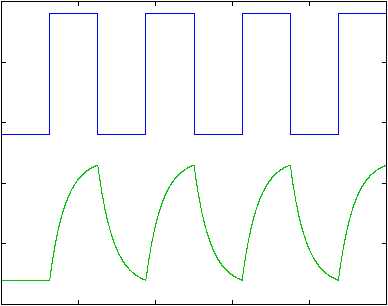 Communication channels like telephone lines are
usually analogue media. Analogue media is a bandwidth limited channel. In
the case of telephone lines the usable bandwidth frequencies is in the
range of 300 Hz to 3300 Hz.
Communication channels like telephone lines are
usually analogue media. Analogue media is a bandwidth limited channel. In
the case of telephone lines the usable bandwidth frequencies is in the
range of 300 Hz to 3300 Hz. 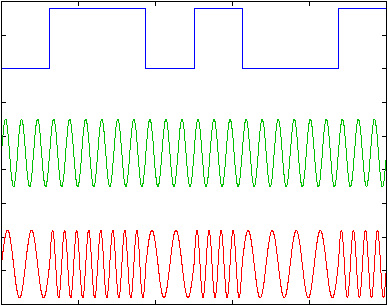 The device that
changes the signal at the transmitting end of the communication channel is
called the 'modulator'. The device at the receiving end of the
channel, which detects the digital information from the modulated signal,
is called the 'demodulator'.
The device that
changes the signal at the transmitting end of the communication channel is
called the 'modulator'. The device at the receiving end of the
channel, which detects the digital information from the modulated signal,
is called the 'demodulator'.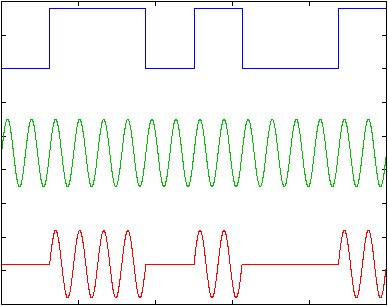 The
The