




|
|
|
Last Updated - 4Mar01 For most of the last 100 years of the 20th century the connection between the subscriber and their telephone exchange was copper twisted pair buried in the pavement or distributed overhead on poles. Given the enormity of the investment in this 'local loop' infrastructure it is hardly surprising that it had lasted for so long. However, by the late 1990s the convergence between voice, computer and television applications - and its inexorable move to digital-based technologies - had led to an erosion of demarcations.For most of the history of fixed line telephony, the bandwidth that copper provided was some 3kHz, limited by analogue techniques and designed to be the cheapest solution that the telecomms operator could get away with. However, the twisted pair is inherently capable of much higher bandwidths and over short distances can carry video or broadband data. New technologies - such as ISDN and ADSL - were developed to enable higher performance to be delivered over the existing infrastructure. Innovation and competition was significantly helped by government action to end incumbent telecomms companies' monopoly over the local loop. In addition, the 1990s had seen cable companies investing massively in alternative connections to the home. Not all use the same technology, but the great majority have fibre optic cable to the curbside cabinet and coaxial cable from there to the home. In most cases these cable networks were installed to deliver television to the home and were designed on the basis of broadcast TV services. However, as much of the developed world continues its inexorable move towards broadband, their high bandwidth can be exploited to deliver other forms of digital-based services too. ISDN The irony is that ISDN has been around for many years in the shape of the UK’s telephone network which has slowly been migrating away from being a public switched telephone network (PSTN), towards having an all digital infrastructure. What is still analogue, however, is the ‘local loop’ - the copper telephone cable that runs from the typically digital telephone exchange to the home or business. So in fact, ordinary voice telephone calls go through an ISDN, but the real benefits of ISDN are not available until users pay for their particular strand of the local loop to be upgraded to ISDN. ISDN was initially available in two versions, Basic Rate ISDN (BRI) which is also known as ISDN-2, and Primary Rate ISDN (PRI) or ISDN-30:
Late 1998 saw BT making the first serious attempt to market ISDN technology to the home user with the announcement of the 'BT Highway' services. When a customer subscribes to one of these services, their existing telephone line is retained but the old master socket is replaced by a Highway unit. This has four sockets, two analogue and two ISDN, and can support up to three calls simultaneously. Subscribers retain their old analogue number while receiving two additional numbers, one for a second analogue port and one for the ISDN lines. Two major differences between the 'Home' and 'Business' services are that the latter supports Multiple Subscriber Numbering (MSN) - whereby different devices attached to one ISDN line can have different numbers - as well as BT's new ISDNConnect data service - a permanent low-speed link that uses ISDN's signalling channel. At the same time as BT Highway was launched BT's ISP operation, BT Internet, announced support for 128 Kbit/s access, allowing users to use their two ISDN lines as one high-bandwidth link. Previously, UK-based ISPs had not supported this option - undermining BT's efforts to promote ISDN to the Internet community. Digital Subscriber
Line xDSL technologies are very fast, typically offering download speeds up to 52 Mbit/s and upload speeds ranging from 64 Kbit/s to over 2 Mbit/s, and come in a number of variants:
The different approaches have differing trade-offs between signal distance and speed and differences in symmetry of upstream and downstream traffic which, taken together, make them suited to different applications. Recent developments make ADSL (Asymmetric Digital Subscriber Line) look the most promising for home use. ADSL ADSL has several similarities to ISDN. Both technologies require that copper phone lines be electrically 'clean', and both can operate only on lines that have relatively short runs (typically less than 20,000 wire feet) to the phone company's central office. In most cases, ADSL can operate over existing voice-grade, twisted-pair phone cables without disturbing the existing telephone connections - meaning that local phone companies don't have to run additional lines to provide ADSL service. At the carrier end a DSL access multiplexer (DSLAM) - effectively comprising an ADSL modem and splitter device - terminates and aggregates incoming ADSL lines for transmission onto voice and data networks. The phone signals are sent to the switched telephone network and the digital data routed data to the Internet via a high-speed backbone (implemented as T1, fibre, ATM, or DSL).
To create upstream and downstream channels, ADSL modems divide the phone line's available bandwidth using one of two methods: frequency-division multiplexing (FDM) or echo cancellation. FDM assigns one band for upstream data and another band for downstream data. The downstream path is further divided by time-division multiplexing (TDM) into one or more high-speed channels for data and one or more low-speed channels, one of which is for voice. The upstream path is multiplexed into several low-speed channels. Echo cancellation assigns the upstream band to overlap the downstream band and separates the two by means of local echo cancellation - the same technique used by V.32 and V.34 modems. Echo cancellation uses bandwidth more efficiently, but at the expense of complexity and cost. With both FDM and echo cancellation, a splitter front-ends an ADSL modem to allocate a 4kHz channel for voice, giving users both conventional phone service and digital data over the same wire pair. This means that with an ADSL modem installed, subscribers won't need special interface electronics to run their analogue phones. That's a useful advantage, and one that could speed ADSL's adoption as a single solution for home PC users and small businesses that don't want to install and pay for an extra data line. Also, most home PCs are located near phone wall jacks, which will make ADSL easier to install than, say, cable modems. Downstream data rates depend on a number of factors, including the length of the copper line, its wire gauge, presence of bridged taps, and cross-coupled interference. Line attenuation increases with line length and frequency, and decreases as wire diameter increases. A bridged tap is an unterminated wire pair that sits in parallel to the main wire pair. In the local loop they appear when the local phone company 'taps' off an existing pair to provision a new service to a new subscriber. Typically, they do not remove the un-used cable segment and a bridged tap is created. In the home, every unused phone jack also represents a bridged tap. Ignoring bridged taps, ADSL will perform as follows:
G.lite The original ADSL standard, T1.413, incorporates a splitter in both the remote terminal and the central office. This is designed to separate the voice band from the DSL frequency, the idea being to protect both signals from interfering with each another. As a consequence, installation required the telephone company to send a worker to a subscriber's home to install a splitter and test their telephone line. G.lite greatly simplifies the installation process, allowing users to buy and install an ADSL modem themselves or even purchase PCs with the technology preinstalled. Besides eliminating the need to send out a technician, G.Lite also works in places where a conventional DSL modem will not. That's because it works with Digital Loop Carrier, a digital local loop infrastructure for connecting customers introduced to enhance phone networks in the 1980s. Conventional DSL can't be carried over DLC lines. Like regular ADSL, G.lite is an 'always-on' connection protocol which allows users to make a conventional voice telephone calls simultaneously with the transfer of digital data. The trade-off for the advantages it offers is in speed. While full-on ADSL can reach download speeds of up to 6.1 Mbit/s, G.Lite is limited to 1.5 Mbit/s downstream and approaching 400 Kbit/s upstream. Also, its reliance on DLC connection may be a problem for some suburban and rural areas. Other
xDSL variants SDSL is essentially the same as HDSL with two notable exceptions: it uses a single wire pair and has a maximum operating range of 10,000 feet. VDSL is the fastest DSL technology. It delivers downstream rates of 13 to 52 Mbit/s and upstream rates of 1.6 to 2.3 Mbit/s over a single wire pair. However, the maximum operating distance is only 1,000 to 4,500 feet and VDSL and ADSL equipment aren't compatible, though sharing many compression and modulation technologies. The table below summarises the speed and distance characteristics of the other principal xDSL variants:
ADSL
standards CAP is supported by AT&T/Paradyne and initially boasts speeds up to 1.5 Mbit/s. This scheme uses frequency modulation techniques that send a single signal down the wire; cable TV companies have been using these techniques for years. DMT is a newer scheme that divides the total bandwidth into 256 channels (of 4kHz apiece) that can handle much faster speeds. The DMT equipment breaks the data signal into these smaller channels so that each channel carries a small amount of data; the overall stream is assembled at the subscriber's end. DMT products are just now coming out and will probably be more expensive than CAP products. But DMT has been endorsed by ANSI. However, to date there's no clear-cut winner, and it's too early to tell which standard will be more popular. However, local telephone companies are not the only ones looking to provide the next great leap forward in Internet access technology. xDSL has serious competition from local cable companies, often in conjunction with national backbone provider networks, and their cable modem technology. ADSL
implementation The fact that the two types of modem used in the pilot were based on different communications standards was the source of considerable controversy during the trials. The Alcatel system used Discrete-Multi-Tone (DMT) while the Fujitsu modem used Carrierless Amplitude (CAP). The former offered better performance at greater distances from the local exchange and was less disruptive of other analogue telephone services in close proximity. However, compared with the Fujitsu CAP equipment, it had much higher latency. Whilst this was of little consequence to subscribers who just wanted fast download speeds, it was a significant problem to users who wished to participate in multiplayer games. In mid-1999 the European Union (EU) introduced a legal framework to force incumbent European telcos to allow other telecomms companies to lease its local access lines - the copper wire that runs from the local telephone exchange to customers' homes - a process known as local loop unbundling (ULL). The original plan was for this to be accomplished by January 2001. Shortly after the introduction of the EU regulations, the UK government regulator for telecommunications (OFTEL) issued proposals for the opening up of BT's local telephone lines to other networks in a bid to accelerate the availability of high-speed Internet access in the UK. Slated to come into force in July 2001, these were intended to open the way for other telecomms operators to be able to use their own DSL technology to provide broadband services to customers, including services like high-speed always-on Internet access and video-on-demand. It was mid-2000 when BT's ADSL services came to market. These comprised both retail products - aimed at consumers - and wholesale products - which enabled rival ISPs to offer similar ADSL connectivity to end users. These used DMT-based modems, and were typically available in download speeds of between 512 Kbit/s and 2 Mbit/s, with upload speed a constant 256 Kbit/s. Home user services used a USB connection to the host PC and were generally based on a 50:1 contention ratio, the more expensive business packages used an Ethernet connection and a 20:1 contention ratio. The rollout of both ADSL services and the unbundling of the local loop were beset by problems - technical and administrative. In the case of the former, BT admitted that it had underestimated the capacity that would be required at ADSL-enabled exchanges as well as the number of engineers required to handle both the wholesale and retail implementation operations. In the case of the latter, there was also some question as to BT's commitment to ULL, with many independent operators accusing the telco of being obstructive - not least for it's claims that only 190 of the first 600 exchanges opened on the rolling timetable had sufficient space for co-location, and that the rest would require building separate buildings and connections. By late 2000, following a period of pressure from industry bodies and parliamentary committees, OFTEL had issued a groundbreaking directive to BT proposing that rival operators be able to get independent verification that there is not enough space in local exchanges for their equipment, that they be allowed to freely transfer space allocations in BT local exchanges and that there should be an independent body to resolve the inevitable disputes. BT would be liable to fines if they were found to be delinquent. As 2000 drew to a close, BT claimed to be installing ADSL at around a rate of 5,000 end users a month - with plans to increase the rate to 15,000 by March 2001. However, with some reports forecasting that DSL subscribers would grow from 4.5 million in 2000 to 100 million by 2005, not much more than 2% of UK homes had a broadband connection by this time. This compared with 6% for homes in the USA and France and 3.3% in Germany. In parts of Asia the take-up of ADSL was better still, with Hong Kong having 7.6% of homes ready for broadband, Singapore 4% and Taiwan nearly 2%. In South Korea more than one in three online households has a broadband connection. On the ULL front the telco had committed to having 600 out of the UK's 6000 telephone exchanges ready for other operators by July 2001, with another 200 being unbundled every month thereafter. Cable
modems The devices, manufactured by such vendors as Bay Networks and Motorola, typically are external boxes that attach to client PCs via Ethernet interfaces. However, USB and FireWire cable modems are expected to appear during the course of 1998. In most cases, a cable modem user is assigned a single IP address, but many cable modem providers offer additional IP addresses for multiple computers at a nominal additional charge. Alternatively, some providers allow several PCs to share a single IP address by installing a proxy server. There are two dramatically different classes of cable modems: hybrid fibre-coax (HFC) modems, which are two-way devices that operate over HFC cable, and older one-way modems that operate over traditional coaxial TV cables. Although conventional one-way cable predominates currently, virtually all new cable construction is HFC. Regardless, any cable modem uses one or two 6MHz TV channels.
While local cable companies provide the modem as part of its service, interoperability between modems isn't an issue. However, this will become so in the future, when subscribers will be able to buy and own their own cable modem. One ray of hope is an Institute of Electrical and Electronic Engineers (IEEE) working group committee, 802.14, that's trying to define a common media-access control scheme for sending data over cable. The committee is selecting the best elements from among 17 different proposals and hoped to have its recommendations finished by the end of 1998. A number of vendors are also working together to ensure product interoperability. The cable modem's function is to modulate and demodulate the cable signal into a stream of data; and the similarity with analogue modems ends there. Cable modems also incorporate a tuner (to separate the data signal from the rest of the broadcast stream); parts from network adapters, bridges, and routers (to connect to multiple computers); network-management software agents (so the cable company can control and monitor its operations); and encryption devices (so data isn't intercepted or sent to a wrong destination by mistake). Each cable modem has an Ethernet port that connects to the computer (or network) on one side and to the cable connection on the other. As far as the PC is concerned, it's hooked directly to the Internet via an Ethernet cable. There are no phone numbers to dial and no limitations on serial-port throughput (as is the case with ISDN modems). Cable has a number of practical disadvantages compared with the rival xDSL technology. Two of the most obvious concern location. Not all homes are yet wired for cable TV and some will never be, and many that are hooked up to cable are more likely to have their PC located in proximity to a telephone jack than to a TV or existing cable drop. However, for many home users, cable offers the prospect fast Internet access at an affordable price. Theoretically speeds of up to 30 Mbit/s are possible. In practice, cable companies are likely to cap speeds at, typically, 512 KBps download and 128 KBps upload. Furthermore, since it is a contended service, performance and speed will degrade the greater the number of subscribers in a given locale.
|



 Once it's commercially available - subscribers will simply need
an external ADSL modem to use ADSL; there will also be one in the phone
company's central office. While these devices are still being developed,
prototypes have three connectors on the back of the unit: one goes to the
wall jack and then out to the phone company; one is for a standard RJ11
phone jack for analogue phone service; and one is an
Once it's commercially available - subscribers will simply need
an external ADSL modem to use ADSL; there will also be one in the phone
company's central office. While these devices are still being developed,
prototypes have three connectors on the back of the unit: one goes to the
wall jack and then out to the phone company; one is for a standard RJ11
phone jack for analogue phone service; and one is an 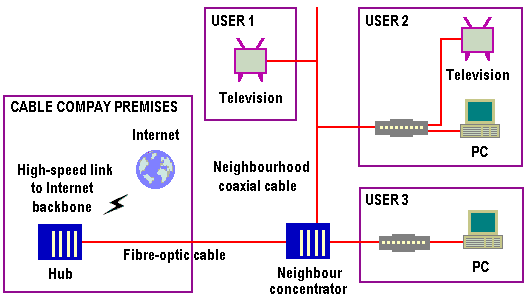 Because the
cable industry's network has a bus topology, every cable modem in a
neighbourhood shares access to a single coaxial cable backbone. Whilst
it's possible for sharing to slow throughput, this can be avoided by good
design. A two-way cable modem provides links to and from the Internet. A
one-way cable modem requires a dial-up modem for uploads. A neighbourhood
concentrator combines data from several neighbourhood cables and
communicates with a larger router, or hub, at the cable company's main
plant via - typically via a fibre-optic cable link. The hub sends TCP/IP
data from each modem to the Internet via a high-speed leased line or
private backbone.
Because the
cable industry's network has a bus topology, every cable modem in a
neighbourhood shares access to a single coaxial cable backbone. Whilst
it's possible for sharing to slow throughput, this can be avoided by good
design. A two-way cable modem provides links to and from the Internet. A
one-way cable modem requires a dial-up modem for uploads. A neighbourhood
concentrator combines data from several neighbourhood cables and
communicates with a larger router, or hub, at the cable company's main
plant via - typically via a fibre-optic cable link. The hub sends TCP/IP
data from each modem to the Internet via a high-speed leased line or
private backbone.