Derived Logical Functions and Gates

Direct links to other logic pages:
Combinational Logic: [Basic Gates] [Derived Gates]
[The XOR
Function] [Binary
Addition] [Multiplexer]
[Decoder/Demultiplexer]
Sequential Logic: [RS NAND Latch]
[Clocked RS
Latch] [RS
Flip-Flop] [JK
Flip-Flop] [D
Latch]
Return to Digital index
page.
Return to Play-Hookey Home
Page.
While the three basic functions AND, OR, and NOT are sufficient to accomplish
all possible logical functions and operations, some combinations are used so
commonly that they have been given names and logic symbols of their own.
We will discuss three of these on this page. The first is called NAND, and
consists of an AND function followed by a NOT function. The second, as you might
expect, is called NOR. This is an OR function followed by NOT. The third is a
variation of the OR function, called the Exclusive-OR, or XOR function. As with
the three basic logic functions, each of these derived functions has a specific
logic symbol and behavior, which we can summarize as follows:


|
|
-
The NAND Gate
-
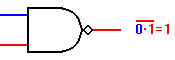
The NAND gate implements the NAND function, which is exactly inverted
from the AND function you already examined. With the gate shown to the
left, both inputs must have logic 1 signals applied to them in order for
the output to be a logic 0. With either input at logic 0, the output
will be held to logic 1.
The circle at the output of the NAND gate denotes the logical
inversion, just as it did at the output of the inverter. Also in the
figure to the left, note that the overbar is a solid bar over both input
values at once. This shows that it is the AND function itself that is
inverted, rather than each separate input.
As with AND, there is no limit to the number of inputs that may be
applied to a NAND function, so there is no functional limit to the
number of inputs a NAND gate may have. However, for practical reasons,
commercial NAND gates are most commonly manufactured with 2, 3, or 4
inputs, to fit in a 14-pin or 16-pin package.
|
|
|
-
The NOR Gate
-
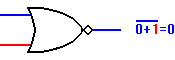
The NOR gate is an OR gate with the output inverted. Where the OR
gate allows the output to be true (logic 1) if any one or more of its
inputs are true, the NOR gate inverts this and forces the output to
logic 0 when any input is true.
In symbols, the NOR function is designated with a plus sign (+), with
an overbar over the entire expression to indicate the inversion. In
logical diagrams, the symbol to the left designates the NOR gate. As
expected, this is an OR gate with a circle to designate the
inversion.
The NOR function can have any number of inputs, but practical
commercial NOR gates are mostly limited to 2, 3, and 4 inputs, as with
other gates in this class, to fit in standard IC packages.
|
|
|
-
The Exclusive-OR, or XOR Gate
-
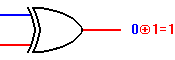
The Exclusive-OR, or XOR function is an interesting and useful
variation on the basic OR function. Verbally, it can be stated as,
"Either A or B, but not both." The XOR gate produces a logic 1 output
only if its two inputs are different. If the inputs are the same,
the output is a logic 0.
The XOR symbol is a variation on the standard OR symbol. It consists
of a plus (+) sign with a circle around it. The logic symbol, as shown
here, is a variation on the standard OR symbol.
Unlike standard OR/NOR and AND/NAND functions, the XOR function
always has exactly two inputs, and commercially manufactured XOR gates
are the same. Four XOR gates fit in a standard 14-pin IC
package. |
The three derived functions shown above are by no means the only ones, but
these form the basis of all the others. On the next page we will look at
how the XOR function is derived. Then we will begin our look at practical
applications for logic gates in various combinations, to see just how these
simple gates can be combined to perform every possible operation in a
computer.
Back to the Play-Hookey main page.


