Basic Logical Functions and Gates

Direct links to other logic pages:
Combinational Logic: [Basic Gates] [Derived Gates]
[The XOR
Function] [Binary
Addition] [Multiplexer]
[Decoder/Demultiplexer]
Sequential Logic: [RS NAND Latch]
[Clocked RS
Latch] [RS
Flip-Flop] [JK
Flip-Flop] [D
Latch]
Return to Digital index
page.
Return to Play-Hookey Home
Page.
While each logical element or condition must always have a logic value of
either "0" or "1", we also need to have ways to combine different logical
signals or conditions to provide a logical result.
For example, consider the logical statement: "If I move the switch on the
wall up, the light will turn on." At first glance, this seems to be a correct
statement. However, if we look at a few other factors, we realize that there's
more to it than this. In this example, a more complete statement would be: "If I
move the switch on the wall up and the light bulb is good and the
power is on, the light will turn on."
If we look at these two statements as logical expressions and use logical
terminology, we can reduce the first statement to:
Light = Switch
This means nothing more than that the light will follow the action of the
switch, so that when the switch is up/on/true/1 the light will also be
on/true/1. Conversely, if the switch is down/off/false/0 the light will also be
off/false/0.
Looking at the second version of the statement, we have a slightly more
complex expression:
Light = Switch and Bulb and Power
Normally, we use symbols rather than words to designate the and
function that we're using to combine the separate variables of Switch, Bulb, and
Power in this expression. The symbol normally used is a dot, which is the same
symbol used for multiplication in some mathematical expressions. Using this
symbol, our three-variable expression becomes:
| Light = Switch |
. |
Bulb |
. |
Power |
|
|
When we deal with logical circuits (as in computers), we not only need to
deal with logical functions; we also need some special symbols to denote these
functions in a logical diagram. There are three fundamental logical operations,
from which all other functions, no matter how complex, can be derived. These
functions are named and, or, and not. Each of these has a
specific symbol and a clearly-defined behavior, as follows:


|
|
-
The AND Gate
-
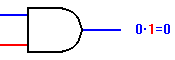
The AND gate implements the AND function. With the gate shown to the
left, both inputs must have logic 1 signals applied to them in order for
the output to be a logic 1. With either input at logic 0, the output
will be held to logic 0.
If your browser supports the Javascript functions required for the
demonstrations built into this page, you can click the buttons to the
left of the AND gate drawing to change their assigned logic values, and
the drawing will change to reflect the new input states. Other
demonstrations on these pages will work the same way.
There is no limit to the number of inputs that may be applied to an
AND function, so there is no functional limit to the number of inputs an
AND gate may have. However, for practical reasons, commercial AND gates
are most commonly manufactured with 2, 3, or 4 inputs. A standard
Integrated Circuit (IC) package contains 14 or 16 pins, for practical
size and handling. A standard 14-pin package can contain four 2-input
gates, three 3-input gates, or two 4-input gates, and still have room
for two pins for power supply connections.
|
|
|
-
The OR Gate
-
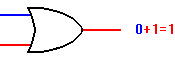
The OR gate is sort of the reverse of the AND gate. The OR function,
like its verbal counterpart, allows the output to be true (logic 1) if
any one or more of its inputs are true. Verbally, we might say, "If it
is raining OR if I turn on the sprinkler, the lawn will be wet." Note
that the lawn will still be wet if the sprinkler is on and it is also
raining. This is correctly reflected by the basic OR function.
In symbols, the OR function is designated with a plus sign (+). In
logical diagrams, the symbol to the left designates the OR gate.
As with the AND function, the OR function can have any number of
inputs. However, practical commercial OR gates are mostly limited to 2,
3, and 4 inputs, as with AND gates.
|

|
|
-
The NOT Gate, or Inverter
-
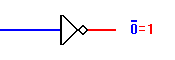
The inverter is a little different from AND and OR gates in that it
always has exactly one input as well as one output. Whatever logical
state is applied to the input, the opposite state will appear at the
output.
The NOT function, as it is called, is necesasary in many applications
and highly useful in others. A practical verbal application might
be:
The door is NOT locked = You may enter
The NOT function is denoted by a horizontal bar over the value to be
inverted, as shown in the figure to the left. In some cases a single
quote mark (') may also be used for this purpose: 0' = 1 and
1' = 0. For greater clarity in some logical expressions, we
will use the overbar most of the time.
In the inverter symbol, the triangle actually denotes only an
amplifier, which in digital terms means that it "cleans up" the signal
but does not change its logical sense. It is the circle at the output
which denotes the logical inversion. The circle could have been placed
at the input instead, and the logical meaning would still be the
same.
|
The logic gates shown above are used in various combinations to perform tasks
of any level of complexity. Some functions are so commonly used that they have
been given symbols of their own, and are often packaged so as to provide that
specific function directly. On the next page, we'll begin our coverage of these
functions.
Back to the Play-Hookey main page.

