


J-K CLOCKED FLIP-FLOP
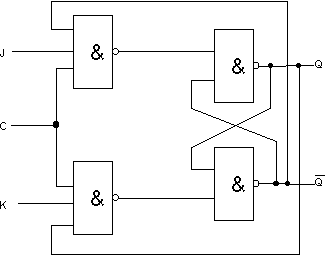
The J-K flip-flop shown is made up of NAND gates. It has two extra NAND gates to CLOCK the flip-flop. The CLOCK tells the flip-flop when to pay attention to its inputs and when to ignore them.
Flip-flops store a BIT of information. In a computer some calculations and processes take longer than others. This means that flip-flops must wait until everything has caught up before they can work out their output.
|
J |
K |
QN+1 |
____ QN+1 |
|
0 |
0 |
QN |
__ QN |
|
1 |
0 |
1 |
0 |
|
0 |
1 |
0 |
1 |
|
1 |
1 |
__ QN |
QN |
Memory means that the flip flop remembers its output. When J and K are 0, Q can be 1 or 0 depending on its value before J and K became 0. When J and K are 1, Q can be 1 or 0 depending on its value before J and K became 0. Q will be the opposite of what it was. This is the meaning of the bar across the top of the Q.
_ _ _
Q means NOT Q. If Q is 1 the Q is 0. If Q is 0 the Q is 1.
If C is 0 then the output of the first two NANDs is high(1) and the flip flop remains in memory state.
Show the output on the diagram when C is 1, J is 1 and K is 0.