

Data and Information
People count using the decimal system. It is called decimal or base 10 since there are 10 symbols used to represent the numbers i.e. 0,1,2,3,4,5,6,7,8,9. People also use an alphabet to represent names and words and these can use 26 or more symbols depending on the spoken language.
Machines understand two symbols ON and OFF, HIGH and LOW, GO and STOP. Computers are digital machines that use data and information in the form of Binary numbers. The binary system is based on two symbols 1 and 0. So that we can talk to computers and computers can talk to us we need to be able to convert from binary to decimal and back again.
Data Representation
Binary
Counting using the binary system goes "zero, one, ten, eleven, one hundred, ..." You leave out all the numbers that have the symbols 2, 3, 4, 5, 6, 7, 8 and 9.
Octal
People have a great deal of trouble remembering binary numbers. It gets pretty confusing with all the 1's and 0's. The octal system is used by computer technicians since it can be easily converted to binary.
Hexadecimal
Octal is useful but hexadecimal is better when large numbers are used. Remember binary has two symbols; octal has eight symbols; decimal has 10 symbols. Hexadecimal has 16 symbols. This means that we have to find 6 extra symbols so that we can count in hexadecimal or HEX.
Digital Interpretation
In digital machines binary information is stored in devices called registers. A four bit register will store four bits and an eight bit register will store 8 bits. We can draw a register by giving one box for each bit eg an eight bit register looks like
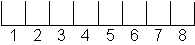
A bit is a 0 or 1 that can be put in each box. If we want to represent the decimal number 3 which is 111 in binary we put the 111 in boxes 6,7 and 8.
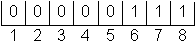
We call a BYTE an
eight bit number and a WORD a 16 bit number.