


http://aol.pcwebopedia.com/TERM/m/machine_language.html
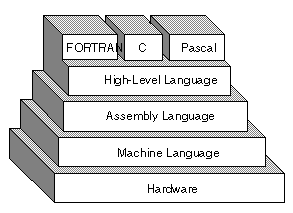
machine language
The lowest-level programming language (except for computers that utilize
programmable microcode) Machine languages are the only languages understood by
computers. While easily understood by computers, machine languages are almost
impossible for humans to use because they consist entirely of numbers.
Programmers, therefore, use either a high-level programming language or an
assembly language.
assembly language
A programming language that
is once removed from a computer's machine language. Assembly languages have the
same structure and set of commands as machine languages, but they enable a
programmer to use names instead of numbers.
Each type of CPU
has its own machine language and assembly language, so an assembly language
program written for one type of CPU won't run on another. In the early days of
programming, all programs were written in assembly language. Now, most programs
are written in a high-level language such as FORTRAN or C. Programmers still
use assembly language when speed is essential or when they need to perform an
operation that isn't possible in a high-level language.
Programs written
in high-level languages are translated into assembly language or machine
language by a compiler. Assembly language programs are translated into machine
language by a program called an assembler.
High level language
A programming language such
as C, FORTRAN, or Pascal that enables a programmer to write programs that are
more or less independent of a particular type of computer. Such languages are
considered high-level because they are closer to human languages and further
from machine languages. In contrast, assembly languages are considered
low-level because they are very close to machine languages.
The main advantage
of high-level languages over low-level languages is that they are easier to
read, write, and maintain. Ultimately, programs written in a high-level
language must be translated into machine language by a compiler or interpreter.
The first
high-level programming languages were designed in the 1950s. Now there are
dozens of different languages, including Ada, Algol, BASIC, COBOL, C, C++,
FORTRAN, LISP, Pascal, and Prolog