


 Input/Output Hardware
Mice
In the early 1980s the first PCs
were equipped with the traditional user input device - a keyboard. By the end
of the decade however, a mouse device had become an essential for PCs running
the GUI-based Windows operating system.
The commonest mouse used today is
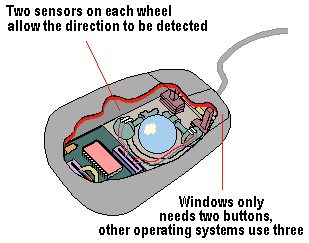
opto-electronic. Its ball is steel for weight and rubber-coated for grip, and
as it rotates it drives two rollers, one each for x and y displacement. A third
spring-loaded roller holds the ball in place against the other two.
These rollers then turn two disks with
radial slots cut in them. Each disk rotates between a photo-detector cell, and
each cell contains two offset light emitting diodes (LEDs) and light sensors.
As the disk turns, the sensors see the light appear to flash, showing movement,
while the offset between the two light sensors shows the direction of movement.
Also inside the mouse are a switch for each
button, and a microcontroller which interpret the signals from the sensors and
the switches, using its firmware program to translate them into packets of data
which are sent to the PC. Serial mice use voltages of 12V and an asynchronous
protocol from Microsoft comprised of three bytes per packet to report x and y
movement plus button presses. PS/2 mice use 5V and an IBM-developed
communications protocol and interface.
Keyboards
A computer keyboard is an array of switches, each of which sends the PC a
unique signal when pressed. Two types of switch are commonly used: mechanical
and rubber membrane. Mechanical switches are simply spring-loaded ‘push to
make’ types, so when pressed down they complete the circuit and then break it
again when released. These are the type used in clicky keyboards with plenty of
tactile feedback.
An important factor for keys is their force
displacement curve, which shows how much force is needed to depress a key, and
how this force varies during the key’s downward travel. Research shows most
people prefer 80g to 100g, but games consoles may go to 120g or higher while
other keys could be as low as 50g.
Printers
In
the 1980s, dot-matrix and laser
printers were pre-dominant, with inkjet
technology not emerging in any significant way until the 1990s. The laser
printer was introduced by Hewlett-Packard in 1984, based on technology developed
by Canon. It worked in a similar way to a photocopier, the difference being the
light source. With a photocopier a page is scanned with a bright light, while
with a laser printer the light source is a laser. After that the process is
much the same, with the light creating an electrostatic image of the page onto
a charged photoreceptor, which in turn attracts toner in the shape of an
electrostatic charge. A laser printer needs to have all the information about a
page in its memory before it can start printing.
Canon claims to have invented what it terms
'bubble
jet' technology in 1977, when a researcher accidentally touched an
ink-filled syringe with a hot soldering iron. The heat forced a drop of ink out
of the needle and so began the development of a new printing method.