it's all about interpretation. The Method is a personal reading of the text, a tracing of the emotional motivation behind a character. It's all you can do when you're given precious little stage directions and you haven't the pleasure of being in the genius's original troupe, to whom he would explain things or at least give a nod of approval when things looked and sounded right. That's the peculiarity of the training. That's the timeless reinvention of the words which have become so classic. The joy is the discovery. The awe and the wonder are the academic disputes you have with others whose eyes read the part differently. It is the self that you put into it. It is every little thing you might choose to entirely spin off the old role anew. Each one burns brightly for his brief time in the part, and that is enough in itself. Though some will complain, will call it misguided or poorly executed, at least let no one say that you were not sincere. What matters is that you tried. What matters is the clarity of the voice you created from those beloved words. You tried the re-creation. Some smiled, some didn't. Let it go.
Dear, dear actor. Dear, dear soul that inflames an old part with the mere new truth of you. There are those who understand. There are those that you made believers. Some of us, we remember.
The above is titled "For JB." There are some people that particularly don't like Jeremy Brett, and they should leave this page right now, to avoid any further adulation and reminiscences.
"That is one mark of a Shakespearean actor: to take the familiar and make it new." --Roger Ebert, 1996 Video Companion review of Kenneth Branagh's Henry V
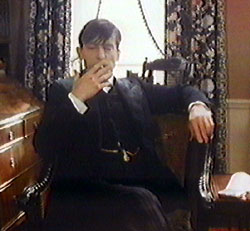
(This is my favorite picture of JB, looking like a mixture of Lord Peter Wimsey and Sherlock Holmes. It's from Michael Sherman's collection.)
JB is Jeremy Brett, who died September 12, 1995. He was for ten years the actor who portrayed Holmes for Granada Television's Sherlock Holmes series which was seen on PBS's Mystery! and on the cable channel A&E. Brett was highly regarded for, and quite talented in, redefining a role for which so many readers held strong preconceptions of what was permissable for the character. Many people, including myself, admired him greatly for the sensitivity and ability that he brought to the part. It was only when I started eavesdropping on The Hounds of the Internet that I ever knew that there existed a resentment, even a hostility, towards Brett among a notable faction of Holmes fans. While I realize that people have a natural right to their own preferences, I think that much of the Brett backlash is harsh, petty, and unecessarily cruel in character. I realize that the fan praise about Jeremy can tend toward the sickeningly effusive (to a non-fan), but something has to be said for civility in criticism.
Links last checked September 2003.
Here on this page, I just have a few of my ramblings about Jeremy Brett [1, 2, 3, and 4], plus a response from another Brett fan, another fan's insightful comment, and now a lovely poem from Wolfgangerl.
To learn more about Jeremy and his death, please refer to these other sites:
To learn more about Sherlock Holmes, and to find a helpful index to my many other Holmes-relevant pages, please check out my Sherlock Holmes tin box.
You might know that Jeremy also played Max de Winter in a TV adaptation of du Maurier's Rebecca in the '80s, and was Freddie Eynsford-Hill in the 1964 movie My Fair Lady with Audrey Hepburn. However, his voice was dubbed for the song "On the Street Where You Live."
[Clarification: This was an odd thing to do because the film's producer had paid megabucks to steal the dashing young singing and acting talent from Laurence Olivier's theatre company.] Get a better idea of how Jeremy sang by checking out Carrie Pratt's sound files (in *.wav format).
I've heard also that the Laurie King fans, whose list is on Beekeeper's Holmes Page, are Brett-friendly, though I haven't read the Mary Russell and Holmes books. I guess Carole Nelson Douglas's Irene Adler books turned me off. The book jacket said "witty, intriguing, fun," but I found her more of a shameless namedropper. Though I admire Douglas's original thoughts on Irene, Nell seemed too haughty, and for some reason it just didn't feel "period" the way that Anne Perry's historically set mysteries do.
[I realized it was necessary to come back and amend this with more recent information. I have now read Laurie King's Russell series, and yes, it is a good series. The Russ-L list is not, one way or the other, Brett-inclined, but its list members are more polite when they disagree about Brett's portrayal of Holmes. Also, I should say that I took another look at Carole Nelson Douglas's Irene series, and it actually kept me enthralled this time. Nell is still a prude, and makes far too many literary allusions, but I realize that Irene should, after all, be expected to move naturally among high society. She's a lot of fun, especially when fencing or confessing that in her past she was a magician's assistant! It's also so refreshing to read about Holmes NOT having an affair with Irene.]
I put this on a separate page in order to both pour out my heart and to spare any Holmes fan who has had enough of hearing how "definitive" Jeremy Brett is. I'm just not in the mood to have my feelings ridiculed, and I think this is a cozier little place for a Brettfan to discuss and reminisce freely. Do excuse me if I return here later and vent frustrations or sob my grief. Catch you later. --crescent(
I suppose I should clarify that, although I was "eavesdropping" for a while, I have since actually joined the Hounds of the Internet, where I'm known as "Miss Roylott". --Yes, that's another alias. Geez, just how many names can a person need?
I don't know. I'm what you would call a shy or retiring person. There's something about the total anonymity of the internet that makes me more comfortable with confessing things that my natural insecurity wouldn't normally allow. It's almost frightening, the freedom of it.
Anyway, I came back here as I'd promised (or threatened, depending on how you like my babbling) because I was thinking more about why certain Holmes fans are not Brett fans, and why some are rather cruel in their comments. Lisa Oldham mentioned to me her experiences with Sherlockian know-it-alls who sneer and make her feel like she's wearing a "kick me" sign. What I gather to be one of the main complaints is the intensity of our enthusiasm for Brett. The way that we fawn over his memory, call him the greatest, watch his non-Sherlockian roles, and strive to learn all about his life. It seems to the critics that we have gone rather overboard in our devotion. Yet, honestly, haven't Holmes fans as a whole been accused of going overboard?
Another argument might be that we are in a way showing a restraint in our devotion. Some fans can rob their favorite actor of his or her own identity. Isn't being typecast one of the worst fates of an actor, making it impossible for the actor to get anything but nostalgia roles? Isn't fan fanaticism what drove Leonard Nimoy to title his earlier book I Am NOT Spock? Isn't the world's fixation on Marilyn at the expense of Norma Jean what made both the actress underrated and the star personally miserable? Wisely or not, we want to know Brett, want to recognize and celebrate his real life. We can't help it, for he has touched our hearts in a very realway. crescent(
I used to link to some images from Michael Sherman's pictures page here, but then I realized that it was unfair to drain on his server when you could go to his website itself. And besides that, there are many beautiful pictures of JB available both as Holmes and as himself on Carrie Pratt's page, Kathy Li's, and other fans'.
Instead I will put here a short essay that I began to write to send to Foxhound's collection of charming "Hooked on Holmes" stories that he posted from a Hounds of the Internet thread. However, it turned out to become a considerable reflection on JB and Basil Rathbone, or what impressions I have of him.
To tell the truth, it takes a little digging for me to figure out how I got hooked, for I have a strange and quirky memory, for a mere twenty-year-old. And please pardon me if I babble.
I was reading Encyclopedia Brown. Must have been. There was a logo, "America's Sherlock Holmes in Sneakers", which I barely noticed. Most days I was watching cartoons, Star Trek, and constant Nature programs. Somewhere along the way, I fell in love with Britain. Can't remember when. One of the Hounds summed it up best in his lovely poem: "my 'culture' to express. I'd learned from all those British snobs on PBS." So yes, I was an Anglophile in the most naive and wholehearted way, getting caught up in the glamour of a place that still had royalty, just like in those fairy tales I was always hearing. There must have been a play too. --"The Importance of Being Earnest"? Hmm. It both sounds right and doesn't sound right. I told you my memory was faulty. No, it must have been a Rudyard Kipling story I was reading in class. "Rikki-Tikki Tavi". Or a Roald Dahl one about a snake in a bed. But then again, yes, my oldest sister got me to sit with her to watch a film version of Wilde's play on PBS. That was it. That's the earliest that I remember. "Superfriends" against Wilde; no contest. I began categorizing all items in the world according to this, in my effort to be precocious enough to impress my parents. American--mediocre, childish. British--witty, for adults with a sense of the absurd. I tended to learn all new "truths" in such sharp, flat outlines. The chasm was forming. Oh yes, it's very easy to learn to be a snob.
So, being in love with "old" Britain, I decided I would find out more about it. I liked the mythic quality of Elizabeth and Victoria. I liked King Arthur. I liked Robin Hood. I liked Sir Francis Drake. I liked the Thames, just the way that it was pronounced. Believe me, I was on a roll, the silly kid I was. But why didn't I take to Holmes? I picked up the canon. I started a story. Didn't finish it. I can't even remember which it was. It's strange how none of the other mystique, especially of Victoria, rubbed off. I think it was because I had started on a pattern of illusion. Getting attached to only the "legendary" side of things set me up for wanting everything to turn out, at least metaphorically, to be all knights and damsels and magic and romance and idealism. Which is nice for a child, but not really authentic for a girl with too-ambitious designs on being precocious. But well, Holmes came off so cold and stiff that first time, and I didn't understand any reason why anybody could possibly think him fun. I felt he was talking at me so much with his cleverness, that I really didn't care to go to the trouble to find out about his nature as I had about other British legends. So I forgot about him.
Yet I heard his name once or twice after, in cartoons, surprisingly enough. But his sidekick was strange indeed. Watson? The Dr. John H. Watson? I remembered little of the story that I'd begun, except that I had been struggling with unfamiliar vocabulary. Surely such a narrator as I'd had impression of had not been such an exaggerated buffoon? At most, he just seemed to enjoy being constantly surprised by his friend. Strange indeed. I was beginning to think that I was not seeing what other people were seeing.
There was of course the Basil Rathbone image floating about everywhere in various forms, almost nagging at me, through ad campaigns and TV show cameos. But though I could see the reverence in this pop-cultural self-reference, it seemed that whatever Rathbone had done that was great and was amazing was no longer part of the equation. Not him, but the "idea" of him, had unfortunately been milked for all it was worth. He'd been compressed into a flat image that the other, much lesser actors were all too obviously patterning themselves after, in their "quick-study" effort for the cameo part, in the meantime letting any actual direct quoting of his words or philosophy or personality, other than the catch-phrase "Elementary, my dear Watson," slide by. All I knew, instinctively, was that whatever I was seeing, it was not Rathbone himself, but a mere dilution of his characterization. It was a reduction out of context, which only left me feeling as ever that I was not holding in my hands clues to the person of Holmes, but just a collection of various no-brainer poses. Strutting about in that inverness and obscuring half his face with a giant magnifying glass that turned him into a Picasso (or an Emerson "walking eye", as I later would associate it), only reinforced my vague images of him and my misunderstanding, letting me only see Holmes as a cardboard creature of mannerisms rather than a careful and reasonable criminal expert, which was what people who took him seriously said he was. Some people said he was silly kid stuff, some people said he was a cultural icon worthy of study. Why wouldn't the media version and the print version match each other?
And then one night, I caught a PBS program called Mystery! There was this lean, brooding, and sharp-featured man who must have been the incarnate of Holmes himself. I did not even know his name at first, nor could think anything but that PBS had extracted a very rare specimen out of Nature. I did not see exaggeration in him, nor quirkiness, nor "clownishness" in his action. I saw a man, sitting very still, with his fingertips exquisitely poised together. He was thinking, that was all. Believe me, the contrast would have struck you, had you seen the way that the cartoons, Star Trek, Father Dowling, and advertising caricatures which made up my cultural world were constantly making Holmes a snob and a pedant, or a foolishly masquerading and costumed eccentric, or a theorizing prude who really had overwhelming naivete about the world he professed to analyze, or a specialist in grasping and superificial conclusions, or a raving, pacing, often speeding-off performing magician--all of them never coming together in any approximation of what one, simple, real person might ever be like in a real world. So what did I see in Brett if I did not see these distorted interpretations?
I saw him talking quietly in a cozy apartment with Watson. I saw him expressing urgency or emotion in a delicate raising of an eyebrow, and a changing pitch in his voice. I saw him rub his hands together and smile with that rare, devilish satisfaction. I saw him truly look like he knew what he was doing on a case. I saw him play the violin moodily and enchantingly. I saw him striding in and out of doors, up and down London, in something other than an inverness, carrying something other than a giant magnifying glass. I saw a flesh-and-blood human being with quick, intelligent insights, and plenty of reserves of energy to attack a fresh problem. This was not a cardboard icon, this was not a phantom derivative. This was a genius. This was a detective.
Not long after this discovery, in under a season, I found that my homework-on-a-schoolnight schedule would not permit me to keep up with the irregular showings on Mystery!. I unfortunately had to let this magnificent Holmes go, after all too brief an acquaintance with him. So I went back to Doyle's stories. I read, concentrating no longer on "What's a hansom? What's a gasogene? Why on earth would he say 'ejaculate'?" but on the story and the imaginative freshness and humor of the characters and plots. When I finally managed to come back to Brett, almost too late, I discovered that I had lost so much of him. Whereas my image of Holmes seemed to grow younger and younger with time, getting playful and even whimsically enigmatic on the level of Lord Peter Wimsey or Albert Campion, Brett had changed and was looking unwell. I stared at his pallor, at his weakness, and could only think that my Holmes was suffering. But then, there was a light in the gloom, and I saw what I'd been waiting to see. In "Three Gables", standing and calmly picking up an apple after the raucous exit of Steve Dixie from 221B, he only commented with offended decorum, "He's broken our window," and tossed the fruit aside. [Compare this to the canonical "Mazarin Stone" adventure, where Holmes says nonchalantly to attackers, "No violence, gentlemen! No violence! Consider the furniture!"] And later still in "Three Gables", coming up the stairs past a much-bruised Watson, he placed his hand on the doctor's shoulder and murmured with just enough, but never too much, pause, "Physician, heal thyself." My Holmes was here--wonderful, subtle, perfect all over again.
So there you go. A totally upside-down interpretation of Brett. Yet it made perfect logical sense to me, and it still does. I could only stare in wonder the first times I heard people say that he was a clown, a caricature. As compared to what, pray tell? As I get more familiar with Holmes now, and hopefully find my way to seeing the great Holmes actors of the past, rather than the frustratingly silly cameos on TV in the present, I may finally get to put Brett up to the test with others who were taking Holmes just as seriously. I may possibly agree with others that there were different, and perhaps even better ways, to do the job. But I shall never agree that Brett's way was one of the wrong ways. That would be to deny everything that first, and finally!, got me hooked on Holmes.
Yippee! A&E is finally re-broadcasting the Sherlock Holmes Mysteries, and I can at last see Jeremy again. I just saw "Solitary Cyclist" and I could just about scream and jump up and down! He was so marvellously young, and I must have been wearing a shockingly large grin on my face, because my friends who passed by me at the TV set couldn't understand my excitement. But I was happy, and my only disappointment was that inadequate pub fight. I mean, Woodley didn't even make a smacking sound against Holmes when knocking him across the pub, and Holmes did look a little silly at first when he fought back. It was, though, "delicious" to see the smile on Holmes's face when telling his victory to Watson. There were two absolutely priceless moments, at the beginning and at the end. Responding to Violet Smith's almost teasing query of "How did you guess?", Holmes pauses and stares her down. "Miss Smith ... I never guess." He holds the "s" just long enough to make you expect him to do the obvious thing of quoting a lecture against guessing from the canon, but then, JB and his producers were never ones to do the obvious, stale, and overdone thing. The other great moment is at the end, when Holmes shares a jolly, easy laughter with Watson over the newspaper. His humanizing trait of self-mockery is always truly warm and wonderful.
Anyway, thank you again to all who have emailed to say that they enjoyed this page! It's wonderful to know that Jeremy has touched so many people, who still care for and respect him. crescent(
I too most enjoy Brett's portrayal. Holmes, in my opinion is a dichotomy of energy and lethargy, swinging from one to the other. In Silver Blaze, we see him go from deep thought in the carriage, to manic like action as he studies the crime scene, scurrying about on all fours. Brett's detractors state that he overplays the latter. But many times we see Brett playing the part of the darker more introverted Holmes. I simply feel that of course the scenes where he "rants", as they put it, stick out more to them; do not emotional scenes always leave stark impressions? We have to actually involve ourselves with his portrayals to see all of his subtle meanings. I think they simply see an active scene,and bluster off about "over-acting". They should concentrate more and realize that Brett balances the "manic" with the "subtle" masterfully.
Jeremy's performance as Holmes was the closest to the actual character, as it becomes apparent from reading stories from the Canon that Holmes himself suffered from bouts of manic-depression. In the very first story, in fact, Watson listens to a man explain Holmes's queer habits of staying up for days in the lab and then lapsing into deep depression. Holmes himself informs Watson of this. This is but one of many references that point to a bi-polar disorder. As a sufferer of this disorder himself, who better to understand Holmes than Jeremy?
Brett never got the credit he deserved. Everyone knows Basil Rathbone (who also did a splendid job as Holmes in a different style) but here in the States when I mention Brett I get a blank look. Rathbone refused to be typecast after the Holmes movies and went on doing other parts. Jeremy was just as versatile and should have become a worldwide household name. The way we Brett fans respond to him is simply "making up for lost time". He was a fantastic actor, and deserves much more credit than is metered out to him today.
By Wolfgangerl
Where he never walked,
you pranced.
Where he never stepped,
you danced.
Where he never talked,
you spoke.
Where he never dreamed,
you hoped.
Where he never stood,
you were.
You brought to life a man,
that never lived.
And
breathed life into a human
never born.
(Poem for Jeremy Brett, who portrayed Sherlock Holmes for ten years.)