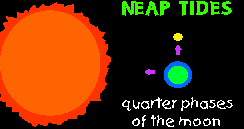
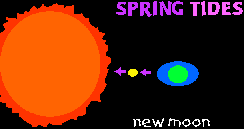
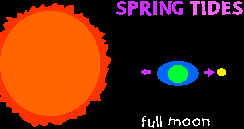
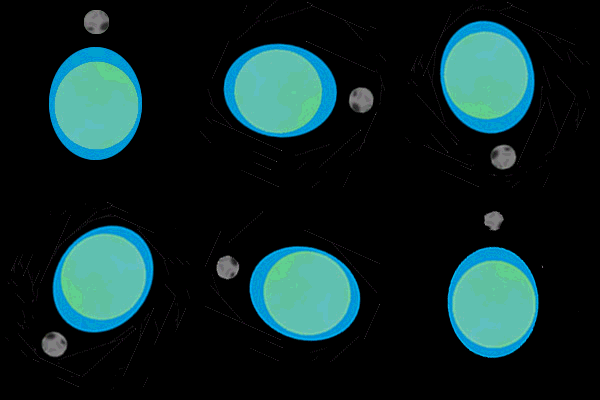
The moon is a lot smaller than the sun, however it also is a lot closer to Earth, which makes its gravitational pull much more powerful then the sun�s. Now imagine if the Sun, Earth and Moon were lined up in a straight line, but this time the sun and Moon are on opposite sides. So, there will be a high tide on both sides, just like there was when the sun and moon were on the same side of earth, but, the only difference is, there is not as big as a high tide because the moon does not have the sun�s help. When the Moon, Sun, and Earth are lined up like these two situations I just explained, it is called a Spring tide. (This has nothing to do with the season, spring!) The Moon has to be a New or Full moon for spring tides to occur. While the moon is going through the first and third quarter phases, the tides are experiencing what we call neap tides. When neap tides occur, there is a little difference between low tides and high tides.
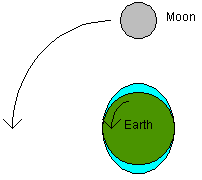
Most locations on Earth experience low and high tides each, twice a day. When there is a high tide on one side of earth, lets say the Eastern, there is also a high tide on the direct opposite side of earth too, because of the suns and or moons gravitational pulls. Also, there are low tides on the left and right sides of the high tides. As Earth spins around on its axis, the high tides on the western and eastern sides start to die down. Once Earth is a quarter of the way around its axis, there will be a full high tide there, (where the low tide used to be.) Again, there is a low tide on the right and left sides of the high tides, (where the high tide used to be.) As Earth spins half way around its axis there will again, is a high tide at the eastern and western sides of earth and a low tide to the right and left side of the high tides. The Earth now spins three-fourths around its axis. Now there is a high tide to the right and left of the east and west just like there was when the Earth was a quarter of the way around its axis! The Earth spins all the way around its axis and starts the whole process over again. This is a little hard to understand.
Here is another way to understand it: When the day just starts, or when
the Earth is 0 percent around its axis, there is a high tide were you live.
When it is one quarter percent around, there is a low tide where you live. It is a high tide again when the Earth is half way around its axis and once again, a low tide when Earth is three quarters of the way around its axis. When it is fully around, the whole method is repeated.