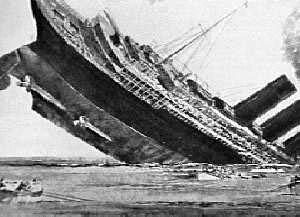
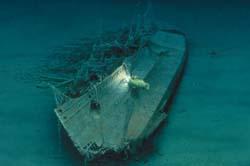
The Lusitania was a British cargo and passenger ship that at one time peacefully crossed the Atlantic, from the U.S.A to England for many years. German authorities threatened the Lusitania of sinking; but this ship was considered unsinkable because of its reserve speed capabilities. Because of the ship�s over-confidence, on May 1st, 1915, the Lusitania set sail from New York, (thinking it would deliver food and passengers to England). But on May 7th, 1915, the Lusitania was too slow in noticing the periscope and torpedo of a German submarine. It was too late; the torpedo hit the Lusitania. Water rushed into the 1st and 2nd boiler rooms causing the ship to rock back and forth, but it didn�t explode it. When the Lusitania rose a little, the 2nd massive explosion hit her. This one took her under the sea.
The exact cause of the 2nd torpedo is uncertain. The Lusitania shows evidence that this blow might have actually come from inside the ship. The reason for this thought questions the ship�s cargo. The Lusitania was supposed to be carrying diamonds, platinum, bullion, and other precious stones. These stones though were not found in the Lusitania, nor were they ever found listed in port records. Instead, some people believe that the Lusitania was actually carrying (under the guise of bales of fur and cheese boxes), 3-inch shells, plus millions of rounds of rifle ammunition. If true, American Law forbid such materials, �and� should never have been placed on a passenger liner� (Simpson 157-15).
The sinking of the Lusitania took the lives of 1,201 people. Only 746 were left to be saved by those who responded to the Lusitania�s SOS (signals for help). In World War I, the single most dramatic incident in the conflicts over German submarine warfare will always stand out in history; the sinking of the Lusitania, in 1915.