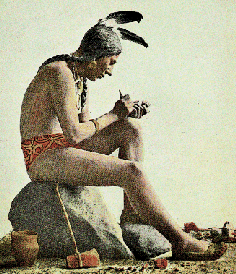
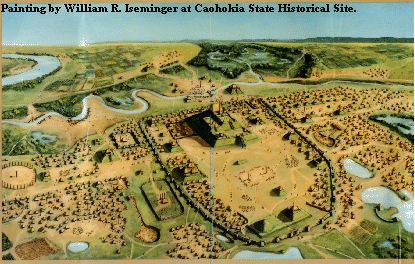
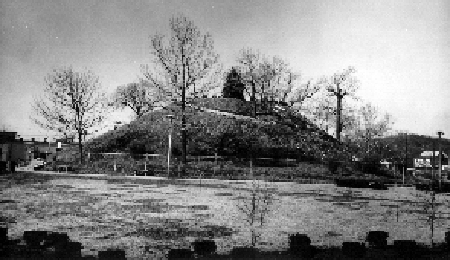
Mound Builders were North American Indians who built large monuments of earth. They had no oxen, horses or wheeled vehicles to carry dirt, this means they would have to carry large amounts of dirt on their back! Many mounds weighed up to 300 tons! Mound builders built these large mounds for burial sites or as platforms to hold houses of chief�s.
Mounds were shaped in all different ways, dragons, tigers, snakes, elephants, and pretty much any thing you could imagine, considering these can almost reach as big as the Great Pyramid in Egypt! Thousands of mounds still exist in Canada and the United States.
People once thought that the Mound Builders disappeared before the Indians came. But scientists have found Indian-made objects in the mounds that the Mound Builders have made, which prove that the Mound Builders were Indians. Another theory says Mound Builders learned how to make mounds from the Vikings. But the Indians began to build mounds way before the Vikings arrived.
The three main cultures of Mound Builders were the Adena, the Hopewell, and the Mississipian culture.
The Adena began making mounds around 700 B.C. They made them in what is now southern Ohio. The Adena culture lived in small villages and supported themselves by hunting, fishing, and gathering wild plants. They also were very skilled at crafting,
The Hopewell culture flourished from 100 B.C. to about A.D. 500. The people grew a variety or crops including corn and squash. By farming, the Hopewell supported a lot more people then the Adena culture. They traded, as the Adena did also. The Hopewell mounds consisted of a ridge that surrounded the mound. They buried all their citizens in tombs, unlike the Adena, and if the bodies were not buried, they would get cremated, and then buried in the mound.
The Mississipian culture lasted from about 700 to the 1700�s. It developed in what is now the southern United States, in the Mississippi Valley area. They raised live stock and grew crops. Many mounds the Mississipian culture built, were burial sites, but some of them were served as foundation for temples or for the houses of the city officials. The Mississipian civilization continued to grow until the 1500�s when diseases brought by European explorers killed many of the people. Only one Mississippian group, the Natchez Indians, survived long enough to be fully described by the Europeans.