| CREME DE LA CREME |
| INTRODUCTION |
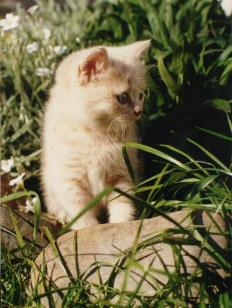 |
| Breeding cream within a breed that sets strict demands to both coat structure, texture, shade and nuance as can be found in the show standard for the British Shorthair is a difficult undertaking. A British Shorthair is a cat that should be bred for the wished round teddy-bear look first and for all. The sentence "you have to build the house first before painting it" is a very apt description on how any British Shorthair breeder should work in his selection program always. How ever, -next to this selection that should be applied for the cream variety as well, this has a second very important breeding goal - selecting for the right cream. This short article gives some genetic background and deals with some selection criteria to reach this illusive goal. Cream is the diluted version of one of the two main colours of the domestic cat - red, (genetically "orange"). The shade of the basic colour, red colour granules, can vary much to begin with in cats anyway.There are pale, rich, orange, yellowish, deep and dull coloured red cats. |
| When de dilution trait is added to the genetic make up, the colour granules clot together allowing air in the hair shaft resulting in the 'bleached out' version of the red, a cream. This clotting does not ensure automatically that each cream British Shorthair has the proper wished shade and light colour. There are "hot" creams, dull cold ones, light ones and dark ones. This firstly depends on the basic colour of the orange granules within the hairshaft. When this should be the only concern, any breeder should simply select |
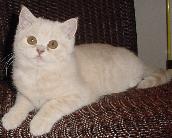 |
| for the lightest coloured hairs and voil�, a lovely light soft coloured cream cat could be produced. How ever, the optical effect of the whole coat structure is involved in creating the wished image. This has to do with the diameter of the hairs, the length of the coat, the different optical effect of the combination of both underwool and top coat and slso depends on the place on the body since shades vary in different bodyparts. And added complication is that the orange gene does not react very much on the basic non-agouti genotype that creams do have. Any red cat (so also the diluted version cream) has some ghostmarking present which means that a vague tabby pattern will be visible within the coat. Originally most British Shorthairs were either blotched [classic] patterned or mackerel. With an added spotting gene these patterns could break up on spotted versions of that basic pattern. Some cream breeders in the past preferred the classic ghostmarking, since this gave a "coat of pattern" which by selection could be made more or less invisible and blend in in the wished solid looking phenotype. More recently also the third possible tabby pattern, ticked, can be found within the breed and since this is a rather non-invasive one, this trait can be used to breed creams that have a more solid look without much barring or pattern showing. Breeding creams is a constant battle to |
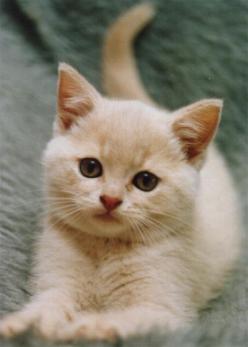 |
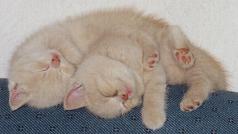
| reach the perfect soft pastel light evenly coloured thourgh colour. Firstly the structure of the cream coat should be of a good short crisp quality. Some creams have a too long soft coat lacking the wished resilience and denseness. Such cats also often show a distinct unwished contrast between undercoat and top coat. The first is whitishly light while the top coat is a darker shade which hides this. Selection for a properly coloured through undercoat is one of the important things to keep in mind. This only can be reached by selecting for a cat that has a high hair implant where eacht hair, be it a dawn hair (undercoat) or top hair (harsher hair) is fighting for a space in the skin to nest. This ensures a dense and short crisp structure but slso that in one glance the combined coat shows to the eye and gives an evenly coloured picture. In the past some cream Persians were used as outcrosses who on the first glance had a lovely light colour. Unbeknownst to many British Shorthair breeders is the habit of cream Persian Breeders to pluck a lot of the darker top coat of such a cat so the lighter long undercoat shines through and gives the light impression. In a British however, not the undercoat but the topcoat determines the optical colour effect and thus introducing cram Persians was partly responsible for those cats still up until today found with a 'two tone' coat - a light undercoat and a darker top coat. If you select for a properly short and dense coat and have achieved it you can select within litters for the proper tone you need in the breed. There are many different shades and tones possible but the essence should be light andeven and soft to see. Also of course notice should be given every time over and over again that youdo not have reoccurring ghostmarking since that spoils the picture. A last rmark: Cream is a colour variety that cannot sustain on its own. You stay needing a diverse enough genepolle to keep the variety healthy and strong. This means you will stay needing other colours within your breeding program. Utmost care should be given to select the *right* partner when opting to use another colour. This rules out those colours which a) do not aim for solidness (like tabbies), b) do not aim for a light and subtle shade (like blacks and chocolates. Preferably a light evenly coloured through blue or in some cases a lilac is seen as the most wished. The resulting bluecream (or lilaccream) females are valuable cats to continue with in creating more good creams and of course are beautiful cats within their own right too. |
 |
| This article has been written especially for this homepage. Mrs. Sluiter is a published author on cats and has written many articles on feline genetics and several other topics and in the past has bred British Shorthairs herself. |
| Author: Mimy Sluiter |
| Momenteel werken wij aan een Nederlandse versie |
 |
| HOME |