What Kinda Man is....
Dubya?
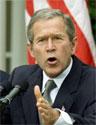
What Kinda Man is.... |
|
On June 22, 1990, George W. Bush sold stock in his own company, Harken
Energy, at $4 a share, for $850,000. Two days later the company reported a
business loss, causing the stock to fall to $2 a share.
Did he have insider
information? (No way, dude!) If so, it was illegal. Bush, who was on
the company's audit committee, was the subject of a Securities and Exchange
Commission (SEC) insider-stock trade investigation. The SEC took no action
against Bush in that inquiry (by the way, in case you weren't aware, his father
was the President of the United States at that time and the SEC is comprised
of five presidentially-appointed Commissioners.)
Forms he was required to file with the Securities and Exchange Commission about the sale were 34 months reaching the SEC. Asked to explain, Bush said "I still haven't figured it out completely."
Harken Energy sold a subsidiary to a partnership of its own executives, which had the effect of concealing $10 million in losses. Arthur Anderson was Harken's accounting firm (same acccountant as Enron Corporation when it created off-the-books partnerships to hide millions of dollars in losses.) The SEC cried foul. Asked to explain the action at a press conference last week, Mr. Bush did his classic shrug and replied "There was an honest difference of opinion as to how to account for a complicated transaction."
Suddenly he's the self-styled leader of a national movement to reform business. Yet he has strong financial and political ties to the world of big business. Did anybody say conflict of interest?
(Do I have this right? "They" have been telling us for decdes that the market works best when the Gov'mint minds it's own god-damned, uh, business......now they've decided the gov'mint NEEDS TO INTERVENE to regulate the boys who's makin' all these here golden eggs?)
Question: How can one best understand this complicated man?Bush pulled out of the Kyoto global-warming protocol and dropped his earlier plan to regulate carbon dioxide as a pollutant. Both actions save the energy industry astounding sums of money. He opposes higher-fuel efficiency standards.
Bush's national energy policy, developed in consultation with industry, included many proposals that would boost energy companies: drilling in the Arctic National wildlife refuge, expanded petroleum and electricity transmission and tax incentives for producing alternative fuels.
Mr. Bush has proposed easing confidentiality rules governing American's medical records, which just coincidentally is hailed by the insurance industry (if somebody has a medical condition that could cost the insurer a lot of money, they wanna KNOW about it.)
Bush signed legislation repealing workplace ergonomics rules, saving business nearly $4.5 billion yearly and replacing the rules with voluntary standards opposed by labor unions.
Bush has proposed ending the Superfund cleanup tax.
Brief biography of George W. Bush:
1946 Born July 6 in New Haven, Connecticut, where his father was a student at
Yale.
1948 Moved with family to Odessa, Texas, where his father entered the oil business.
1962 Entered Phillips Academy, in Andover, Massachusetts.
1964 Entered Yale University.
1968 B.A. in history from Yale. Entered Texas Air National Guard.
1975 Received M.A. in business administration from Harvard Business School.
1977 Married Laura Welch.
1978 Started his own oil and gas company. Ran for U.S. Congress but was defeated.
1981 His twin daughters, Barbara and Jenna, were born.
1983 Became the CEO of Spectrum 7.
1984 Stopped drinking. Purchased (with others) the Texas Rangers Baseball team
for $86 million.
1988 Served as senior advisor for father's presidential campaign.
1994 Elected Governor of Texas.
1998 Re-elected Governor of Texas.
1999 Announced candidacy for presidency of the United States.
2000 "Elected" President.
2004 Re-elected President.