 |
 |
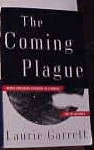
| BOOK REPORT: THE COMING PLAGUE and BETRAYAL OF TRUST by Laurie Garrett Date of Review: June 2001 Laurie Garrett has produced two massive tomes depicting the state of health worldwide in apocalyptic terms. If you manage to stagger through all 1207 pages you will receive a good fright and maybe feel a little bit sick. But take a deep breath and call The Center for Creating the Future in the morning. There are a lot of health-related matters to be dealt with as we go forward, but no reason to believe we are headed over the edge of a cliff. The premise of the first book, THE COMING PLAGUE, written in 1994, has already been pretty well undermined. We have a lot of health concerns here and around the world, but disaster has not befallen us. It is one of our basic beliefs here at The Center for Creating the Future that the doomsayers are always wrong. So far, that has held up. In the health area, we have not been devastated by Ebola or hanta viruses.There has been no plague of exotic diseases brought back from Viet Nam or the Moon. Remember Legionaires' disease and toxic shock syndrome? It is difficult to put these into perspective without seeming to be hard-hearted; people did suffer and die. But the facts are: none of these headline grabbers and others like them have been major health disasters. AIDS, the one truly massive, devastating new disease, was a known calamity well before Garrett`s book and even in that case, it is under control in the U.S. and other medically sophisticated countries. Indeed, the recent uptick in AIDS in this country is the result in over-confidence in the very real progress that has been made. The truly nightmare conditions in Africa, where AIDS can accurately be described as a major plague of devastating proportions, is at least as much a matter of political and social failure as a medical failure. Garrett`s second book, Betrayal of Trust, published in 2000, presents a matter of real concern: the world-wide decline in public heath programs. While most people would probably credit wonder drugs for our dramatically improved life span over the last century, most of the credit goes to public health efforts going back to the mid-nineteenth century: major sanitation investments, antisepsis, and vaccines. Garrett reports that these programs are being undercut in the U.S. and worldwide. While she ignores the fact that in the U.S. and other developed countries, life spans continue to lengthen, she does point out some major problem areas which are not getting sufficient attention. Much of this is due to underfunding, much of which is occurring because we want to believe our problems are solved or that individual actions are enough to protect us. Another issue Garrett brings out is the paradox that as one disease is wiped out, it creates opportunities for previously limited diseases. She also goes into much detail on the problem of the ability of bacteria and viruses to become resistant to medications. Some of this is simply the natural evolutionary process, but it is dramatically exacerbated by our eagerness to pop a Magic Bullet for every sniffle, and then to ignore the instructions to finish off the prescription and the bugs. We must learn to be more involved in our own health care; no system, public or private, mainstream or alternative, will absolve us of that responsibility. Garrett`s message is weakened by several things. For one, these books are just too damn long, a product of her ability to turn a phrase and her unwillingness to leave one out. For serious books, with a serious message, there are too many New Journalism-style subjective words and phrases. Depressed heath officials '''sigh", economies are "crushed", Ukrainian guards at Chernobyl "lazily smoked cigarettes." She also overstates her case. She really does believe we are doomed: "It may seem paradoxical to hear that there are voices of discontent--including my own--decrying the global state of public health, claiming that triumphs of our time are transient, under siege, even doomed." Garrett arrives at this gloomy conclusion by way of her politics. An unreconstructed old liberal, she seems not to want to see anything positive, much like John Kenneth Galbraith, who predicts a rerun of 1929 every time the stock markets dip or an overseas economy starts to slide. (If you doubt my characterization of her politics, she refers to the junior senator from New York as Rodham Clinton.) You're lucky you have The Center to plow through this stuff for you-- dip into them if you want, but save yourself the strain of reading the whole load. Garrett has buried a lot of hard work and some serious issues in too many words and a too-gloomy view. Remember--the doomsayers are always wrong--so far. Jack Latona The Center for Creating the Future [email protected] www.creatingthefuture.org Fort Lauderdale, FL USA |
 |
| Extract from the book Betrayal of Trust -- an example of New Journalism ["fragile, ailing"] with a largely unknown term, nosocomially. "Even in weatlhy America, hospitals had become places where many patients grewer sicker than they had been when they checked in, catching diseases on the wards. By 1997, 10 percent of all patients who spent more than one night in the average U.S. hospital acquired a nonviral infection nosocomially, carried to their fragile, ailing bodies on contaminated insturments or the hands of medical personnel." page 268 Chapter Four Footnote page 632 nosocomial = "contracted in a hospital" a more general version of iatrogenic (the disease is contracted from the treatment of a medical physican) |
| Jack Latona established the Center for Creating the Future, Inc., in 2001 as a think tank to further explore concepts about the future he had developed for a university course on The Millennium. In addition to their theoretical interest, these concepts have significant practical applications for businesses and other organizations. As a result, The Center�s web site now has two sections, one to continue theoretical discussion of the future, the other to provide information on how The Center can assist organizations to begin to create their futures now. Please CLICK HERE to go to the Center�s new web site at www.creatingthefuture.org. Click HERE for the H/Artwalk |