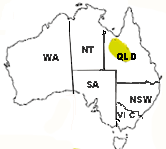
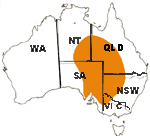
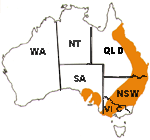
The Bearded Dragon ( all species except dwarf ) is an unusual mid sized stocky agamid lizard and has prominent spikes along it's side and a large, essentially triangle shaped head. Forming a sort of shield around the snout is a spiney jaw pouch which, when swollen, looks like a beard and makes any predator think twice before attacking. It's basic colour derive's from shades of brown, grey, and reddish-brown to bright orange. The ventral surface ranges from pale to dark grey, with white elongated spots edged with black. Mature males can reach as large as 10 inches (2 feet) in total body length, although around half of this is the tale.
Colourations vary between species and placement. Also morphs have a much wider colour range which will also soon be added.
Bearded Dragon's are omnivores this meaning that they will eat a wide range of insects such as Meal Worms, Crickets, cockroaches and pinky mice ( baby mice ). The feeding scedule usually consists of feeding the Bearded(s) twice daily with crickets letting them eat as much as they can in about 15 20 minutes taking out uneaten crickets, you can then add a dish of mealworms. Pinky mice should only be fed to full grown adults and only as a treat once or twice a month. Beardeds will also eat a variety of plant life such as brockoli, cabage, coli-flower, leak, raddish stone fruits and also leaves and flowers (It is said that you should avoid feeding spinach). Although you can get some fussy one's so it can be a game of trial and error and a good idea is to spray the vegetables and leaves with water before you give it to your lizard(s). You should feed your lizard(s) greens every day. Bearded's should also have a fresh supply of water in the coolest part of the enclosure which should be changed every day and because Bearded's are an arid animal, any water spilt should be swept up as quickly as possible, although arid creatures it is also a good idea to pray Bearded's with water every second day ( daily with babies ). Although I have noticed that spraying is a much more succesfull way of getting your Bearded to drink. With young Bearded's you must ensure that they have adequate heat after eating so as they can digest their meal, heating should be set at an overall temperature of 27 to 30 deg celcius with a basking temperature of 33 to 35 deg celcius. Also make sure that food given to babies is smaller than their head ( shorter than the width of their mouth ) if not it can lead to bad digestion and parlysis then eventualy death. Their is a vitamin/calcium called D3, which is available in pallet or powder form and is essential for good digestion and it also aids towards good bone structure. Although whith newly introduced Bearded's especially juveniles it is not uncommon for them not to eat for a couple of days. If they continue not eating after a week then you should make a liquid supplement of water and some type of Bearded pellet food and feed it to your lizard through an eye droper.
Note: During winter Beardeds may not eat as much or at all because they go into a state of hybernation although this is natural it is advised that you try and keep them in a state of semi-hybernation by moving them under the heat lamp for an hour or so each day. This is because, while hybernating Beardeds become highly susceptible to disease and parasites.
Also note that it is easy to breed Mealworms and Crickets at home, with Mealworms all you need is a large bucket or container filled with oats, then put in a large container of Mealworms and add some fruit or vegetables each week. Crickets will need a sealed enclosure with grass and, paper or egg cartons on the bottom then put in about 50 Crickets and feed them carrots, apples oranges and oats etc, they also feed on dry dog and cat food. Spraying the food for the crickets with is a good way of providing water because crickets will usually drown if supplied with a water bowl. Keeping the containers for these insects along with your lizard enclosure free of mold/fungie because it makes the lizard(s) very ill if swallowed
An adult Bearded needs an enclosure of around 3ft in length and 2ft high. The enclosure should also have addequate heating/lighting fitted, ussualy consisting of a 100 to 150watt (depending on enclosure) heat lamp such as an infa-red or ceramic lamp, then you will need a 80 to 100 watt basking lamp which you can buy from your pet shop or you can buy a house spot light from any hardware store (I have found these to be just as good and a lot longer lasting) then you will need a UV-B light which are available in bulbs or tubes. UV-B lights are essential as they give the lizard calcium/vitamin D3 naturaly provided by the sun although you don't have to have one if you are adding the supplement to your lizard(s) diet although it is recommended that you do get one (this light should not be placed over glass as the UV-B ray will not penetrate). Also I reccomend an electronic thermometer which hooks up to the heat and basking lamps switching them on and off to regulate the temperature, which should be set at 25 to 33 deg celcius overall with a basking temperature of 35 to 38 deg celcius. All lights except the heat lamps (the infa red or ceramic bulb) should be swiched off at around 6:00pm till 7:00am alowing them to sleep either switch them on and off yourself or buy a timer. Unconcistant lighting hours will harm the lizard(s) making them tired and unhappy.
Note: There should be an area away from the basking and heat lamps so as the lizard(s) can regulate the(re) temperature.
Bearded's like to climb so you need to have some branche's postioned so as they can do so. They also like to have places to hide (Although hidding places are not recommended during the first few months of hatchlings ) supply things such as hollow logs and rock caves, this is a special part of constructing your substrait because if a Bearded doesn't have some were comfortable to hide and sleep it gets stressed which can give them a lack of immunity towards parasites, so once you have your Bearded(s) in the enclosure make regular checks to see if it or they are sleeping in the places you have provided. If not move your substrate around trying to have it so as that all lizards are finding an under cover area to sleep in (Note: wait about 2 weeks so as the liazrd(s) get used to the enclosure ). Good things for the floor of your enclosure are paper which can be ugly but cheap, effective and easy to clean. You also have gravel or stones which looks good and is also easy to clean but a problem is that the food such as crickets and cockroaches get into the gaps in the rocks and most of the time dying there, this being a waste of food for the lizard(s) and a waste of money for you. Another problem being mostly with juveniles is that they miss their prey and swallow the rocks instead which causes them to choke. My prefered option is sand, although not as easy to clean it looks great and your lizard food isn't dying at the bottom of it. You can buy sand from your pet shop which will usualy be a high quality high grain very smooth sand but it is also rather expensive, so an alternative is buildersand or play sand which can be bought from a nursery it is a lot cheaper and it looks just as good.(Remember to break up any large clumps as the juveniles can choke on them also)
I have red arcticles were people have said that sand is not a good idea because if it is eaten it can cut the lizards insides. I disagree with this because I use sand and have not had a single problem. You must also remeber that in the wild, the vast majority of Bearded Dragons live in dusty to sandy areas. Althoug in the wild the ground is only covered by a shallow layer of dust or sand. This easy to immitate in your enclosure by simply wetting the sand so as it is moist not drenched then wait for it to dry. The top will be a dusty sort of layer with the bottom being hard although still soft enough for them to dig.
As far as I know the only health risk's to Bearded's are mights which can be removed easily and take a very long time to afect the lizard(s) badly. The treatment is easy just go to your pet shop and get lice spray in Australia you will need to buy bird mite and lice spray because of chemical import restrictions. When treating, spray the lizard(s) all over the body except for the head leave for about a minute then wash off with water. Another problem can be partial paralysis (of the back legs) due to the food being to big or bad dygestion which can be caused thru not having a suitable basking lamp for heating or the lizard(s) not being provided with enough vitamin calcium D3. Also keep the enclosure of your bearded(s) and the enclosure of any insects bred as food free of mold/fungie. Mold/fungie can make Beardeds very sick if digested. It is a good idea to keep your Bearded's stress to a minimum this can be accomplished by taking all uneaten live food out of the enclosure after feedings. Sleeping spots such as hollowed logs or rock caves. Also with newly introduced Bearded's it is recommended that they are not handled for around two weeks so as that they can get used to the environment. if you can do so, especialy with juvenile Bearded's put them in an enclosure by themselves unless of course you have a group of baby's.
Note: I am still researching so if anyone has any information please E-mail it to me at [email protected] thank you.
|