|
|
 |
 |
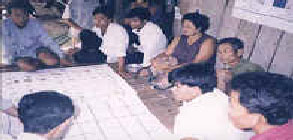
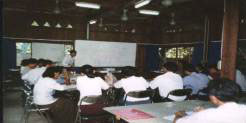
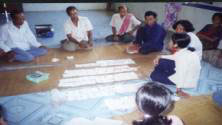
CRD research activities
CRD Training activities
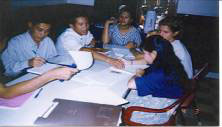
Research
design
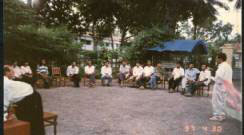
Theory session
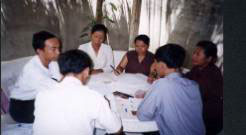
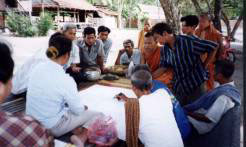
Group
interview
Small group discussion
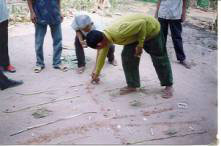
Participatory research
action
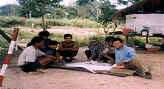
Field practice
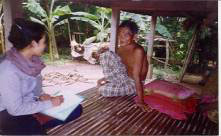
Individual
interview
Closing session
CONTENTS
PART 1: NARRATIVE
|
From the Chairman of the Board ………………………………….
5 Introduction ………………………………………………………….. 6 Personnel ……………………………………………………………. 10 Board of Trustees ………………………………………………… 13 Cambodia and CRD ………………………………………………… 14 Charter & Policies ………………………………………………… 16 About Cooperation ………………………………………………….. 18 |
FROM GROUP TO LOCAL NGO,
a historical overview
|
The Start, Challenge & Crisis ……………………………………… 20 The Transition ……………………………………………………… 21 The Ambition & Future ……………………………………………. 22 |
FROM THE CHAIRMAN OF THE BOARD
|
A period of six years have passed since the first activity of a small group of researchers resulted in what is today the research and training organization Cambodian Researchers for Development. It is now an organization directed, managed and staffed exclusively by and with Cambodians who are born in the country. Like many other non-governmental organizations an outsider initiated CRD. I was that outsider and I am proud to have been able to raise this child. But if I not had taken the initiative, someone else would surely have done it. In 1994, just after the UN-brokered national elections, there was a boom in the development activities and a demand for project-related studies and surveys but no locally based organization with the capacity to do this.
|
INTRODUCTION
|
THE AIMS For several reasons, one being too busy working for other organizations, another one being never being asked for it, the NGO Cambodian Researchers for Development has never before prepared a report about all its activities. As part of a two-year advisory assignment, sponsored by ICCO Netherlands, the former director was tasked to transfer analyzing and writing skills to the professional staff. What is a better opportunity to learn this than by writing about oneself? Therefore, it was decided that part of the advisor’s time would be used to assist the staff of CRD with writing contributions for an annual report. Because of the lack of prior annual reports |
|
The 1995 - 2000 report is thus a team product and a farewell present from the founder. The aim is first to inform the clients, trainees and sponsors about the organization, its philosophy, strategies and structure, and what CRD has to offer in the future. The aim is secondly to document what has been achieved in these six years.
THE REPORT
To facilitate easy reading the report is organized as follows. The first pages offer an introduction of the organization, its history, policies and major achievements. The following section is a narrative about the five years of CRD’s existence. In this narrative are very short stories, messages or pictures inserted from present and former staff. In part 2 is presented detailed information about the agency and its special programs, about the finances and outputs, and about its staffing and personnel policies prepared by staff from the various units or projects.
THE NON-GOVERNMENTAL ORGANIZATION
|
|
This report is about a very special kind of development NGO, a non-governmental organization that provide services to other development organizations, from abroad, in the country or with the government. The services are mainly social studies for |
|
policy-making purposes, situation studies for development projects or programs, surveys of target groups, evaluation of development projects or programs and training of project staff on data collection and monitoring & evaluation methods and skills |
|
To a limited extend CRD facilitates strategy workshops or contributes to discussion sessions or conferences. The focus of all these services is aimed at transfer of skills while guaranteeing a high professional standard, and oriented towards participatory and target group-level approaches.
The NGO began its activities in April 1994 with an assignment for Save the Children Fund (UK), for AICF and CARE International: - a situation study about children, a survey of water usage and a course on monitoring & evaluation. These three kinds of work have set the trend for CRD's future jobs: social studies, project surveys and project staff training. However, during the year 1994 CRD did not yet exist as a NGO. November 1994 a large research and training program was commissioned to CRD that required that the informal organization applied for the status of a local NGO. December 1994 such an application was submitted to the Council of Ministers.
GOVERNMENT RECOGNITION
| Although the large study on Women in Socio-Economic Transition (see below) was the immediate reason to form a NGO and become legitimate, it was no advantage being a NGO. Or better said it didn't matter, reason not to worry when the government nullified all prior registrations that had not passed the Ministry of Interior. CRD re-applied in 1997 with this ministry but was rejected on the grounds of having a foreigner heading the organization (despite that no law required | that a Cambodian should be head!). In November 1997 the foreign founder and director handed over his directorship to his Cambodian deputy and a new application was submitted to the MOI. After more than two years and despite the proper submission of all required documents and a Letter of Support from the Ministry for Rural Development the Ministry has not yet registered CRD as a local NGO. Renewed efforts to get a formal registration are progressing but need support. |
ORGANIZATIONAL STRUCTURE
Cambodian Researchers for Development is organized like many other NGOs, with a Management Team, a Director and a Board and functions like a company. However, the organization is a non-profit agency. This was decided at the start and was re-confirmed during a Staff meeting in 1997 before the handing over of the directorship to the new management. The Director is in charge of the operation of the organization and personnel affairs, but decisions regarding policy and recruitment require the support of the Management Team, consisting of the heads of sections and projects. The Board of Trustees (BOT) is an appointed body with 7 members serving for several years. New members are selected by the BOT from among persons nominated by Trustees or CRD's staff.
Current Organigram of CRD
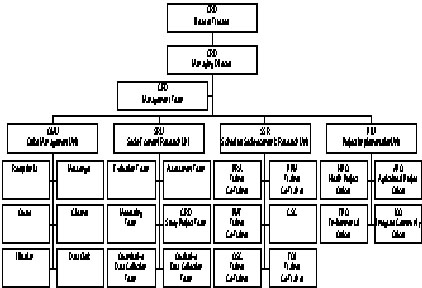
The function of the BOT is to secure the agency's proper direction and functioning according to the Charter, to approve amendments in Charter and Policies, to appoint or dismiss the Director, to approve the annual budget, to mediate in case of internal conflicts and to support the NGO through networking and capacity building. It is not the role of the BOT to take initiatives, to check expenditures or to become involved in the daily operations.
CRD aims to conduct studies and training in a professional and sustainable manner. This requires not only adequate skills and attitudes, but also a sound business mentality. From its inception the NGO has generated all its funds through fees for services and courses. Although some times were not easy this has created among the staff an independent mentality and a business eye for the NGO's future.
SPECIAL PROGRAMS
Women in Socio-Economic Transition
The program 'Cambodian Women in Socio-Economic Transition' aimed to assess the situation of women in socio-cultural and economic terms in the period of transition from a planned to a free economy through a learning process. The study was administered and coordinated by CRD and executed by two NGOs and two government agencies.
The Secretariat of State for Women's Affairs conducted a study on women's rural economy and one on attitudes towards women leaders, the Maternal and Child Health Institute of the Ministry of Health studied birth spacing practices, Khmer Women's Voice Centre surveyed child raising practices and Cambodian Researchers for Development conducted a study on women and migration. The umbrella research project has been funded by UNFPA, UNICEF, the Dutch Government, The Asia Foundation and IDRC.
CRDs task was to coordinate the individual studies and to provide methodological training and support. The successful presentation of their work by four female researchers in Beying at the Fourth Women's Conference and a widely distributed overall report completed mid 1996 this program.
Local Participation in Democracy and Development
| Late 1995 researchers from CRD began a research in project area in Takeo province to follow closely the democratization processes of reforestation activities implemented through MCC. Soon this project was extended to a district in Kampong Speu were ZOA had started with a community development program for former displaced persons, and to a district in Kandal province to review the participation of farmers in a fish-pond income generating project implemented by government staff. One year later a fourth study area was added in a district in Prey Veng to follow the development of grassroots democracy in a dry season rice irrigation area. |
|
|
The formal Agreement |
Continue
| academic manner. GESEAS had similar agreements with institutions in Indonesia and Malaysia and with this involvement CRD staff became focussed on a presentation of people’s democracy in a regional context. This project became part of the overall program on democracy whereby data collected in the four mentioned areas were used to illustrate the state of democracy in the country. Several researchers from outside CRD were invited to contribute to this regional study using the findings of the program or implementing their own studies facilitated through CRD and with CRD staff. This combination of activities and sources has resulted in a series of project | reports, presentations at four workshops in the Asian region and two conferences in Europe, and the imminent publication of several books. In 1999 the Swedish agreement was extended with another three year study period, but now with a focus on globalization processes. At the same time the data collection in the four grassroots areas was concluded although the analysis of the mass of data will require several more years. At present the program consist only of the latter project on Globalization and from year 2000 onwards no further activities in the framework of the overall program are planned. |
Social Science Methods
From May 1995 till February 1996 an innovative series of courses was offered for senior project and government staff on topics related to data collection and analysis of social phenomena. Experienced lecturers, mostly from abroad, taught during one-week sessions about such issues as Participatory Rural Appraisal, Development Issues, Gender Approaches etc. A total of 25 participants completed the full course.
|
Program |
Participants |
|
|
Development Issues |
Ministry of Education |
This series of courses was the second training activity of CRD; the first was a 3-week training for 20 participants of the Women in Socio-Economic Transition research on data collection methods and techniques. Both these activities have opened the way for a more systematic training approach. Starting with separate courses on project monitoring and evaluation (PME), participatory rural appraisal (PRA), questionnaire and baseline survey courses all these and new developed courses were integrated in a new program starting mid 1997: The School for Social Research. This School has taught over 500 participants social science data collection techniques in its new constructed school building with a grant from the Dutch government and offers a comprehensive program of field-oriented project monitoring courses. Till recently most of the participants were staff of international NGOs but from year 2000 onwards the School offers under an ICCO grant a reduction of the course fees up to 75% for local NGOs fees that might result in a shift to this group.
Workshop on Social Research |
PERSONNEL
THE START
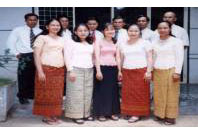
Over the years the staffing has fluctuated between 3 and as many as 25 persons, with currently 11 nationals full-time employed, headed by Mr. Ly Sareoun. Two more Cambodians holding a Ph.D. are half-time employed in senior positions. The gender balance is 6 women and 8 men, with 3 women and 4 men in leadership positions. Of the 14 staff 8 persons are professionals, 2 for administration and 4 for support and household. Among the 8 professionals 6 staff are able to work independently as project or team leader. This achievement came not without problems. It started April 1994.
| When end March 1994 the Assistance to Vulnerable Groups project of the UN World Food Programme was terminated after three year, most of the project staff left WFP, including the project manager. He commenced with a study about the situation of children in Kratie province for Save the Children Fund (UK) and assigned two of his former WFP staff as Research Assistants. Two more former co-workers were hired for a few weeks during the water use survey in Kratie province. These 5 people, 2 man and 3 women were the core of what later would become the NGO named Cambodian Researchers for Development. |
John Vijghen |
The commission of the large study program ‘Women in Socio-Economic Transition’ in October 1994 that initiated the formation of the NGO the organization required additional personnel. The agency’s name Cambodian Researchers for Development with the acronym CRD was chosen to emphasize that it were Cambodians who would conduct the research for the policy-makers of development projects. The new NGO soon expanded its staff not only with the two former WFP co-workers Ms. Sdeoun Van Youthea and Ms. Srey Neang, but also with several new staff. However, the five first workers knew each other well from before and functioned as a core team that gave consistence to CRD; both Ly Sareoun who is now Director and Sdeoun Van Youthea who is a team Leader are still with the agency.
|
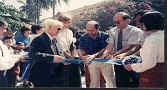
Shared Decision-making: New Deputy Directors |
The new staff included an expatriate Khmer, Ms. Cheng Nivana and Ms. Claire Escoffier from France. Claire was like the founder John Vijghen a trained Anthropologist. She, assisted by Nivana, was put in charge of the study on working women and the methodological on-the-job training of the large study program ‘Women in Socio-Economic Transition’. Ly Sareoun and Cheng Nivana assumed about a year later the position of Deputy Director, respectively for Research & Training and for Administration & Human Resource Development. |
THE GROW SPURT
After one-year existence as a NGO, the agency’s staff had grown from five to some 25 persons, not including the housekeeping people. 1995 was the year of growth and expansion, not only for CRD but for many other development projects and organizations in the country. A large UNDP sponsored project to research the democratization of the Cambodian society was commissioned to the three research institutes existing in Cambodia at that time. CRD was tasked to conduct the field work while the two other organizations would process the data and organize presentations. Six more staff were recruited and entered an internal training program. The Staff had reached its largest size, 25 persons, including 3 employed foreigners but exclusive 2 foreign students.
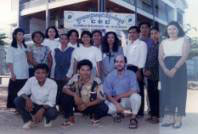
CRD’s staff: 1995 |
This grow spurt came abruptly to an end after the UNDP project was rejected by the two Prime-Ministers. Obviously they regarded the ambitious project a potential threat as it could reveal the poor state of the democratization in the country. Because contracts were already signed (although not yet ratified by UNDP NY headquarters) and ‘green light’ was given to CRD to recruit and train project staff the cancellation was not only unfortunate, but threatened CRD’s existence. |
Anticipated funds were not available and CRD could not continue the employment of the for the project recruited and trained staff, and the financial loss required a further release of staff. Fortunately, no one needed to be fired, but with the active help of CRD several staff found other suitable employment and resigned. In March 1996 the staff had decreased to some 14 persons.
GENDER & DISABILITY
| Since that time no abrupt changes in staffing have occurred, gradually grow returned and while some people found elsewhere better opportunities and left, new staff replaced them or filled new positions. The current size of about 12persons seems adequate, manageable | One young lady who had suffered polio when she was a child worked for a long time as receptionist. She left for a better job elsewhere. Another physically disabled young man was added to the field team. That was an experiment because he lacked both his legs. |
| and sustainable. It is CRD’s pride to have always been able to recruit and retain female staff, also for senior functions, as reflected in the current gender balance: 6 women and 8 men. It was and still is CRD’s policy to encourage the employment of disabled people. | Except in some situations were he had problems, such as wading through high water, his work did not hamper from his handicap. Unfortunately his handicap influenced his attitude towards CRD’s respondents and trainees negatively and his one-year contract could not be prolonged. |
FOREIGNERS & NATIONALS
From the start of the NGO, as the name proves, it was the intention that foreigners only would join the staff on a temporary basis till Cambodians with similar skills and capacities could be assigned. This included the directorship, and after a learning period of 3 years the co-founder Mr. Ly Sareoun took charge in November 1997. However, it was still a heavy task to run a professional research and training organization, keep the quality high and generate for 100% its income. Fortunately, under a grant of a Dutch sponsor the former Director was able in part-time to assist Director and Management when and were needed till December 1999.
| Finances and administration were always a weak aspect of CRD. The Deputy-Director put in charge of Administration & Human Resource Development resigned after one year for personal reasons. Although she had made a good start CRD did not manage to find a national replacement with sufficient skills. It was therefore very fortunate that VSO responded favorably to a request for a Volunteer to set-up financial and administrative systems and train local staff to maintain these. Carole joined CRD in January 1999 and continued her assistance till April 2000. Although the financial expertise among CRD staff still needs improvement the Management Committee decided that it is time to do it without foreign assistance. Indeed after a period of five years support from foreigners has now completely ceased and CRD is doing fine without. This is the best compliment Carole, John and Claire could get. |
VSO’r: |
| After a hand-over period of two years Director and Staff are fully in charge of and responsible for the operation of CRD, with guidance from the partly renewed and fully ‘manned’ Board of Trustees. Fortunately cash-flow irregularities are a thing of the past with an ICCO business grant. Another grant aimed at reducing the training fees for staff from local NGOs guarantees enough participants for the program of the School for Social Research. Although this lessens the burden of those now responsible for income generation and paying the bills, the poor economic situation in the country | and the subsidized rates of some other institutes make it not easy to sustain, but CRD’s staff took the chance to mature and has obviously made the best of it | |
|
BOARD OF TRUSTEES
The Board of Trustees (BOT) has a history of its own. October 1994 a Board of 6 persons, 3 nationals and 3 foreigners was formed to guide and assist the new agency. Each Trustee was selected because of his/her ability to promote CRD among international NGOs and UN agencies, and in the Government. However, the sixth Trustee, an academic from the Phnom Penh University, never showed up. The five remaining Trustees were very active during the first two years, they helped finding work and supported the capacity building. In one case in particular they played a crucial role to solve a serious conflict. One foreign intern circulated rumors that the management misused funds and that her counterpart staff was inadequate for the job. This caused much unrest among staff and donors alike. The BOT investigated the matter, arranged for a financial audit, and found no proof for financial mismanagement. Also, the Board concluded that the intern lacked cultural and technical qualifications and not the Cambodian staff who worked with her.
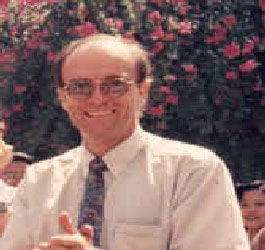 Chairman BOT, Dr. Vincent Faveau, Director of UNFPA, in action (1995) |
Two foreign Trustees left the country in 1997 and in that turbulent period the BOT was not able to attract suitable replacements. The matter of new Trustees was put on the backfire and the BOT remained less active during 1998. Early 1999 two new Trustees were found, but the two national Trustees felt that after 5 years they should leave the Board. Fortunately, replacements were found and from May 2000 onwards the BOT will again function as intended. The Board exist now of 3 nationals and 3 foreigners, among them 3 women, and they represent the UN, local and international NGOs. John Vijghen will chair the Board during the year 2000 but after that year the chair will rotate annually among the Trustees. |
About Role of Trustees (from the amended Charter)
The BOT shall examine and validate all matters of policy,
annual workplan and budget.
The qualified Director shall be nominated by the BOT.
The BOT may replace the Director in case of serious professional mistakes.
The BOT shall appoint advisors.
CAMBODIA & CRD
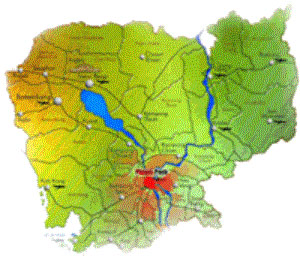
| THE LAND OF THE SUGAR PALM ‘Until you run out of sugar palm trees you are in our land’. It is said with a smile and a warning: ‘do not touch our land’. Kampuchea (pronounced kampucha) or the kingdom of Cambodia is inhabited with smiling people who at times in their history have turned ruthlessly against invaders and their own countrymen. It is the country known in the world for the genocide by Pol Pot who caused the death of a quarter of the population. It is also the country which was brought into the realm of democratic nations by a tremendous effort of the world community; one of the successes of the United Nations. Some called it an experiment in democracy till July 1997 when the second Prime Minister took power by force and ousted his rival first Prime Minister. It is in this country that another experiment took place that is still ongoing. The creation of an independent Social Science Institute in a country which has never experienced a social science academic tradition, where there is not yet an advanced social science program, and which social structures are based upon political alliances or patronage, didn’t happen overnight or without problems. However, after five years a flourishing agency exists. CAMBODIAN RESEARCHERS FOR DEVELOPMENT While the United Nations Transitional Authority of Cambodia prepared the nation for general elections and thousands of foreign electoral officers introduced the concepts of democracy to a once fatalistic population the idea was born to introduce the concept of studying one’s own society. The general elections were a success, the majority of the population voted for a democratic |
alternative. Immediately after the elections the losers, the former communist party, refused to relinquish power and manipulated the world powers into accepting a ‘government of national reconciliation’ which kept the former power structure largely intact. Lack of insight in the social system and a limited understanding of the social processes have contributed to this abandonment of a tough stance by the world community. At the time no Cambodian researchers existed to provide such insight and understanding. Some foreign scholars warned for this outcome - the present political situation and power structure is almost like before the elections - but they were not listened to. The study of the Cambodian society had yet to begin. One year after the general elections a research group was founded with the aim to study the society and the processes of development in terms of poverty alleviation and participation in decision making on all levels. Although the assistance of foreign scholars would be needed to introduce proper social research methodologies the aim was to develop such skills and capacities among nationals. The research group was formed into a Non-Governmental Organization, not associated to any government agency or the national university. The latter lacked any social department but was anyway under the patronage of political figures. The name chosen for the organization ‘Cambodian Researchers for Development’ symbolizes both the advancement of the national capacity and the development of the society. A national folk theme animal, the rabbit as the seeker of truth, was selected to figure in the agency’s vignette. Effective from January 1995 the NGO Cambodian Researchers for Development was created. |
Continue
|
Cambodia’s major social problem concerns its distribution of resources and the limited freedom to participate in social and political decision making. Due to the increasing gap between the rich and the poor more and more children don’t get sufficient food or adequate education. Women constituting more that half of the population are virtually not represented in the public realm, which is culturally the domain of men. Although women keep the household budget, a significant proportion of men demanding money for gambling, drinking with friends and visiting prostitutes use violence, leaving their women not only with the physical suffering but also with the burden to feed the children. Women may also suffer most from the traumatic events eighties in remote parts of the country; they lost love-ones and had to feed and protect their children during those terrible times. CRD has initiated and executed such studies, some still continue, some on-hold pending further funding. One must realize that during three generations or thirty years virtually no field studies could be conducted about the Cambodian society and population. Cambodia is still a white spot on the social science map. Researchers from CRD aim to fill these white spots to increase knowledge and understanding. The Coup de Force On 5th July 1997 fighting broke out between rival forces of both major political parties. The Pritikar (the Event) as Cambodians call the ‘coup which was no coup d’Etat’ was a turning point on the way to democracy. Tension was strong between both sides for years and there were few who believed in a peaceful solution. But the former communist party took back what it lost |
during the general elections with unexpected rigor and violence. Democracy got a blow but there are many aspects of democracy. Researchers from CRD study since more than four years local participation and democracy in affairs of rural communities. Evidence starts to emerge that the concept of democracy in its basic principle has taken root. The results are still weak and further research is needed and goes on despite the political conditions, but there shines a light at the end of the tunnel. It are Cambodian researchers who help their countrymen to find the way out of the darkness. Who are these men and women who started from nothing and created an Institute which completed studies on topics ranging from Water Use Practices to Village Decision Making, Children’s Situation, Migration of Rural Women, NGO Cooperation, Village Development Committees and Women in Leadership Positions; who enabled the publication of more than 30 reports and papers; and who continued to conduct field work on democracy issues while fighting was going on? National Researchers Their names are less important, their nationality is. All are Cambodians who remained with their people in times of conflict and hunger. This group of researchers, academics and non-formal educated field researchers alike, are the backbone for the Kingdom’s emerging young research core who wish to study their own society in order to further its development. (longer version published in April 1999 in the IIAS Newsletter publication of the International Institute for Asian Studies) |
CHARTER & POLICIES
CHARTER
The Charter describes CRD as a non-governmental and non-profit making organization with the aim to further the cause of social science in Cambodia done by nationals. The original model for CRD’s Charter was taken from another agency and is not much different from charters of other NGOs. The Staff of CRD has reviewed the Charter during 1999 and proposed changes in secondary articles to adjust the Charter to the present situation and conditions. The Board of Trustees will in its next meeting discuss this matter. The main article of the Charter is listed in brief below:
| 1. | The purpose is to develop the capacity and human resources in the domain of the social sciences through the training of researchers; |
| 2. | The purpose is the collection and collation of data for policy and scientific purposes and assistance to grassroots organizations; |
| 3. | The purpose is to create networks with researchers and research organizations in Cambodia and abroad. |
POLICY DEVELOPMENT
CRD’s policies were developed as on outcome of the daily functioning, e.g. Per Diem rates or work methods, and the result of strategy meetings with Management Team and Staff. Most of CRD’s operational or work policies were never regarded as written in stone and when appropriate management made changes. Because of some turbulent periods and a few crises operational policy-making tended till mid 1997 more to follow than to precede events. In order to facilitate the hand-over of the directorship a more systematic policy-making process was needed. A Management Team was formed and at annual Strategy Workshops existing policies were reviewed and when appropriate new policies proposed.
However, it is the main policy that measures that affect the basics of the organization, e.g. CRD’s Non-Governmental Organization or Non-for-Profit character or the philosophy of the work, e.g. CRD’s service and training orientation, should not be changed unless necessary for the proper operation and survival of CRD. In such a case ample discussion among Staff and a final approval by the Board of Trustees is required before such policies can be amended.
MAIN POLICIES
Despite CRD’s expertise in monitoring and evaluation methods and techniques and its general recommendation to other organizations to document the process of policy making it must be acknowledged that CRD itself is lacking a sophisticated system of documentation. One of the aims of this Jubilee Report is to document what happened.
The basic policies of CRD can be categorized as follows:
| · | Operational policies: e.g. management procedures, work methods, running office; Manuals are developed for the various components: |
| 1. | Projects - Project Management Manual; |
| 2 | Training - School for Social Research files; |
| 3. | Office, Housekeeping, Vehicle and Library - Office Manual; |
| 4. | Contracts and Commitments - Agreement Manual & Consultant Rate Scale. |
| · | Personnel policies: e.g. recruitment, promotion, salaries, benefits, training; the Personnel Manual is the document used for recruitment, promotion, termination, salaries, benefits and ‘pension fund’. |
| · | Financial policies: e.g. per diems, consultant rates, financial responsibilities; Manuals are developed or special agreements exist for the various components: 1. Consultant rates - Staff Assignment Policy; 2. Per Diem - Contracts and Budgets; 3. Budgets and Accounts - Financial Manual and Grant Agreements. |
| · | Policies on type and kind of work: CRD is committed to carry out the following activities but is not limited to these: 1. Social studies to increase understanding of processes in the society; 2. Project evaluation and collects data aimed at development of the society; 3. Courses on data collection, M&E and other project-field oriented training; 4. Commissioned work for international and local organizations or governments. |
No activities that will have adverse affects on the population or on the development of the society will be carried out by CRD or its staff. The implementation of these works are guided by the principles of quality, relevance and appropriateness as defined in Strategy Workshop minutes and Discussion Papers.
Excerpts of Minutes of Strategy Workshop Sihanoukville 2000
|
Vision of CRD: To be well known with a best service institute with quality, sustainability, independent, and leading toward by its confident, popularity throughout the country and abroad. Goal of CRD: The goal is to increase the capacity of the Cambodians in socio-economic research, training and community development. The Institute is adhering to its goal related to the development activity. Though its main objectives of project implementation, socio-economic research and methodological training services. Contract-research activities have been commissioned by clients, such as the Asian Development Bank, the World Bank, CARE International, ZOA Refugee Care Netherlands, Canadian Center for International Study, UN agencies and other local & international organizations. Within quality outputs, plus positive effects and impact CRD has evolved with the new initiative of a long-term project implementation program. CRD tries with increasing success to collaborate with the core-funding agencies and aims in the long run at an affiliation with or integration in the Cambodian project implementation NGO sector without abandoning its commitment to NGO-related development work. |
Strategy of CRD: Wherever possible, cooperation is sought with international and local organizations, internal and external firms, donors, government institutions, UN agencies and universities. CRD also seeks the collaboration with other relevant institutes and universities abroad to strengthen its activities, working in the participatory approach to reach its goal and objectives. Future of CRD: The original situation in which CRD carried out studies and training on an ad-hoc basis, due to its reliance on commissioned research and training requests, has gradually changed into a more programmatic orientation. Training courses are becoming more focused on a holistic-methodological approach, while remaining strongly field- and development or applied oriented. In the field of training one outcome of this re-orientation is the project ''School for Social Research'', which aims to provide training to development project staff in a more regular study program and with advancing course levels. An outcome in the field of research is that studies are carried out more in the framework of the program '' Socio-economic research'' with an increasing emphasis on local participation in project activities and capacity building. This plan aims through a longitudinal approach and collaboration with other institutes to gain more comprehensive insight in the effects and impact of development intervention in Cambodia. In summary, CRD's aim in the future will be to attract more commissioned studies, evaluations, training courses and implementation its activities which will feed into its program. Other contract-research will remain possible in so far as it is development oriented and contributes not only to the financial subsistence but also to further institutional building in terms of staff capacity development and experience increase. |
ABOUT COOPERATION
NATIONAL
CRD is a research and training NGO with institutional aspirations. At its conception efforts were made to link the
organization with the Cambodian academic community. At some time an association with the University of Phnom Penh was considered but due to the
politicized nature of the university this could not be realized. However, on an individual level CRD has maintained good relations with academics and sometimes conducted lectures for university students.
|
At another occasion some years later CRD and the Cambodian Development and Resource Institute discussed the feasibility to merge CRD in the larger CDRI to become the research component. Although the leadership was interested CRD’s staff were reluctant and afraid to be absorbed by its bigger brother, while CDRI did not offer guarantees for a kind of autonomy. In good spirit both agencies decided to go each their own way. In 1996 the director of CRD took the initiative to call organizations involved in research activities together to form the Research Forum. This initiative was supported by a number of sponsor |
agencies and the International Development and Research Agency of Canada hosted the Forum for some time. During the first 5 monthly meetings CRD chaired the Research Forum, after which another organization took over. Virtually all organizations involved with social research took part till the political disturbances of 1997 and all activities came to a stand still. Unfortunately no one tried to resurrect the Research Forum after 1997. In 1999 CRD was one of the most active organizers of the conference on the Meaning of Cambodia. The efforts of CRD have contributed much to the success of the conference. |
INTERNATIONAL
On an international level CRD has also kept its doors wide open. Several graduates from western universities have completed their studies through CRD. Other researchers have made use of CRD’s field staff and its experience to conduct studies and surveys. It is unfortunate that a few such foreign academics did never share their study results with CRD or the Cambodian society. This has made CRD’s staff reluctant to associate with researchers from abroad. This is not the case with researchers of the Gothenburg University in Sweden. In 1996 an agreement was reached between the Gothenburg East and Southeast Asian Studies
Center and CRD to conduct a long-term social study on democratization processes. This study was also conducted in Indonesia and Malaysia and it offered researchers of CRD the opportunity to meet with the regional and Swedish academics during bi-annual workshops. This project was in 1999 extended with another 3 years.
CRD has quite often and is currently still conducting commissioned assignments for the Asian Development Bank and the World Bank directly or through sub-contracts. This relationship proved to be beneficial for all parties involved. Currently CRD is the witness organization selected by the World Bank to work together with the Royal Government for the resettlement and compensation of people affected by a road project. This project will reconstruct the National Roads no. 6 from Kampong Kdai to Siem Reap, and National Road no. 3 from Kampot province to National Road no. 4.
ICCO
One relationship that deserves special attention is with the Dutch donor organization
ICCO. The sponsor started in 1997 to fund the advisory activities of the Founder and continued during 1998 and 1999 to sponsor the CRD Staff Development Plan. Although this financial support was no core-funding it has made possible the transition from expatriate managed agency to a local NGO. It was not only the financial support but also the encouragement to focus on self-reliance, autonomy and sustainability that has
realized the LNGO.
| CRD was always and is still proud to have generated its own income through commissioned work and training fees. However, it is for a local NGO difficult to find financial resources and ICCO has facilitated the start as fully grown local NGO with a business grant to cover liquidity fluctuations and a scholarship grant to subsidize training fees for staff of other local NGOs. With this back-up CRD went with confidence into the next millennium. |  |
Northwest Relationship
Were others are talking about South-West relationships CRD has established a new relationship with a group of local NGOs in the northwest of the country. This cooperation is still young but seems very fruitful for both sides. CRD will gain access to a new area and new requirements for training and support; the local NGOs will benefit from CRDs expertise and built their capacity in the field of project monitoring and development in a more systematic and profession manner.
FROM GROUP TO LOCAL NGO,
a historical overview
THE START
Cambodian Researchers for Development was conceived during the aftermath of the turbulent UN-peace keeping operation and UN-brokered national elections (1992-1993). First it was a single initiative to conduct a social study, but soon it became a more complex and ambitious program of training, capacity building and data collection. These three aspects remained the core of the organization throughout the following years. Four projects come in mind that had set the direction for the future. The sponsors of these activities are also an illustration of the diversity CRD stands for:
| · | CHILDREN IN FOCUS (Child-centered study commissioned by SCF(UK) 1994) |
| · | CAMBODIAN WOMEN IN SOCIO-ECONOMIC TRANSITION (five studies coordinated by CRD resulting in presentations at the 4th Women’s Conference in China and a report of four of these studies, funded by UNFPA, Dutch, UNICEF). |
| · | WATER USE PRACTICES (small survey commissioned by CARE Int. 1994) |
| · | SOCIAL RESEARCH METHODS (a series of courses from May ‘95 till Feb. ‘96) |
|
Observations: The situation in the country is not good. Children do not get good education. Men do not get steady jobs. Women are illiterate. We must help. |
THE CHALLENGE
Begun as an enterprise to offer consultant services and confronted with a high demand for these services CRD’s core staff re-thought the purpose of the organization. At the end of 1994 a conscious decision was made, initiated by the management but fully supported by all staff, to become a non-governmental and non-for-profit organization. At the same time it was clear that the business orientation and commercial strategies to generate income through services should continue and that CRD not should depend on donations. This was a challenge met throughout the entire existence of the organization with varying success, but overall CRD did achieve this objective. This was proven by the fact that salaries always were paid and on time, except occasionally the Director’s salary. The ‘philosophy’ of earning one’s own income through fees has inspired a mentality of efficiency and independence one not often find among NGOs. But this independence nature carries also risks and CRD staff has learned the hard way how best to cope with such risks.
My idea is that research is a tool for development. Without data you can not evaluate. If we not evaluate we can not see how problems change.
THE CRISIS
One good example of such coping strategy is the 1996/97 Crisis. As often is the case this crisis was an accumulation of a series of events that each on its own would have been a problem but not would result in a life-threatening situation. Three factors were at the basis of the crisis: 1. The last-minute cancellation of a large project; 2. heavy commitments in salaries and housing rents; and 3. An expatriate intern who could not communicate with the staff and accused the management of misuse of funds. The last issue was the direct cause for the crisis. Christmas 1996 was not an event that the founder/director remembers as a peaceful time. It was during his holiday abroad that the Chairman of the Board called and informed him about the problems. Staff refused to work further with an expatriate intern who was in charge of a small research project and about accusations by this intern that donor grants were not used properly. The director canceled his holiday and returned to face the problem and order a financial audit. However, awaiting the outcome of this audit sponsors froze their funds while at the same time negotiations were ongoing with UNDP for compensation of the initial work for the canceled project.
Money was short, new assigned staff entitled to resettlement payment, the owner of the premises raised the rent with 100%, funds and new work on hold – it was a desolate situation. Fortunately, with the active help of the Board members and full support from staff, and a positive result of the audit clearing the management of all blame, the situation was reversed after several months. It took the organization more than a year to fully recover and at a cost.
The expatriate intern was blamed for unethical behavior by the investigation commission, installed by the Board and Donors, but she had left the country taking with her crucial document belonging to the project, without completing her tasks or returning her advanced air-travel costs. As a result the project had to be terminated without something to show for. No agreement with the owner of the large premises with the excellent training location renovated with CRD’s funds could be reached about an increase of the rent and the organization moved to cheaper accommodation. Experienced staff, not sure about the future of CRD, left to find employment elsewhere. But after all CRD recovered well and is now again back on track.
THE TRANSITION
When in November 1994 the ‘group’ decided to continue as a NGO it was not evident to all staff that the Dutch founder/director one time would hand-over his responsibilities. However, it was for him a logical consequence of the decision to become a local NGO. The growing capacity of the staff, the gradual sharing of decision-making and the encouragement of potential donors to become fully localized, brought the idea of handing-over of management functions and responsibilities closer to home. At some time during 1996 the first steps were taken and management tasks were delegated to the most senior staff. In particular Mr. Ly Sareoun took over part of the management in his function as Assistant to the Director, changed soon into Deputy Director.
On 1 November 1997 the founding director stepped down and handed-over all responsibilities and tasks, except the financial management which he continued to manage till 31 December 1997 after which also this last element of the leadership was localized.
| On 1 November 1997 the founding director stepped down and handed-over all responsibilities and tasks, except the financial management which he continued to manage till 31 December 1997 after which also this last element of the leadership was localized. |
I got a lot of friends because of my work |
|
My impression of Research. When I was a boy I thought that a researcher is someone who works for the KGB. Research in Khmer means to pull thing out like to pull a fishing net out of the water. Now I know that research is finding ways to improve the country. |
The transition was facilitated with a grant from ICCO, a Dutch sponsor agency. Although the ‘philosophy’ of CRD was and is to generate its own income this doesn’t include expatriate salaries. The grant enabled the former Director to spend part of this time on capacity building and transfer of skills during the transition period from 1997 till 1999, the latter years in the capacity of Advisor. |
These three years were sufficient to realize the transition from expatriate to local management and fund raising. Special courses and lectures developed and conducted by the Advisor furthered the professional skills of the senior staff, thereby enabling the local staff to take on consultant and research tasks previously only done satisfactory by expatriates. A volunteer expatriate administrator from UK, Carole, worked with administrative staff from begin 1999 till April 2000 on necessary skills and systems, such as financial bookkeeping, to assure an independent but effective administrative functioning of the organization. Effectively within the three year transitional period not only sufficiently managerial, technical professional and administrative skills were transferred but also the skills to negotiate contracts and keep a sponsor networks flourishing. Currently the organization functions without the need for expatriate skill support.
THE AMBITION AND FUTURE
CRD has an unique position among the NGOs and Institutes in Cambodia. It combines a strong service orientation with a real academic pretence to carry out social studies. Because of its conception in the NGO community its services are mainly targeted at NGO projects and project staff. However, frequently the World Bank, Asian Development Bank, EU and UN agencies and other international organizations require services from CRD. The fact that these organizations often return with new assignments is proof of the satisfactory work delivered.
| Since 1995 the organization is also involved in a regional research project on democratization processes and contributes in that academic framework papers and presentations at workshops and conferences. CRD’s ambition in this field is to strengthen interregional collaboration with the motto: ‘Unity is strength’. The future seems favorable for the organization, but the challenge |
One day I received a message from another organization to order CRD to do a project. I was very excited. |
|
will be to find new niches to exploit and to keep the old relations good and alive. CRD is not the only service providing and training organization and, although still limited and cordial, competition is existent and might contribute to a tendency for higher quality and more diversification. This is not a threat but a stimulant to better the output. The future might see another threat in the form of less democratic strategies by the government to curb critical voices. It should remain CRD’s strategy to circumvent such limitations in order to further research the society and offer better solution for problems and constraints. CRD’s strengths lies in its people who are not afraid to endure discomfort to reach their goals. |
|
It is difficult to use the anthropological method in the field. One time I observed a funeral. I joined the eating of food, drinking of tea and paying respect to the monks. But I could not sleep at night, I had to follow the process of the ceremony. Another time I slept in a poor man’s house whit a hole in the roof. When the rain came I had to move from place to place to escape the rain. Sometimes I get ill because of the field work conditions.
|
|