CONNECTING WITH NATURE
By Jim Woodward, Troop 1 BSA, Sacramento, California
Spoken at Chapel Rock, Camp Cody in the High Sierras, Elevation 7,250'
August 4, 2002
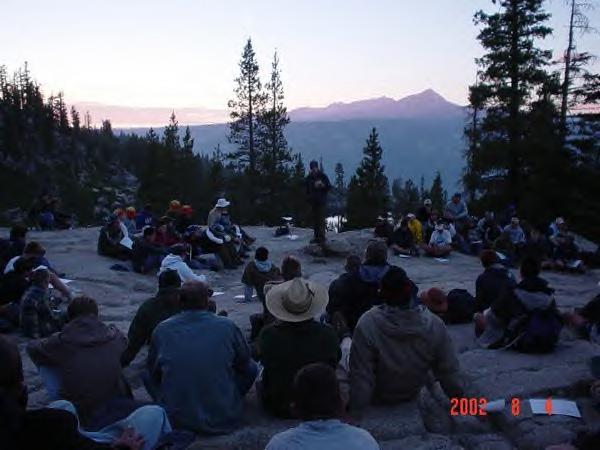
Cody is such a special place, isn't it? And what a glorious day this has been. For some of you, like me, this may be your first visit to this inspirational site. This may be your first day in camp, and perhaps, for a few of you, your first night away from home and family. For many of us, this place was love at first sight. Most of us have found something here we love and enjoy, and are glad we returned.
Chapel Rock is obviously a very special place, the high country with a special vantage, a special outlook on the High Sierras. This calls for some words that may help us form or strengthen our connection to this place, in spiritual, not just physical, emotional and social terms.
150 years ago, people did not see the Sierra Nevada mountain range as a sanctuary, or a retreat, or a refuge from city life. Nor was it a preserve for recreation and inspiration. After crossing the Great Plains, the Rockies, and bone-dry deserts, it was a scene of hardship, one more terribly difficult barrier to overcome before reaching the Promised Land to the west. At the summit, wagons had to be disassembled and pulled up rocky cliffs on ropes. And it could be a place of death and desperation.
40 miles due north of us, just beyond the Crystal Range that we see, the Donner Party met their fate in winter of 1846-47. Their tragedy came as a result of poor leadership, a lack of teamwork, and being terribly unprepared. A little girl named Patty Reed who survived an ordeal of hunger and isolation could never go back to enjoy these mountains. Her lasting advice was to "hurry on to your destination, and don't take no cutoffs" that could lead to disaster.
For 2 decades, most immigrants avoided Donner Pass, instead using Carson Pass, just 10 miles directly southeast of us, or Echo Summit, just 10 miles on the map to the northeast. Very few left the beaten path or ruts to see what lay beyond. Only a few knew of the pure water of Cody Lake, and good pasture up at Cody Meadows, and such things were rare along the trails to California.
By 1870, the frontier was closed in California, and by 1880 the frontier was closed throughout the western states and territories. By the 1880s, the Sierra was being overrun with sheep by the 10-thousands. All the meadows were close-cropped and trampled. And the loggers were coming. Many people prayed and worked for an alternative to complete commercial exploitation of the public domain, an alternative with more people as a presence, and more of what's here naturally.
For the Sierra Nevada, one man's vision stands out above all others. John Muir wrote, "Climb the mountains and get their good tidings. Nature's peace will flow into you as sunshine flows into trees." How could this possibly work? Some of you may have had this experience, but it's difficult to explain.
In the preservation of park land elsewhere in California, the Jesuits played an important, perhaps decisive role. They believed that in places of outstanding natural beauty, such as redwood forests, that people could directly understand the divine plan for creation, that God's handiwork could be comprehended intuitively for the uplifting of the human spirit.
In the New Testament, there are some words about how we are to relate to this land. It says, "Blessed are the meek, for they shall inherit the earth." There is truth and beauty in this verse, though it is often misunderstood. There is a problem with the translation into English. To be meek does not mean to be namby-pamby. It does not mean being passive, or downtrodden, or even quiet. I'm told that in Hebrew to be meek meant to be assertive but not arrogant, to be confident but not overly proud, and to uphold the values and principles that we are all taught, but to do so without anger or aggression. "Steadfast" might be a better word.
So what about the promise of inheriting the earth? I used to joke that the meek may inherit the earth, but they won't get the mineral rights. Or that the meek might inherit, but they won't stay that way once they get title.
Well, I have some good news: We've already inherited. The earth, and all its great places, is a gift to us. It is a gift in so many ways that it's humbling to think about them all. Those who founded Camp Cody in 1937, for example, gave a gift to the boys then and for generations of Scouts into the future, a gift that has been renewed each year in an unbroken chain.
The natural heritage of the Sierra Nevada is another gift of life that many of you have already come to know pretty well. Some of you feel very much like John Muir when he said "going to the mountains is going home."
But it's one thing for me to talk about it, and it's another thing for you to really make it your home, your special place that includes a stronger connection with God and the natural world He set in motion. Here's a suggestion: Find your own way, whether you seek it or let it come to you.
For the big thinkers among you and big picture guys, Astronomy or Geology may be your window on creation. For active and energetic explorers it may be a hands-on pursuit such as Rock Climbing or Archery, developing your own God-given potential. For those who are ready to re-create with practical benefits, your path may lead you to Fishing or Cooking. But don't forget the Zen-like spiritual side to preparation that is also part of nurturing our good nature.
The hands-on approach to managing your natural inheritance is equally valid, such as maintaining a trail, or lashing together a gateway: anything you do that leaves the land a little better for your presence here.
This goes beyond "take only pictures" and "leave only footprints". For the 9 days we are here together, we are part of nature, living pretty harmoniously with this largely natural landscape. Generations before us saw Nature as something to be conquered, tamed, or harvested. Nature is not our adversary anymore.
Down in Sacramento, one block west of the Capitol building, there's a pair of stately Roman-style buildings on either side of a traffic circle with roses and a fountain in the middle. Impressive, perhaps, but none of it looks natural. Above one of the buildings, carved in granite is this California prayer: "Give me men to match my mountains."
This is why we come up here, so that when we go back to the valleys we are stronger, better, and nobler for the experience. To be a man to match these mountains is:
- To be solid and enduring, yet productive and approachable.
- To know the peaks and valleys of life, and to know how to reach them or get through them.
- To know where we are in time and space, and how our direction and course relate to "true north" principles.
- To know places of beauty, stillness, relative safety, and reservoirs of goodwill within our range of light.
- To be receptive to light and energy, and supportive life, while discharging our responsibilities without complaint.
- To know and prepare for seasons of change, opportunity, and renewal.
- To be a man for all seasons, rock-solid with integrity, and not just a fair weather friend.
Return to Passages
|
|