
PAN
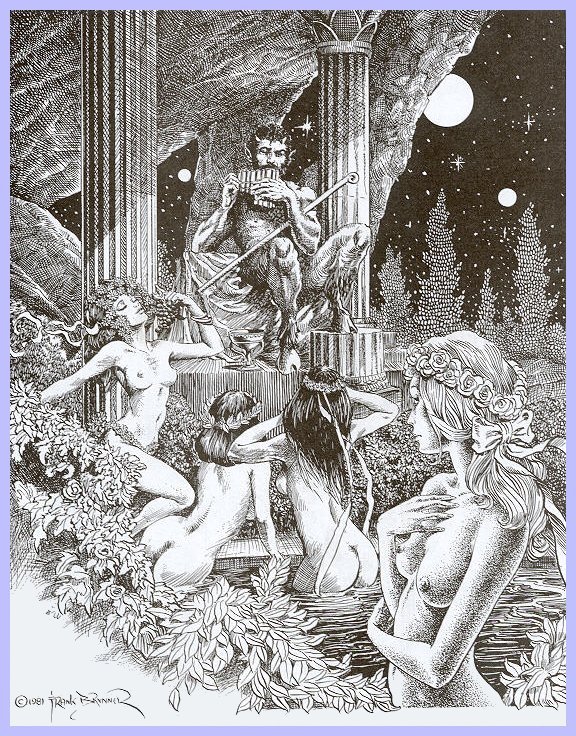
Pan was the son of Hermes, (the magnificient Arcadian god). His mother was either the daughter of King Dryops (whose flocks Hermes had tended to) or Penelope (whom Hermes had approached in a form of a he-goat).
It was told that Pan was succeeded in seducing Selene (the moon goddess)- he dressed himself in fleece of a dazzling white ewe and drew Selene into the forest where she stayed (either that, or he himself then transformed into a white ram). During the battle of Marathon (during the Persian wars) he appeared before the Athenian ambassadors sent to Sparta. Pan promised to make the Persians flee if the Athenians would begin to worship him in Athens. In gratitude the Athenians built a sanctuary for him on the Acropolis and from there the cult of Pan spread through out Greece.
Every region in Greece had it's own form of Pan. Thessaly's was called Aristaeus. Aristaeus had the name that meant, "very good" which is also what, "Zeus" in Arcadia had meant. Pindar says that Aristaeus was carried after his birth by Hermes to Gaea and the Horae who fed him on nectar and ambrosia, transformed him into Zeus, the immortal god, and into Apollo, the pure, the guardian of flocks and of the chase and pasturage.
The Pan in Mysia (in Asia Minor) was Priapus, his mother was said to be Aphrodite or Chione and his father was either Dionysus, Adonis, Hermes, or Pan. It's told that Hera, jealous of Aphrodite, caused Priapus to be born with an extraordinary deformity (to which reflects his name). Priapus resided over: raising of bees, fields and flocks, the culture of the vine and fishing. He protected gardens, and orchards where his image was placed.
Usually depicted as goat-like in appearance, Pan prances through the fertile countryside playing his seven-reed pipe in wild abandon. His piping can be as soft and seductive as the breeze, but when he's angered, his bellow and howl can be heard for miles.
He fought with the Olympians against the Titans of Kronos and for his terrifying war cry, his name is still associated with PANic fear.
His lust for the nymphs, naiads and dryads is legendary. The nymph, Syrnix, was the name sake for Pan's reed-pipe because she was turned into a reed to escape the amorous advances of the Goat God (I'm not sure where this story originates). Also, the nymphs Pitys and Echo, were made famous when they fled from Pan. For their insolence Pitys was turned into a pine tree and Echo was transformed into a voice that could only repeat that last word spoken to it.