By MINDY LACY
"Shelbyville News, Shelbyville, Indiana" (USA)
Thursday, November 23, 2000 Just as precious as life itself is the new kidney Jayme (Anderson) Tunis can feel just under her skin in front of her right hip.
Instead of having two kidneys functioning in the back of her body, which remain, Tunis� new kidney works alone in the front.
Tunis is a 1982 Shelbyville High School graduate who currently lives in Whiteland. Tunis� sister, Jodi Anderson, lives in Shelbyville.
For the first time in three years, Tunis, the 36-year-old stepmother of two teen-age girls, said she feels like she has a normal life again since she received the kidney on Aug. 20 from a man who was tragically killed.
Instead of being unable to get out of bed four days out of seven and fighting the nausea, headaches and fatigue, Tunis has gone back to work. She spends spare time advocating for more organ donations.
And she�ll be able to celebrate her 10th wedding anniversary this year with her husband, Thomas.
Since transplant surgery three months ago, Tunis said she feels a kinship to the kidney�s previous owner, a 22-year-old man she never knew.
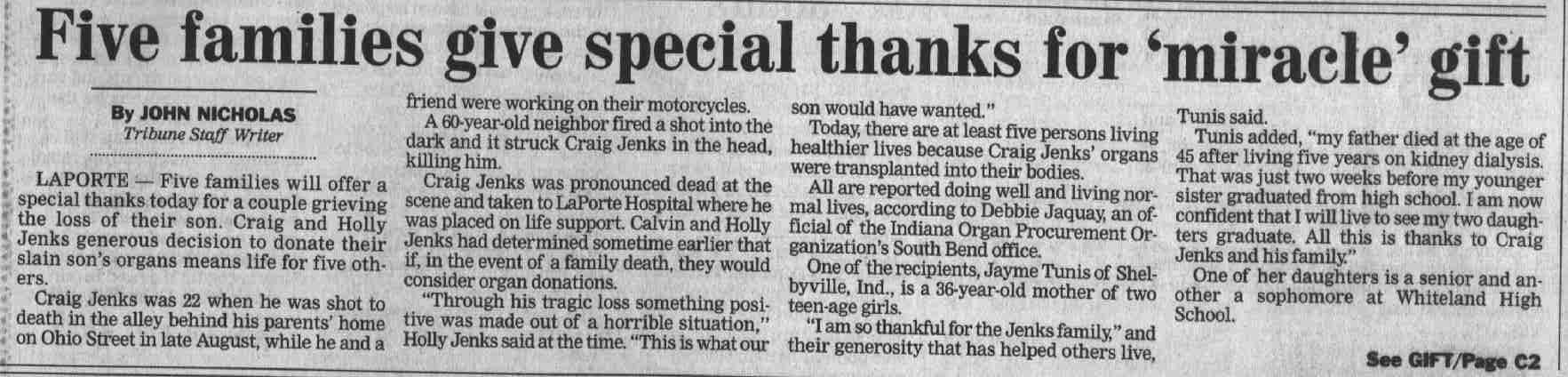
The donor was Craig Jenks of LaPorte. He was shot once in the head while working with his friend on a motorcycle that was parked in his mother�s front yard.
A 60-year-old neighbor apparently became agitated from the noise of the motorcycle and fired one shot toward Jenks and his friend.
After firing the gun, the neighbor went back into his home and died from a self-inflicted gunshot wound.
The next day doctors declared Jenks brain dead.
The young man�s family members immediately faced the question of whether they should donate his organs.
As a result of the family�s decision to donate, more than 30 people, including Tunis, have benefited.
Tunis waited a year on a transplant list for a matching donor. She was a perfect match to receive this kidney.
�They said we couldn�t have been a better match if we had been brother and sister,� Tunis said.
At least one patient Tunis knows of had been passed over eight times for an organ because he did not match the tissue types.
While recovering from the surgery, Tunis said she wanted to know more about her donor. Through a friend, she matched what information she had about the 22-year-old man through a search on the Internet.
Within about 10 minutes, through the media, Tunis had all the information she needed to contact her donor�s family.
Through telephone conversations and e-mail, Tunis keeps in touch with Jenks� mother, Holly Jenks, and his grandmother, Frannie.
The kidney came in the nick of time for Tunis, whose body was beginning to reject dialysis treatment, which was the only thing keeping her alive.
Three years ago, as Tunis began to suffer extreme fatigue, nausea and vomiting, doctors discovered her kidneys were shutting down.
Tunis� kidneys had been damaged beyond repair by diabetes that was detected when she was 14.
She had to quit her job and take medical disability.
�I didn�t think I was going to be able to see my youngest daughter graduate from high school,� Tunis said.
High levels of wastes and fluids, possibly toxic, accumulated in her blood. She had 40 hospitalizations and surgeries before the transplant.
Tunis tried to get her name placed on a transplant list. She was not able to get a clean bill of health, so she was forced to wait until her other medical conditions were taken care of.
Doctors found coronary artery disease and a tumor in one of her lungs. Both were found to be non-life-threatening, and she was placed on a transplant list.
Meanwhile, Tunis started dialysis. It was only thing besides a transplant that could help her live.
Kidneys normally cleanse the blood, ridding it of waste, salt and extra water. When they fail, a person may only live a week to 10 days without dialysis.
There are two kinds of dialysis. In hemodialysis, blood is pumped out of the body into an artificial kidney machine that slowly cleans the blood and puts it back into the body.
In peritoneal dialysis, the inside lining of the belly acts as a natural filter that extracts wastes through a catheter.
Tunis had to go to a dialysis center in Beech Grove three times a week. After a year of hemodialysis, Tunis� deteriorating veins and arteries could no longer support the treatment.
�They said that I have the veins of an 80-year-old,� Tunis said.
She then turned to peritoneal dialysis. A plastic bag was surgically inserted into her belly.
Tunis� father had taken this treatment for five years before he died of kidney failure in 1985.
Soon, Tunis� own body was beginning to reject peritoneal dialysis.
She was afraid she was beginning to develop an infection that would force her to undergo another surgery to remove the bag and go back to hemodialysis.
On Friday, Aug. 19, she had just put on her pajamas and was climbing into bed when the phone rang. She hadn�t been feeling well all that day.
As she picked up the phone, she automatically thought it was her oldest daughter ready to blurt out an excuse to stay out longer with her boyfriend.
But instead, it was Cheryl Thompson, a registered nurse from Methodist Hospital�s transplant unit.
�It�s show time. Are you ready?� Tunis said Thompson asked.
Tunis said she recalls asking if she was the first person in line for the kidney or the backup recipient in case the first person didn�t match.
�This one�s all yours,� Tunis heard.
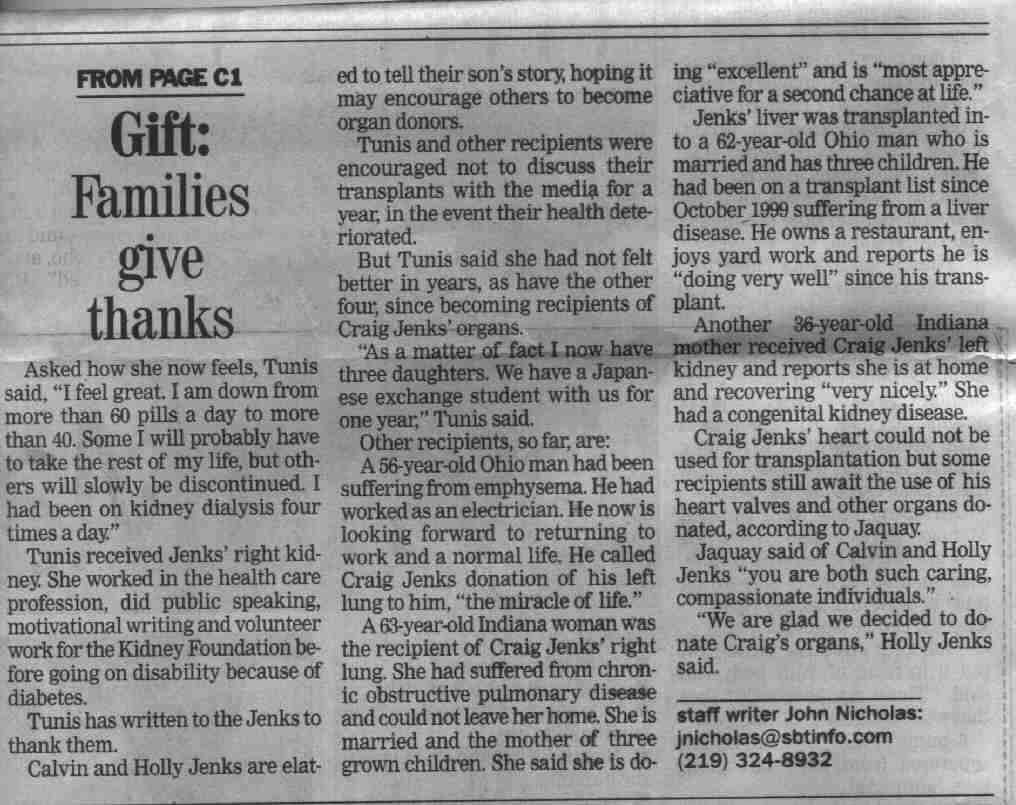
Since Tunis received her new kidney, she has ended dialysis and is enjoying more freedom. She still strictly watches her diet and has to take 45 prescription medicines daily. Most are anti-rejection drugs.
Although the kidney is functioning well, Tunis� body could still reject the new organ, especially this first year, she said.
But without her new kidney, Tunis would have to endure dialysis treatments for the rest of her life.
The only thing Tunis can say to the Jenks family is �thank you.�
News Articles
Home
