 |
| SOFALA |
| Gold Nuggets from Little Oaky Creek |
| SOFALA "Australia's oldest surviving gold town" |
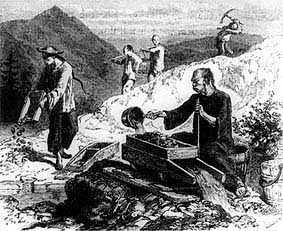
| When the Chinese arrived in 1857, they suffered much animosity at the hands of Sofala's prospectors, but were respected for their workmanship and thoroughness. Later, they were to suffer racism and massacres on other Australian goldfields. Many Chinese relics can be seen in the local museum at the nearby historical town of Hill End. |
|
 |
| Chinese workers washing gold-bearing aluvial sands with the cradle, on the Australian goldfields, c1860. Published in 'Man and Metals'. |
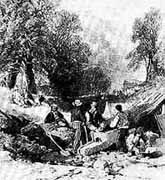
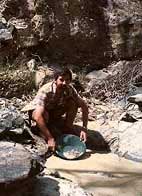
| Diggers cradle and pan for gold. |
| Sheep Station Point c. 1851 - from Charles Read's book "What I heard,Saw and did at the Australian Goldfields", London 1853 |
 |
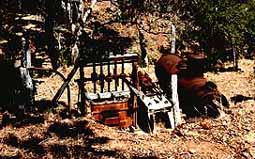 |
| Rustic remains of ore stamper (crusher), Little Oaky Cr. |
 |
 |
 |
 |
 |
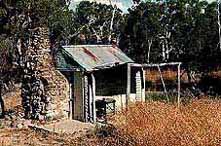
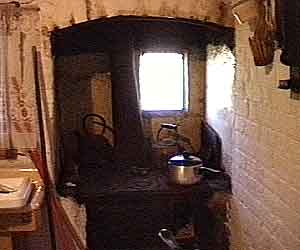
| Miner's Mud and Wattle cabin, near Sofala. |
 |
 |
 |
 |
 |
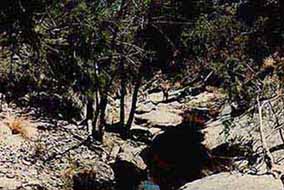
| Upper reaches of Big Oaky Creek. Wild goats, roos, snakes and nuggets!! |
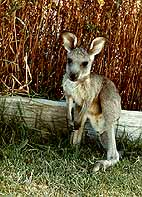
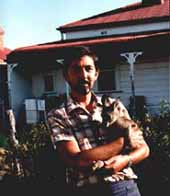
| "Joey" Good Mates! |
 |
| Central Highlands |
| New South Wales |
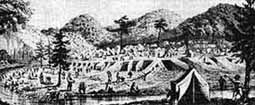
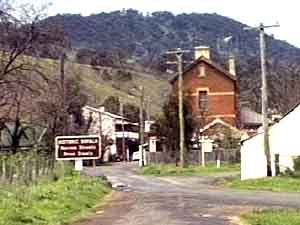
| In the Summer of '85, I set out on a camping trip to the old gold fields in the Central Highlands of New South Wales. As a young lad, I had already some gold prospecting experience on the Goldmines River near Avoca in County Wicklow, Ireland. I had read much about the history of gold exploration in Australia, and especially the region to the west of the Blue Mountains in New South Wales. The mountainous region around Sofala and Wattle Flat, just north of Bathurst, seemed like a good choice for a young "Sourdough". Sofala is only 245 km west of Sydney, but it took several days on a laden down bicycle to reach the area. It was my first experience of the Australian bush and it did not take long to realize the hidden dangers and hardships which faced the early pioneers in this dry and rugged land. Sofala lies in the Turon River valley, and it was near here at Summerhill Creek, that Edward Hargaves discovered gold on the 12th Feb. 1851. In a short time the population peaked to 10,000 as people flocked to the area. A ramshackle tent city, with dozens of pubs, grew up around Sofala. But by May 1854 the gold ran out and many moved away. However, a year later more gold was discovered at nearby Wattle Flat. Today, Sofala retains much of its old world charm, and many of the quaint wooden houses remain. Now the area is a great attraction to artists, as well as prospectors who still come in search of fortune. They too will discover that the real gold is found in the hearts of the people who live there, and the lonely valleys and deep ravines which gulp the sky, the domain of the wedgtail eagle and the grey kangaroo.... somehow the gold is not all. |
| SOFALA in N.S.W. is thought to have been named after Nova Sofala in Mozambique, on the east coast of Africa. Nova Sofala was a famous Arab and Portuguese gold trading town near the modern port of Beira, in Mozambique. Discovered by Vasco da Gama in 1498. Da Gama returned to Portugal with information on the gold trade of the east African coast, and King Manuel sent Dias to found a fortress and factory at the gold exporting port of Sofala. Sofala was destroyed by the sea towards the end of the 19th Century. |
| Panning was very tedious for the amount of aluvial gold recovered. Using a simple home built cradle made the work easier, but all the larger pieces of gold came from "crevicing" the bed-rock. Small nuggets were found by searching old diggings with a metal detector. |
 |
 |
 |
 |
 |
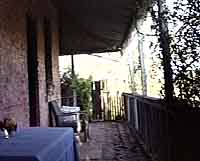 |
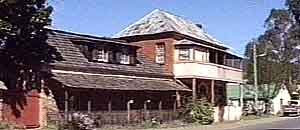
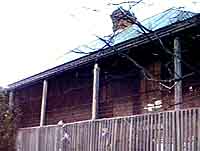
| The Parson's Lodge overlooking the Turon River at Sofala. |
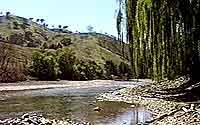 |
| Turon River at Sofala. |
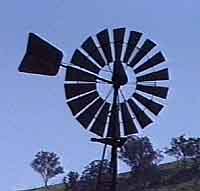 |
| Water pump, Sofala. |
 |
| Sundown, Sofala. |
 |