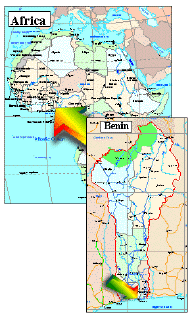
 Benin is bordered by Nigeria to the east, Togo to the west, Burkina Faso to the north-west, Niger to the north-east, and the Atlantic Ocean to the south. The total area measures 114,763 square kilometers; Benin is about 700km long and 120km wide in the South, increasing to 300km wide in the North. It is roughly two-thirds the size of Portugal, or about the same size as the U.S. state of Pennsylvania.
The terrain of Benin varies greatly between the North and South. The South is a coastal plain with dense vegetation and several lagoons near the coast. The lagoons are created by the flow of the country's three major rivers (the Ou�m�, the Couffo, and the Mono) into the coastal plain's sand bar. The largest lagoon, Lac Nokou�, divides Cotonou and Porto Novo. This lake is also home to Ganvi�, the famous fishing village built on stilts. In the North, the terrain becomes more barren and mountainous. In the far North, the Atakora mountains reach a height of 658 meters.
Climate
Like the terrain, Benin's climate varies greatly from North to South. The South has a sub-equatorial climate, with 2 dry seasons and 2 rainy seasons (rainy seasons are April-July and October-November). The temperature in the South ranges from about 18-35�C (65-95�F). In the North, the climate is tropical, consisting of one dry season and one rainy season (rainy season from June-October). The temperature varies more in the North, reaching 46�C (115�F) during the hottest part of the year, which is from March to June.
Benin is bordered by Nigeria to the east, Togo to the west, Burkina Faso to the north-west, Niger to the north-east, and the Atlantic Ocean to the south. The total area measures 114,763 square kilometers; Benin is about 700km long and 120km wide in the South, increasing to 300km wide in the North. It is roughly two-thirds the size of Portugal, or about the same size as the U.S. state of Pennsylvania.
The terrain of Benin varies greatly between the North and South. The South is a coastal plain with dense vegetation and several lagoons near the coast. The lagoons are created by the flow of the country's three major rivers (the Ou�m�, the Couffo, and the Mono) into the coastal plain's sand bar. The largest lagoon, Lac Nokou�, divides Cotonou and Porto Novo. This lake is also home to Ganvi�, the famous fishing village built on stilts. In the North, the terrain becomes more barren and mountainous. In the far North, the Atakora mountains reach a height of 658 meters.
Climate
Like the terrain, Benin's climate varies greatly from North to South. The South has a sub-equatorial climate, with 2 dry seasons and 2 rainy seasons (rainy seasons are April-July and October-November). The temperature in the South ranges from about 18-35�C (65-95�F). In the North, the climate is tropical, consisting of one dry season and one rainy season (rainy season from June-October). The temperature varies more in the North, reaching 46�C (115�F) during the hottest part of the year, which is from March to June.
Chinese Embassy Chancellerie Boulevard Marina Tel. 30.07.65
Cuban Embassy Face H�tel du Port Tel. 31.52.97
Danish Embassy 04 B.P. 1223 Les Cocotiers C/08 Tel. 30.38.62
Egyptian Embassy B.P. 1215 Route de l'A�roport C/26 Tel. 30.08.42
American Embassy USA ZR C/125 B.P. 2012 Tel.30.06.50 - Chancellery for the American Embassy; Face Camp Guezo B.P. 2012; tel.30.23.67 - American Cultural Center; B.P. 2012 ZR C/113; tel. 30.03.12 - USAID; B.P. 2012 ZONGO EHUZU C/00563-D; 30.05.00
French Embassy Tel. 30.02.25 - French Cultural Center; B.P. 416; Tel. 30.08.56 - Mission of Cooperation Cultural Action Tel. 31.14.65 - Paierie of France Tel. 31.26.27 - French developmental funds Tel.31.34.53
Ghanaian Embassy B.P. 488; 30.07.46 -Diplomatic Mission Tel30.03.45
Libyan Embassy B.P. 405 C/36; 30.04.52 -Libyan Cultural Center; tel. 31.31.80
Embassy of Niger B.P. 352 Tel.31.56.65
Nigerian Embassy B.P. 2019 ZR C/112 Tel. 30.11.42
Dutch Embassy Tel. 30.41.50
Russian Embassy B.P. 920 Les Cocotiers C/H10 Tel. 31.28.34
Embassy of Chad 08 B.P. 359 Ayelawadje C/323 Tel. 33.06.10 Consulates
Belgian Consulate Tel. 30.18.75
French Consulate Tel.31.26.38
Greek Consulate B.P. 8116 Patte d'Oie C/130 Tel. 31.29.91
Dutch Consulate B.P. 296 Tel. 31.29.91
Swiss Consulate 08 B.P. 0123 C/H-5 Tel. 32.07.02 - Medical-Sanitary Beninese-Swiss Program (IUED); 08 B.P.0792 Haie Vive C/1151; Tel. 30.16.83
Base - Oua (PO2) Pole Occidental 2 01 B.P. 2906 Tokplegbe C/05146 P Tel.33.39.35
World Bank Mission Bureau ZR C/T 2842 Tel. 31.21.24
Bit Base Artisan Support B.P. 1048 Les Cocotiers C/0-3 Tel. 32.01.56
Training and Population Research Center (CEFORP) 03 B.P. 1079 Gb�gamey Tel. 30.07.70
Regional Center for Sanitary Development Tel. 30.03.09
Commission of European Communities Delegation B.P. 910 EX BCB Central Agency Tel. 31.53.28
Compensation Funds for Departing Volunteers Program Akpakpa next to Coop Tel. 33.14.61
United Nations Population Fund B.P. 5016 ZR C/115 Tel. 31.53.66
European Funds for Development Tel. 31.26.17
Guaranteed African Funds for Economic Cooperation (FAGACE) B.P. 2045 Boulevard Marina Tel. 30.03.76
International Federation for the Red Cross B.P. 08-1070 Les Cocotiers Haie Vive C/09-A Tel. 30.06.14
Canadian Funds for Local Initiatives 04 B.P. 1124 ZR Tel. 30.05.32
High Commissariat for Refugees Bureau ZR C/24 Tel. 30.28.90
IITA - Benin (Research Project) 08 B.P. 2523 Tel. 35.01.88
Regional Institute for Public Health (IRSP) B.P. 918 Zongo C/310 Tel. 31.48.64
Teaching Materials for Health Personnel B.P. 188 Tel. 30.12.36
United Nations Organization (PNUD) B.P. 506 ZR C/111 Tel. 31.30.46
United Nations Organization (Representation UNICEF) B.P. 2289 Tel. 30.02.66
World Subsistence Program (PAM) Tel. 30.09.73
World Health Organization (WHO) B.P. 918 Tel. 30.17.53
� United Nations Organization for Nourishment and Agriculture (FAO) B.P. 1369 FAO Representation in Benin Tel. 31.36.49
Fishing Project DIPA Tel. 33.09.25
WANAD Project B.P. 506 Tel. 31.45.65
Management Project for Natural Resources 06 B.P. 884 Cotonou Tel. 33.04.21