___________________________________________
6.
Islam: the Prophet Muhammad
and the pillars of Islam
___________________________________________
Current estimates suggest that Islam currently has about 1,200 million
adherents, or one fifth of the world population. Statistically, this places
it second only to Christianity with around 2,100 million adherents, though
that figure includes nominal Christians and should therefore be taken with
a grain of salt. Followers of Islam are called Muslims. The term Muslim
essentially means ‘a submitted person’. That is the person is submitted
to God, who is called Allah. These Muslims are predominantly in North and
West Africa, the Middle East, western, southern and central Asia and in
south-east Asia. The largest Muslim nation in the world is our next door
neighbour, Indonesia with approximately ninety percent of around one hundred
and ninety million. That is approximately fifty million more than the next
largest nation. The most recent ABS figures rate Muslims as 1.8% of total
New South Wales population. If this figure was roughly true across Australia,
it would represent around 300,000 adherents nationwide.
The History of Muhammad
Islam began in the Arabian peninsula during the seventh century. Despite
attempts in the northern section of the peninsula to preserve an ancient
way of life, it was on the verge of collapse. Society was based on the
tribe rather than on a political state. Stability was maintained by a sense
of tribal solidarity. You could rely on others in the tribe. Tribes in
the north were polytheistic, having many gods and goddesses. By the seventh
century there were some itinerant religious preachers who proclaimed that
the most important god was al’ilah, or ‘The God’
At the end of the fifth century, the area around Mecca had been seized
by the Quraysh tribe. They made Mecca its tribal religious centre and honoured
a shrine in the city called the Ka’aba, or ‘the cube’ which contained
images of it tribal Gods. The seventh century saw the break up of this
tribal life and religious beliefs. Trade from the south was channelled
through Mecca. This brought about a great deal of prosperity to those in
Mecca, and this new wealth changed the pre existing tribal ties and ideals
to the extent that a completely new social system developed.
Around 570 Muhammad was born in Mecca to parents of the Quraysh tribe.
Being orphaned by six, he was then brought up by his grandfather who died
two years later. After this his uncle Abu Talib took care of him. As a
young man he entered the service of a widow and trader named Khadija. Despite
being fifteen years her junior, he married her at aged twenty five.
Muhammad was not satisfied with the religion of the Meccans. He used
to retire periodically to a cave near Mecca for contemplation. He seemed
to be among the few Meccans who shunned the idolatry of Mecca, though he
did not follow a particular religion. He had his first experience of a
revelation from God at the age of forty (610 AD) while in his cave. Islamic
tradition holds that this experience was accompanied by a vision of Gabriel
who came down to reveal the Truth. This experience disturbed Muhammad,
and it was not until some time later that he came to terms with his experience,
understanding that it was not evil or just a dream. He now felt called
to preach and share his message, though his message only attracted relatives
and close friends. His early themes as a preacher were;
Belief in one God
his goodness and power
the return to God for judgment after death
man’s ingratitude with regards to God’s goodness
worship of God as a method of expressing gratitude
the negative attitude of Meccans towards the lower strata of society
the need for socioeconomic justice within that society
The general reaction to his preaching was hostile. This can be traced to
the way in which much of his preaching criticised the gods of Mecca and
the attitudes within Meccan society. He was considered to be mad and a
sorcerer, and his followers were first verbally, then physically persecuted.
Muhammad came to understand his struggle in the wider picture of past prophets,
such as Noah, Abraham, Moses and Jesus, who had all experienced persecution
from their own people. It confirmed for him that his experience was a recurring
experience throughout history, and that his mission must continue in the
proclamation of the truth revealed to him.
In 622 AD a group came to Mecca from a town called Medina. They were
impressed with what they heard, and considered him to be a prophet. Muhammad
was invited to go to Medina to become its religious and political leader.
This was the turning point in the spread of Islam. It gave the prophet
protection and a launching pad for the message to spread further. This
migration is known as the hegira, and is the starting point for
the Muslim calender. The Muslim calendar is a lunar calender, and is 11
days shorter than our solar year.
Medina’s three thousand inhabitants consisted of two hostile pagan Arab
tribes and a community of Arabised Jews. The Jews had developed an agricultural
which had been over run by the other tribes. On Muhammad's arrival, he
developed a community between the Meccan Muslims who he had brought with
him, and the Medinan converts to Islam. This represented a break with tribal
religious systems and can be seen as the genesis of the ‘Islamic Community’,
or the umma. He also set up a charter guaranteeing religious freedoms
for the Jews and actively sought peace. At this time, there was a good
deal of respect for other monotheistic religions, including Christianity
with which he had some contact with.
Verily, they who believe (Muslims), and they who follow the Jewish
religion, and the Christians, and the Sabeites, whoever of these believeth
in God and the last day, and doeth that which is right, shall have their
reward with their Lord.
Sura 2:62
And again;
But if the people of the Book believe and have the fear of God,
we will surely put away their sins from them, and will bring them into
gardens of delight: and if that they observe the law and the Evangel, and
what hath been sent down to them from their Lord, they shall surely have
their fill of good things from above them and from beneath their feet.
Sura 5:69
However, unlike the pagan Arabs, the Jews of Medina did not accept the
prophethood of Muhammad. In an attempt to reach a political settlement,
Muhammad commanded Muslims to pray facing Jerusalem, though this changed
when it failed to reign in Jews (and Christians who he also attempted to
woo). Muslim-Jewish relations worsened over time, culminating in the expulsion
of two Jewish tribes from Medina on the grounds of anti Muslim behaviour,
and the near annihilation of the third tribe after collaborating with a
hostile Meccan army in 5 AH (627 AD). Despite their hostility, he was keen
to win over the Meccans. There were several reasons for this. Firstly,
it was the home of Islam, being the place where the initial visitation
occurred. Secondly, Mecca was of high strategic importance. It was considered
as the Arabic religious centre. It held their sanctuary to which Arabs
would make an annual pilgrimage. This sanctuary is known as Ka’ba, or the
cube and the Black stone built into one corner was said to have been placed
their by Abraham and Ishmael.
And when Abraham, with Ishmael, raised the foundations of the House
they said ‘O our Lord! Accept it from us; for thou art the Hearer, the
Knower. Sura 2.127
It was clearly a problem to Meccans that Muhammad was in control of
Medina on account of its geographical position. Mecca had come to rely
on caravan trade particularly with Syria, and Medina was on the Mecca-Syria
trade route.
***********ENTER HERE (map Hinnells p. 128)
After being on the receiving end of several attacks, the 10, 000 Muslim
army conquered Mecca in 8 AH. Muhammad did not seek the destruction of
the inhabitants. Rather, he sought to purify the city, tearing down all
the religious idols of Mecca. However, he did keep the cube, but removed
its previous religious significance, making it a Islamic sacred site. The
defeat of Mecca led other tribes from various parts of Arabia to send delegations
to the Prophet, paying homage to him and accepting Islam. By the time of
his death in 11 AH Islam had spread to all corners of Arabia.
The five pillars of Islam
Major Islamic practices can be summarised under the five pillars of
Islam.
1. Belief that there is no god but Allah and Muhammad the Messenger
of Allah
2. Prayer
3. Zakat (a kind of welfare tax)
4. Fasting
5. Pilgrimage to Mecca
These pillars are prescribed in the Qur’an, though none are described there
in any great detail. During the first three centuries after the death of
Muhammad, these practices came to be strictly regulated by Islamic law.
These are the basic activities by which one demonstrates their surrender
to Allah, though there are differences in interpretation between the various
schools of Islam.
Pillar one is Shahada, or the profession of faith. It is the
proclamation that Allah is God above all and that Muhammad is his prophet.
The initial proclamation of this by a person signifies their membership
into the Islamic community. This confession, as subsequently used in the
obligatory daily prayers, means that the person is obliged to practice
the Islamic religion in its totality as prescribed in Islamic Scriptures.
The term Allah is simply the Arabic proper name for God, and is used by
Arabic Christian as well as Muslims. This means that Christians and Jews
and all followers of monotheistic religions agree with Muslims on the first
statement of the Shahada. It is the second part of the statement that distinguishes
Muslims. The assertion that Muhammad is ‘a prophet’ is more than just classifying
him as one in a long lines of prophets from God. It is a statement that
signifying that Muhammad is the last and greatest of all the prophets throughout
human history. This proclamation is the rallying cry of Islam, and the
fundamental definition of Islamic belief .
Pillar two is salat, or prayer. Prayer is the first and foremost
duty of a Muslim. A friend who was on a mission in Indonesia told us of
how she would be wakened each day before sunrise by the local caller, proclaimed
from the top of mosques, using loudspeakers to call people to the mosque
for prayer with several phrases including ‘Awake, for it is better to pray
than to sleep.’ To the Christians credit, they too get up and participate
in times of group prayer.
A very physical type of prayer is designated in the Salat. Five
times a day the Muslim is to face towards Mecca and, either alone or in
a congregation, obtain a state of ritual purity through various preparatory
ablutions, and go through a ritual of prayer and action which expresses
in both word and deed the surrender of the adherent to Allah. Prayer is
more than a ritual. It is fundamentally a moral and spiritual duty, which
on an individual level strengthens the believer, keeps away evil and works
towards spiritual and moral perfection. On a social scale, it builds and
strengthens the solidarity of society and promotes social cohesiveness,
equality, brotherhood and disinterested service to humanity. In light of
this, it is encouraged where possible that these prayers take place in
the context of the congregation preferably at a mosque. This duty is required
of all mature aged women and men, though menstruating women and new mothers
are exempted from this duty.
Submissiveness is further expressed in the third pillar, zakat,
or alms giving. The Qur’an stresses the giving to the poor following the
prophets example;
who for the love of God distburseth his wealth to his kindred, and
to the orphans, and the needy, and the wayfarer, and those who ask for
ransoming.
Sura 2:177.
A proportion of each Muslim’s income should be given to support the
Islamic community. This can be done in a voluntry fashion, such as giving
alms to the poor in the street. However, Islam does not confine itself
to voluntry spending. It is enjoined on all financially able Muslims to
donate a share of their wealth to be spent on specific purposes;
But alms are only to be given to the poor and needy, and those who
collect them, and to those whose hearts are won to Islam, and for ransoms,
and for debtors, and for the cause of God, and the wayfarer. This is an
ordinance from God: and God is Knowing, Wise.
Sura 9.60-1
9.60 is sometimes translated ‘those whose hearts are to be won to Islam’
adding to the ‘cause of God’ which is the spread of Islamic evangelistic
activities. In some countries the alms are deducted in the same way as
tax and then distributed for good purposes. The Zakat is important as it
redistributes wealth and purifies wealth, by its purification of the soul
from greed and selfishness, developing a healthy humanitarian attitude
within society.
The fourth pillar is saum. This involves fasting during the
holy month of Ramadan, which is in the ninth month of the Muslim calender.
Given the eleven day difference in our calenders, Ramadan can occur at
any time during our year. The next occurrence will be near the beginning
of December 1999. From dawn to sunset the Muslim must refrain from eating,
drinking, smoking, and sexual intercourse. This month of Ramadan is identified
in Islamic tradition as the time when the Qur’an was revealed to Muhammad.
This month regarded as a sacred time and its proper observance involves
this fasting. As the end of this month there is a feast of Id-ul-Fitr.
This feast lasts for three days. Before the feast commences, the head of
each family distributes alms to the poor. This act is followed by a prayer
meeting at the mosque. This first day is a time of rejoicing. Over the
three days, time is taken to visit friends and special festive cards are
sent to those who cannot be visited.
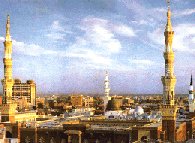 The final
pillar is the hajj. At least once in a lifetime Muslims are expected,
if it be physically and economically, to make a pilgrimage to Mecca during
the twelfth month of their calendar Dhu-l-Hijja. There they perform
specific rituals which recall the events which initiated their tradition.
Those who are in Mecca go to a nearby town called Mina just outside Mecca
and there is a vast sacrifice of sheep and goats.
The final
pillar is the hajj. At least once in a lifetime Muslims are expected,
if it be physically and economically, to make a pilgrimage to Mecca during
the twelfth month of their calendar Dhu-l-Hijja. There they perform
specific rituals which recall the events which initiated their tradition.
Those who are in Mecca go to a nearby town called Mina just outside Mecca
and there is a vast sacrifice of sheep and goats.
This sacrifice commemorates Abraham’s complete submission to God’s
commands in his preparedness to sacrifice his son. Those who are not in
Mecca go to their local mosque and when they return home, if economically
possible and permissible by local laws, they sacrifice a lamb, cow, or
camel. After sharing a meal any surplus meat is given to the poor.
It is not uncommon for Muslims who have completed the pilgrimage to
the Holy Land to take a new or additional name as a symbol of the significance
of the event for their personal identity. One example of this can be seen
in President Suharto of Indonesia, who had been traditionally considered
a very nominal Muslim. He added the personal name “Muhammad” after his
pilgrimage in 1990. This represented a strong turning point in his relations
with sections of the Islamic community.
Return to the Index