Twentieth Century Marketing ruins variety.

What does Santa Claus look like? Ask
any child this question and they will probably describe the rotund grandfatherly
figure seen everywhere today. But it hasn't always been that way, thanks
to the efforts of that great multinational, Coke. The Santa we know was
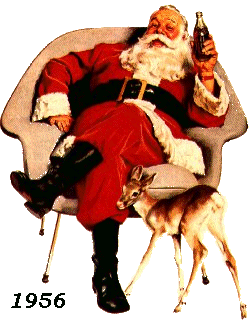
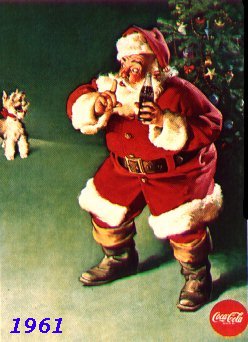
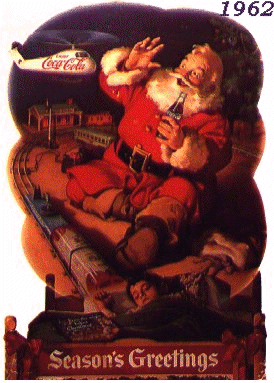
created for Coca-Cola in 1931 by Haddon Sundblom. Coke used Sundblom's
images for 35 years in their ad campaigns, exposing this image of Santa
Claus worldwide and making the Sundblom Santa the only Claus around.
The
Patron Saint of Children and Seafarers
 The
foundation of today's Santa Claus is Bishop Nicholas of Myra (or Smyrna)
who lived in the fourth century. Bishop Nicholas was known as a rich and
generous man who threw gifts to poor children through their windows. Except
for the white beard, Bishop Nicholas did not resemble Coke's image of Santa
Claus. However, it is thought that Santa's outfit is based on the Bishop's
red and white robes. Bishop Nicholas was canonized and is known as the
patron saint of children and seafarers.
The
foundation of today's Santa Claus is Bishop Nicholas of Myra (or Smyrna)
who lived in the fourth century. Bishop Nicholas was known as a rich and
generous man who threw gifts to poor children through their windows. Except
for the white beard, Bishop Nicholas did not resemble Coke's image of Santa
Claus. However, it is thought that Santa's outfit is based on the Bishop's
red and white robes. Bishop Nicholas was canonized and is known as the
patron saint of children and seafarers.
In the 11th century, Italian soldiers carried St. Nicholas' remains to Bari where they erected a church in his honour. Christian pilgrims visiting the church carried the story of St. Nicholas' generosity back to their homelands and adapted it to their own cultures. As a result, several versions of Santa Claus appeared throughout the world.
Ruprecht,
La Belfana and the Three Kings
 For
instance, in Germany, Saint Nicholas travelled with an assistant named
Ruprecht who carried a sack of presents and a rod. Good children received
gifts and bad children were hit with the rod. Italian children were visited
by La Belfana (a good witch dressed all in black) on January 6th, being
the Epiphany. In several Spanish speaking countries, children expected
the Three Kings to come bearing gifts on January 6th as well. However,
it is the Americanized-Dutch version of Santa Claus (Sinterklass) that
children all over the world recognize today. In sixteenth century Holland
children would place clogs filled with straw for Sinterklass's donkey.
Sinterklass would then leave small gifts in the wooden shoes. In America
the shoes have evolved into stockings hung by the fireplace.
For
instance, in Germany, Saint Nicholas travelled with an assistant named
Ruprecht who carried a sack of presents and a rod. Good children received
gifts and bad children were hit with the rod. Italian children were visited
by La Belfana (a good witch dressed all in black) on January 6th, being
the Epiphany. In several Spanish speaking countries, children expected
the Three Kings to come bearing gifts on January 6th as well. However,
it is the Americanized-Dutch version of Santa Claus (Sinterklass) that
children all over the world recognize today. In sixteenth century Holland
children would place clogs filled with straw for Sinterklass's donkey.
Sinterklass would then leave small gifts in the wooden shoes. In America
the shoes have evolved into stockings hung by the fireplace.
The
Night Before Christmas and Lou Prentice
 In
1809, author Washington Irving described the first details of the Dutch
Santa Claus to the American public in his magazine piece, "The History
of New York". However it is details in Clement Clark Moore's 1823 poem
A Visit From Saint Nick, better known as "The Night Before Christmas" that
are commonly accepted today. Moore's Santa Claus is an elf-like figure
who travels with eight reindeer and enters homes through the chimney. Moore
also included details of Santa's twinkling eyes and laughter. Thomas Nast
expanded on the details of Santa Claus' life when he developed a full figured
Santa for Harper's magazine in the 1860's. Nast also made Santa human-sized
and added details such as the North Pole workshop and Santa's list of good
and bad children.
In
1809, author Washington Irving described the first details of the Dutch
Santa Claus to the American public in his magazine piece, "The History
of New York". However it is details in Clement Clark Moore's 1823 poem
A Visit From Saint Nick, better known as "The Night Before Christmas" that
are commonly accepted today. Moore's Santa Claus is an elf-like figure
who travels with eight reindeer and enters homes through the chimney. Moore
also included details of Santa's twinkling eyes and laughter. Thomas Nast
expanded on the details of Santa Claus' life when he developed a full figured
Santa for Harper's magazine in the 1860's. Nast also made Santa human-sized
and added details such as the North Pole workshop and Santa's list of good
and bad children.
The
end result - what have we become?
In 1931, Sundblom was commissioned for
the Coca-Cola advertisements. Sundblom modelled his Santa Claus after his
neighbour, retired salesman Lou Prentice. After Prentice died in the 1940's,
Sundblom modelled the Santa portraits after himself. Santa continues to
appear on Coke products and advertising every Christmas season, spreading
it's image of Saint Nicholas worldwide.
Now, unfortunately, children in all countries await an Americanized standardized Santa Claus at Christmas each year rather than La Belfana or the Three Kings. Christmas has become a homogenized holiday. I ask you, where does the blame lie? Is it with Coca-Cola for encouraging their capitalist image or with consumers who bought into it so quickly? Feel free this Christmas, to break with 'tradition' and go for something more 'traditional'