 |
| Palestinian refugees: Tragic past and uncertain future |
"Refugees wishing to return to their homes and live at peace with their neighbours should be permitted to do so at the earliest practical date " UN Resolution 194 |
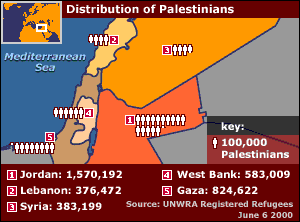
| By BBC News Online's Kate McGeown and Martin Asser There are more than 3.7 million Palestinian refugees in the Middle East and many more worldwide - and they want the right to go home. The Palestinians say their diaspora - uprooted from their homes ever since 1948 and scattered around the globe - is the greatest and most enduring refugee problem in the world. Whether they will be allowed to return to the land that used to be called Palestine is, and always has been, one of the main obstacles to progress in the Middle East peace process. During the Arab-Israeli war that followed the 1947 partition of Palestine by the UN into an Arab and a Jewish state, many Palestinians fled or were driven from their homes by the advancing Jewish forces. The exact number displaced at that time is not known but the United Nations Relief and Works Agency (Unrwa) has put the figure as high as 957,000. Approximately one third of these people fled to the West Bank, another third to the Gaza strip and the remainder to Jordan, Syria, Lebanon and throughout the world. After the outbreak of the 1967 Arab-Israeli war, another wave of Palestinians were displaced, many of them for the second time. As Israel expanded its territory, 300,000 Palestinians left the West Bank and Gaza, most of them to settle in Jordan. Palestinian assertions of the right of return for themselves and their descendants are based both on a moral standpoint, claiming the refugees' rights to return to homes from which they have been displaced, and on a number of resolutions issued by the United Nations. At the heart of these is General Assembly Resolution 194 of December 1948. It states that Palestinian "refugees wishing to return to their homes and live at peace with their neighbours should be permitted to do so at the earliest practical date". Israel's objections Israel refuses to assume responsibility in any way for the refugee problem and is adamant that Palestinians and their descendants cannot return. Many young Palestinians have lived all their lives in refugee camps The former Israeli Prime Minister Ehud Barak recently offered a token repatriation, allowing small scale "family reunifications" in the interests of peace. The Israelis have long called for the refugees to be absorbed in their Arab host countries, something those hosts - with the exception of Jordan - have refused to contemplateThe United States appears to have sided with Israel by asking the Palestinian leadership to "waive" the right of return, although supporters of that right say it is inalienable to each individual refugee and not for Yasser Arafat and his negotiators to give up. Roger Hardy says for both parties in this conflict, to accept the historic claims of the other side is implicitly to undermine your own historic claim. But for any Palestinian leader, an agreement which cancelled the refugees' right of return is politically unthinkable. |
 |
 |
 |
 |
 |
|
|
|
| Click here to return to Main Page |
 |
|
| "The Occupying Power shall not deport or transfer parts of its own civilian population into the territory it occupies." �Article 49 of the Fourth Geneva Convention of 1949 Between 1967 and Nov, 1999, the Israeli's established 145 settlements containing 172,000 Israeli citizens. These data do not include East Jerusalem. (source: B'tselem) |