|
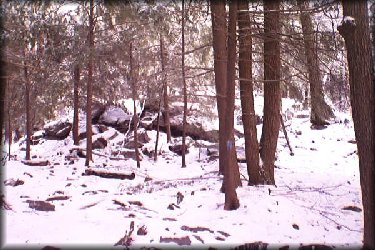
"Everyone has a special place. Or several special places. At least those who know the beauty of nature do. A place to admire the beauty of nature. Or a place with magical powers, where the mind is free to roam, and ponder."
There are about a dozen hemlocks here. The two nearest the swamp have a circumference of over ten feet. I cannot get my arms around them. The lowest branches are thirty feet in the air. I cannot measure how tall these trees are, but I�d guess well over one hundred feet. The rest are smaller trees, further back from the swamp. I have seen coyote tracks in the snow here. In the summer, I have seen the residue that black bears leave behind that shows that they have gorged on the blueberries that grow up on the ridge.
Tsuga Canadensis. The Eastern Hemlock. A magnificent tree. It matures in 250 to 300 years. It can live to 800 years. It can reach 165 feet in height, and 202 inches in circumference. The oldest of my trees (we trail maintainers become very possessive) is probably less than 150 years of age. In the 1800s, iron was the magic word here. Large parts of northern New Jersey were clear cut to fuel the iron forges. Clinton Forge still stands six miles south. Double Pond Forge (since renamed Wawayanda) is four miles to the west. The mines of north Jersey supplied the iron for the Revolutionary War, and for the Civil War. So my trees are probably less than 150 years old.
Hemlock Woolly Adelgid (Adelges Tsugae Annand) was first reported in the USA on the Pacific Coast in 1924. It has not caused extensive damage on the Pacific Coast. It was first reported on the east coast in 1953 in Richmond, Virginia. It is Asian in origin. It is �woolly� because in its first stage the eggs are protected by a woolly white coating. The larvae hatch, and feed upon the soft spot where the needles of the hemlock are connected to the branch. The needles fall to the ground to become part of the compost that forms the floor of the forest. After several years of infestation, all of the needles have fallen to the ground. The tree dies. The Hemlock Woolly Adelgid (HWA) has no natural predators in the United States. In Japan, it is kept a minor annoyance by a predatory ladybug (Pseudoscymnus Tsugae). Pseudoscymnus Tsugae is being introduced into the eastern US.
About two years ago, I noticed that the bark about twenty feet up the tallest of the hemlocks had a shredded look, with the ground beneath coated with the rich chocolate coloring of the bark. And I looked higher up and saw that there were no needles on the crown of this tree. This year, I saw the same thing happen to a second tree. Woolly Adelgid has arrived. I guess that in another five years or so, all the hemlocks in this grove will have succumbed to the pernicious attack of the HWA. The magical spot will be gone. I don�t want to see the hemlocks die and fall to the ground. Firstly, the magic will be gone. Secondly, I cannot clear the trail if they fall across it. These are massive trees. The trail can be rerouted. The hemlocks will be gone. But the magic will have died.
In researching this love story, I have found that the hemlocks are gone from Sparta Mountain. They�re dying in the Water Gap. Tillman�s Ravine is under attack. Eight miles north is the Hemlock Ravine. Perhaps the predatory ladybug (Pseudoscymnus Tsugae) will save the Hemlock Ravine. Perhaps not.
Higher up on the ridge there are some elms. They grow as suckers upon the roots of elms killed back by the Dutch Elm Disease. They grow to a height of about twenty feet, and are killed by the disease. The elms continue to try to grow (something to do with the root system, and being deciduous trees) Coniferous trees like the hemlocks just die. Sooner or later, the elms will give up. And they�ll probably survive the hemlocks.
There are, of course, many special, magical places. I know where the Pink Lady�s Slipper blooms. Where the glacial erratic balances on the ridge. Where the purple sandstone separates into thin sheets. I watch the vultures swirling on the thermals. But this magical place is dying, and soon will be no more.

 |