Evolution can be broke into two main parts, micro and macro evolution. In micro evolution, small changes occur usually in relatively small amounts of time, a generation or so. Micro evolution involves a small number of traits and minor genetic changes. (Heller) Speciation does not occur with micro evolution. Speciation is when a species descends from another. Macro evolution takes place over a longer period of time for the most part. Over time, these small changes in traits and in genes lead to speciation.
This hypothetical example came from Life the biology of science book. Rather than photo copying it, I made my own version...poorly, but it gets the point across. At point 1 A barrier is established. At 2, the two populations diverge genetically but are still reproductively compatible. At 3, reproductive incompatibility is established, resulting in two new species. What this example shows is that "genetic divergence between separate populations begins before reproductive incompatibility evolves." (Heller 483)
Darwin's finches are a classic example of this. There are 13 species of finch on the Galapagos Islands. These finches all evolved from a single species similar to the Blue-Black Grassquit Finch commonly found along the Pacific Coast of South America. (Darwin's Finches) When the finches arrived on the Galapagos Islands, they adapted to their habitat. The size and shape of their bills reflect their specializations. "Vegetarian Finch and Ground Finch all have crushing bills while Tree Finch have a grasping bill and Cactus Finch, Warbler Finch and Woodpecker Finch have probing bills." (Darwin's Finches)
Individual organisms in a population don't evolve, populations do. Populations evolve when individuals with different phenotypes, the physical expression of the organism's genes, survive or reproduce at different rates. Alleles are the alternative forms of a genetic characteristic found at a given gene on a chromosome. For example; if the characteristic is hair colour. Forms of this characteristic may be black brown and white. The actual colour is known as the phenotype. The phenotype is encrypted in the organism's genes. Different forms of those genes are known as alleles. The allele frequency of a population is equal to the number of copies of the allele in the population over the sum of alleles in the population. "Allele frequencies remain the same from generation to generation unless some agent acts to change them." (Heller 467) When a population changes it's allele frequency, that population has evolved. To understand how evolution works, you must know the mechanics behind it.
The mechanics of evolution in short are; mutation, gene flow, genetic drift, sexual selection, and natural selection. Mutation is any change in an organism's DNA. This can be caused by errors during DNA replication. Most errors are either harmful or neutral. However, in same cases errors can give an organism an advantage. When members of one population migrate to another population, new alleles are added from to the gene pool of the second population and subtracted from the first. This changes the allele frequency in both populations. This process is known as gene flow.
Genetic drift is the random loss of individuals in a population and the alleles they posses. By random, it is meant that their death had nothing to do with their genetics. These events are known as bottle neck events. Genetic drift usually only effects small populations. An example of a bottle neck event is a forest fire. If a large amount of a population's members are killed in the event, it was not because of their genetics but more of being in the wrong place at the wrong time. The small number of members left of the population now represent all of the population. This could alter the genetic variation dramatically. Advantageous alleles in a population could be lost in an organism that died in the bottle neck event. Harmful alleles could increase or decrease, depending on which organisms survived.
This is what happened to the greater prairie chicken, millions of which lived in the prairies of North America when Europeans first arrived there. As a result of both hunting and habitat destruction, the Illinois population of prairie chickens plummeted from around 100 million birds in 1900 to fewer than 50 individuals in the 1990s. A comparison of DNA from birds collected in Illinois during the middle of the twentieth century with DNA from the surviving population in the 1990s showed that Illinois prairie chickens had lost most of their genetic diversity. As a result, both hatching success and chicken survival were low. To increase genetic diversity of Illinois prairie chickens, birds from Minnesota, Kansas, and Nebraska were introduced to Illinois. They interbred with the Illinois birds, restoring much of the genetic diversity of that population, which is now increasing in size. (Heller 469)
Sexual selection also affects the allele frequency of a population. If individuals in a population posses a preferred phenotype they will reproduce more frequently. This will increase the frequency of the preferred phenotype in the next generation. Peacocks are an example of this. Female peacocks prefer a male with a large colourful tail. Therefore, males with larger and more colourful tails reproduce more. This results in peacocks with larger and more colourful tails in the next generation.
Natural selection is the last and most important mechanic of evolution. All previous mechanics influenced the allele frequencies, but natural selection is what results in adaptation.
For adaptations to occur, individuals that differ in heritable traits must survive and reproduce with different degrees of success. When some individuals contribute more offspring to the next generation than others, allele frequencies in the population change in a way that adapts individuals to the environments that influenced their success. This process is known as natural selection. (Heller 470)
Natural selection can act on characteristics in a few different ways. One way is known as stabilizing selection. This preserves the average characteristic in a population. This reduces variation but does not change the mean of the next generation. Directional selection favours individuals that vary in one direction from the mean characteristic. This causes the mean of the next generation to shift towards that desired trait. Disruptive selection favours characteristics that vary in two sides from the mean.
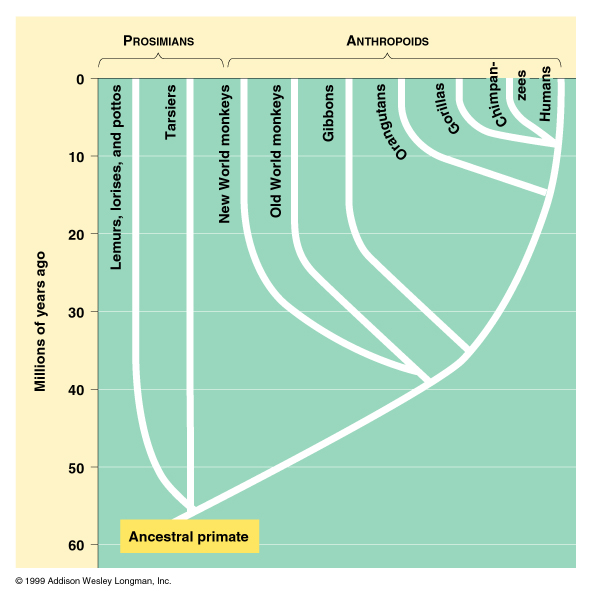
Primates descended from a small arboreal (tree living) insectivorous mammal in the early Cretaceous period, approx. 100 mya. A nearly complete fossil of an early primate dating at 56 million years old was found. It had grasping feet with an opposable big toe that had a nail instead of a claw. (Heller 674) These grasping limbs are one major adaptation that distinguishes primates from other mammals. This primitive primate, Carpolestes, did not have eyes positioned in the front of the face, which provides good depth perception, like modern primates do. The primate lineage split into two main branches; prosimians and anthropoids about 55 mya. Some examples of prosimians include lemurs, pottos, and lorises. Anthropoids include gibbons, monkeys, apes and humans. "New World monkeys diverged from Old World monkeys early enough that they could have reached South America from Africa when those two continents were still close to each other." (Heller 674) New World monkeys are tree dwelling organisms. They have long tails which are capable of gripping branches. Old World monkeys can be tree dwelling or terrestrial. Baboons and macaques are some examples of Old World monkeys. About 22 mya the lineage that lead to modern apes broke from the Old World monkeys. As many as 100 species of apes ranged over Europe, Asia and Africa. (Heller 674)
About 6 mya hominids, the lineage that led to humans, separated from the other ape lineages. "The earliest protohominids, known as ardipithecines, had distinct morphological adaptations for bipedalism- locomotion in which the body is held erect and moved exclusively by movements of the hind legs." (Heller 676) The most complete fossil skeleton of Australopithecine, 3.5 million years old, was found in Ethiopia in 1974. It was nick named Lucy and was assigned to the species Australopithecus afarensis. "Fossil remains of more than 100 A. Afarensis have now been discovered. During the part 5 years, fossils of other australopithecines that lived in Africa 4-5 million years ago have been unearthed." (Heller 676) The earliest members of the genus 'homo' was Homo habilis. Homo habilis evolved from A. garhi about 2 mya. Tools that H. habilis used to obtain food have been found with the fossils. Homo erectus evolved around 1.6 mya. H. erectus expanded around Eur-Asia. It used fire for cooking and hunted large animals. Many stone tools have also been found with their fossils. H. erectus died out around 250,000 years ago. H. Sapiens came into existence around 200,000 years ago. Although early H. Sapiens had larger brains than any other organism from the genus Homo, it wasn't as big as they are today. H. Sapiens brain sized increased rapidly until it reached it's modern size about 160,000 years ago. (Heller 677)
This striking change was probably favored by an increasingly complex social life. The ability of group members to communicate with one another would have been valuable in cooperative hunting and gathering and for improving one's status in the complex social interactions that must have characterized early human societies, just as they do ours today. (Heller 677)
Problems are flagrant right from the beginning with the Bible. There are two accounts of creation in Genesis.
And God made the beast of the earth after his kind, and cattle after their kind, and every thing that creepeth upon the earth after his kind: and God saw that it was good. And God said, Let us make man in our image.... So God created man in his own image, in the image of God created he him; male and female created he them. (Gen. 1:25-27)
This says that humans were created after other animals. It also leads one to believe that man and woman were created at the same time. A few lines later, the Bible contradicts itself.
And the LORD God said, It is not good that the man should be alone; I will make him an help meet for him. And out of the ground the LORD God formed every beast of the field, and every fowl of the air; and brought them unto Adam to see what he would call them: and whatsoever Adam called every living creature, that was the name thereof. (Gen. 2:18-19)
This says that humans were created before the other animals.
And the LORD God caused a deep sleep to fall upon Adam, and he slept: and he took one of his ribs, and closed up the flesh instead thereof; And the rib, which the LORD God had taken from man, made he a woman, and brought her unto the man. (Gen. 21-22)
This says that woman were created after man and after animals. Gen. 1:3 says that God created light, but it wasn't until the 4th day that God created the Sun. If you don't need the Sun for light, what?s the purpose in making the Sun?
And God made the two great lights; the greater light to rule the day, and the lesser light to rule the night: he made the stars also. (Gen. 1:16)
This says that the Moon generates its own light. 'and the lesser light to rule the night.' In reality, the Moon reflects the light generated by the Sun. It does not generate it's own light.
Another one of the many stories in the Bible which just doesn't make sense is Noah's Ark. In Genesis 6:15, the dimensions of the ark are given as 300 cubits long, 50 cubits wide and 30 cubits high. That translates into approximately 450 feet in length. "The longest wooden ships in modern seas are about 300 feet, and these require reinforcing with iron straps and leak so badly they must be constantly pumped." (Isaak) And as if that wasn;t enough, the ark would have to be stable enough to hold two organisms from every living species. There have been over 1.5 million identified species in the Animal Kingdom alone (Heller 503), and that number would sky rocket if even half of the species of off insects were named. If God told Noah to bring representatives from all forms of life, Noah would have had to get all organisms from the Plant Kingdom, the Fungi Kingdom, the Protist Kingdom, the Bacteria Kingdom and the Archaea Kingdom on top of all those Animals. Archaeans are single celled, prokaryotic organisms that live in the extreme environments of Earth. Some of these extreme environments include boiling water, super-salty pools, sulfur-spewing volcanic vents, acidic water and deep in Antarctic ice. (Archaea) Good luck with that. This brings up an interesting question, how did all these species of organisms get to Noah? Penguins can't fly, and can't live in warm temperatures. Many organisms require certain diets to survive. For example the koala relies on Eucalyptus leaves to live, did they bring it along with them? "Some cave-dwelling arthropods can't survive in less than 100% relative humidity." (Isaak) How did the iguanas or komodo dragons which are specific to only certain islands in the South Pacific Ocean get all the way to the Mid East? Or all the millions of different species of insects from the Amazon? The list goes on and on.
Say somehow Noah pulled it off. Now how is he going to care for all these organisms? Many animals are strict carnivores and eat only certain types of animals. The Bible says that the flood was started on the 600th year of his life, and it wasn't until the 601st year of life that it ended. "Many animals require their food to be fresh. Many snakes, for example, will eat only live foods (or at least warm and moving). Parasitoid wasps only attack living prey. Most herbivorous insects require fresh food. Aphids, in fact, are physically incapable of sucking from wilted leaves." (Isaak) Where was all this food stored? And the water? Noah couldn't have gotten the water from the ocean because the ocean is salt water. And if the flood water had diluted the oceans water enough to make it drinkable, that would kill most of the marine organisms living in it.
Fifteen cubits upward did the waters prevail; and the mountains were covered. (Genesis 7:20) If the flood happened, then it would have had to cover the highest mountain tops, Mount Everest is over 29,000 feet high, with fifteen cubits to spare. And this outlandish task had to be accomplished with 40 days and nights of rain. There are 24 hours in a day, 960 hours in 40 days, and roughly 29,000 feet of land to cover. That translates into 6 inches of water every minute, assuming no water is absorbed by the Earth. Where did all the water come from? Oceans make up about 97.2% of all the water on Earth, approx. 317,000,000 cubic miles. On Earth there is approx. 326,000,000 cubic miles of water. (Perlman) Out of the remaining 2.8% of water on Earth, about 2.14% is strictly from ice caps. 'If the water locked up in polar ice were to completely melt, the oceans would rise about 240 feet above its present level." (Lenz) If you were to take all the water from melted ice caps, ground water, fresh water lakes, inland seas, soil moisture, atmosphere, and rivers, it wouldn't nearly be enough to cover Mt. Major, never mind Mt. Everest.
If a global flood happened, why do ice caps still exist? "Such a mass of water as the Flood would have provided sufficient buoyancy to float the polar caps off their beds and break them up. They wouldn't regrow quickly. In fact, the Greenland ice cap would not regrow under modern (last 10 thousand years) climatic conditions."(Isaak) If somehow they weren't broken, scientists would expect to find evidence of sediments, noticeable changes in salinity and oxygen isotope ratios when observing the ice cores, but none of this data has shown up. (Isaak) A flood of this magnitude would leave evidence at the sea bottom. Large amounts of terrestrial debris, a shift in oxygen isotope ratios (rain has a different isotopic composition from seawater), a massive extinction, just to name a few. Why do none of these show up? (Isaak) According to the Bible, the only humans to enter the ark were Noah, his wife, his three sons and their three wives. Most Biblical fundamentalists believe the flood took place about 4,000 years ago. The diversity just among members of the same species today is far too great to obtain in 4,000 years. Take humans for example. Noah was believed by Creationists to live in the mid east. If only Noah, his three sons and all their wives were the only humans on the ark, you would expect that everyone existing today would look like Mid-Easterners. We would all also share similar genetic disease. In reality, this is not the case. The diversity that exists today among humans could not have evolved in just the last 4,000 years. If there really was a flood that covered the whole Earth, God must have concealed all evidence of it to trick logically thinking people.
There are 928 chapters in the Old Testament, the absurdities that I listed all came within the first 8. Trying to comprehend all of this in a logical way is impossible. And that is why some Creationists use the slogan 'with God, anything is possible' as their main argument. Reasons like that just breed ignorance.