
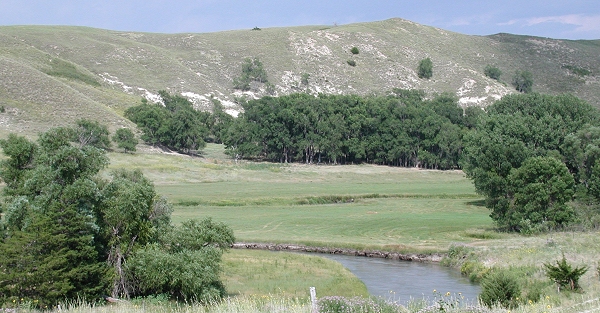
North and west of Mullen, in Cherry County, between the Middle and North Loup Rivers, is a large section of land known as Dry Valley. Soon after the railroad was completed as far as Mullen in 1887, Hugh Boyer, his wife and nine sons came from Virginia to make their home in Nebraska. Mr. Boyer and his sons, all of whom were of age, selected homesteads in Dry Valley. Mr. Boyer was a man of sterling character and left a monument of good will and friendship when he passed away at a ripe old age. At his funeral, the pastor took for his text, "A Mighty Man has fallen." There was genuine grief at the passing of this man who meant so much to his neighbors. In 1889 Steve James, William and Buck Pearman arrived with their families. In 1897 Calvin F. Long and F. W. Pool, with their families joined the settlement. Mr. Long had served in the Confederate army with General Early, when he surprised General Sheridan's forces at Winchester, Virginia. He was a splendid citizen. The writer knew and admired him very much. Going out to plow corn one day, riding one horse and leading another, he met a tragic death, and was found by his family when he did not return at the regular time. Mr. Pool lived in Cherry County until 1920, then moved to Mullen where he has lived since that time. He has served as County Judge of Hooker County for several years.
During the nineties, C. U. Long, Enoch Anders, J. R. Pool, Floyd Anders, Denis and H. B. Boyer, and their families arrived. In 1901 Robert Boyer, Tom and Will Car and families, R. F., Richard, and William Osborn, Joseph, Thomas, W. E. Verda, Lloyd, Con., and Carl Boyer, Rush Boone, A. B. Mastin, and Isom Cox became members of the community. These settlers were all from Virginia.
There were other settlers from various states who joined the settlement also. Elisha LeLaCheur was one of them.
The land was fertile and they made their living by farming, poultry raising and later dairying. They had a sorghum mill which did a good business making molasses. They harvested their grain with a mowing machine, there being no binders at that time in the community.
Their first school was a subscription school taught by Hugh Boyer, in a sod house in 1892 and 1893. In 1902, a school district, No. 98, was organized and a frame building was erected. The first teachers were Lydia Gorsuch, salary $20.00 (96) per month; Mollie Bush, salary $25.00 per month. In 1906 a Sunday School was organized in the school house, with J. R. Pool as Superintendent. The sessions were well attended and created much interest.
About this time, two missionaries, Reverends Stuart and -- Hall came into the community with a large tent and held a series of meetings. The result was the building of the Dry Valley Church, which was dedicated to the Congregational denomination. Reverend N. H. Hawkins of Seneca was pastor for a number of years. Miss Maxine McNeal, a member of this church went as a missionary to China, and was captured by the Japs, held for more than a year, then released and returned safely to her native land.
In November, 1894, a prairie fire swept the community. Elisha LeLaCheur and his brother-in-law, John Bliss, were overcome by the flames and were so badly burned that they died soon after reaching the house. A son, John LeLaCheur, was only saved by the team which became frightened by the flames and dragged him out of the line of fire. Mr. Elisha LeLaCheur's son, Frank, now owns the old homestead. When this history is being written most of the pioneers have passed away, and a number of their sons and daughters are carrying on. Stock raising, poultry and dairying are becoming important factors in their operations. As in all other sections of the county, the trend is away from farming, and stock raising is taking its place.