
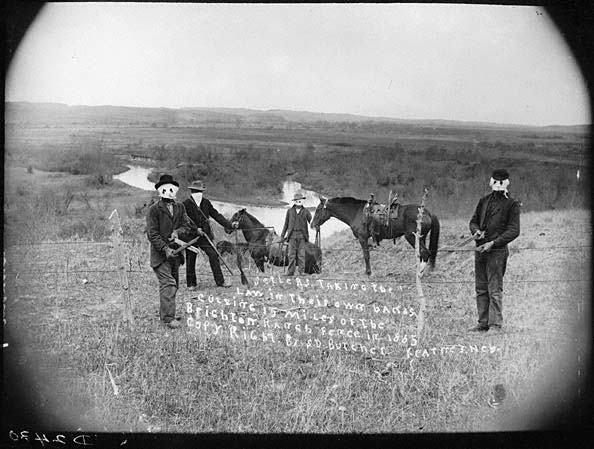
The period known as the "open range days" began in Nebraska when Ed Creighton brought a large herd of cattle from Texas into what is now Cheyenne County, in 1869, and located on the North Platte River, near Ogallala. They came over the Chisholm Train. Soon other ranches were established along the North and South Platte Rivers.
Another tragedy marked the shipping season in the fall of 1882. The F. L. Outfit had loaded out a shipment at Thacher. One of their cowboys was shot and killed by mistake by a man who was looking for another man whom he wanted to "get". The body was buried about one fourth mile north of Thacher.
The cattle gathered in the beef round-up of 1882 in Cherry County were shipped from Thacher. Those gathered in 1883, 1884, and 1885 were shipped from Valentine. Since that time cattle were shipped from the stations along the Northwestern Railroad. From west to east on the Niobrara River, the E. S. Newman Outfit, carrying the brand of N had the home ranch on the north side of the river near the mouth of Antelope Creek, not far from the Lavaca Bridge. Two of the cowboys who worked on this ranch during the winter of 1879 were Charles and Bob Ford, who later killed the famous Jesse James.
The years of 1882, 1883, and 1884 were the years of most rapid settlement. All through the 80s the home seekers came. There was ample rainfall during that decade and the settlers (30) were blessed with good crops and gardens. As has been said, the open range cattle were moved out of the county in 1885, leaving room and opportunity for the settlers who wanted to engage in raising livestock.
Students in future years will be interested in knowing how settlers lived on their trips from eastern homes to the new country in which they were making their permanent homes. Mr. and Mrs. Clarence Cutcomb of Cody, Cherry County, were among the first settlers to locate on a homestead south of Cody. We shall let Mrs. Cutcomb tell the story of their trip from near Muscatine, Iowa, to their Cherry County homestead. "We left our home near Muscatine, Iowa in the spring of 1887. We came by train to Norfolk, Nebraska and from there in a prairie schooner, (covered wagon) drawn by two horses. We camped along the way and slept in the wagon. It took us two weeks to get to Cody from Norfolk. Mr. Cutcomb filed
Our fuel consisted of cowchips until a prairie fire burned all of our supply. We then went to the Niobrara River for pitch pine wood which was plentiful. As a protection against prairie fires, we plowed a number of furrows around our sod house. Our home was near Cutcomb Lake which was named for us. Mr. Cutcomb was twenty years old, and I was sixteen at that time."
When the nineties arrived, a change came over the country. A severe drought in 1890 ruined the crops, causing many people to become destitute. The session of the legislature which met in 1891 appropriated $200,000.00 for relief of the people. This drought was followed by a depression which created a panic in 1893, which also was the driest year on record in Cherry County. It even exceeded the great drought years of 1934 and 1936. To add to the misfortune of the settlers, a hot wind on July 26, 1894 made an almost total failure of the corn crops.
A great event in the history of Cherry County, as with other counties in the sandhill region of Nebraska, was the passage of the Kinkaid Amendment, to the Homestead Act, which went into effect June 28, 1904. It provided that a person who had never taken a homestead could file on 640 acres of land. If he already had a homestead of less than 640 acres, he could take additional land to make a total of 640 acres. All present settlers had first right to file on land which adjoined their original homesteads.