|
These early pioneers
were well-aware of the risks. Ocean travel on tiny wooden ships was a
perilous voyage. And the risks of settlement were even greater! There
were stories of savage Indians, wild animals, harsh winters, and many
other dangers.
|
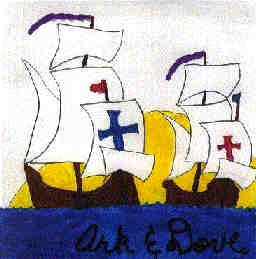
Artwork
by Ashley
R. of the Delmar School
|
On the day
of the feast of St. Cecilia, November 23, 1632, the Ark and the
Dove departed Cowes Harbor in the Isle of Wight for the New World.
George
Calvert, the first Lord Baltimore, had a dream of providing
refuge for his fellow Catholics from the religious persecution of
17th Century England. He wanted to create a colony in the New World
where there would be religious freedom and a separation of church
and state. All religious groups would be tolerated and could live
peaceably in the same civil society. It was an idea that had never
been tried before.
|
The second Lord Baltimore,
Cecil
Calvert, gambled his family's fortune to make his father's dream come
true. In 1620 Cecil Calvert purchased land in Newfoudland, Canada, and he
created a settlement at Ferryland in the Province of Avalon.
Calvert visited Avalon in 1627 and 1629, but ultimately the colony failed
due to the harsh conditions in Newfoundland. On his return to England, he
visited the colonies in Virginia. |





