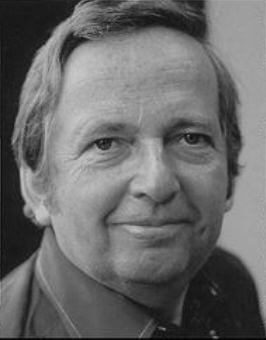
Peter Thomas was born on December, 1st 1925 in Breslau, Germany (now Wroclaw, Poland) and later relocated to Berlin where he lived until he started writing soundtracks. He was first exposed to music by his grandfather, who led a German army band. He started taking piano when he was five, went on to trumpet and violin, and studied at the Morsches Conservatory. By the time World War II ended, he was playing professionally. He spent the early postwar years as a cocktail pianist, mostly at clubs run by the various military forces occupying Berlin (in all four sectors), which gave him a crash-course in pop music.
He kept up a course of classical music study, and in the early 1950s, began working at radio station RIAS. He performed, conducted, and arranged for the station, and got his first exposure as a composer writing spot and incidental music. He learned about sound engineering, studio techniques, how to work efficiently with an orchestra, and how to write and arrange in a wide variety of styles.
By the late 1950s, Thomas had begun freelancing with the re-emergent German film studios. He got his first shot at soundtrack composing with the 1961 Rialto Films movie, "Die Seltsame Grafin", one of a popular series of B-movies based on the mysteries of pulp author Edgar Wallace. Thomas went on to score over half of the 32 films in the series. He also scored the six films based on the German Westerns written by Karl May (Hitler's favorite author), which featured the Indians, led by Chief Winnetou, as heroes instead of the cowboys. Thomas added a third hero, Jerry Cotton, another pulp fiction creation, to his list with the 1965 film,"Schüsse aus dem Geigenkasten". Thomas racked up a total of eight Jerry Cotton scores, which are considered some of the best spy music around.
Next, Thomas launched into space with the soundtrack for the seven episodes of the 1967 joint Bavarian/French television series, "Raumpatrouille." Although he occasionally tossed in a vocoder he discovered in the corner of a Siemens factory, Thomas avoided the use of special electronic effects to produce the sensation of space in his music. Instead, he wrote a tightly-harmonized pairing of brass and female voices, a soulful Hammond B-12 organ, and plenty of thumping electric bass and guitar. It was the reissue of the "Raumpatrouille" soundtrack in 1994 that sparked Thomas' rediscovery and left us all wondering how anyone could have overlooked such cool music.
Though Thomas avoided overusing electronic instruments for "Raumpatrouille," that shouldn't be taken to mean that he was averse to them. He was constantly experimenting with electric keyboards and circuitry. One of his inventions, the "Thomwiphon," a 12-oscillator synthesizer, is now on display at the Deutsches Museum in Munich.
|
Mr Bungle covered 2 Thomas selections during their 95-96 tours in support of Disco Volante.
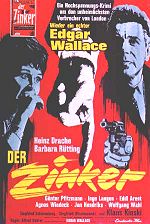
"Der Zinker" (The Squeaker), was taken from the 1963 Edgar Wallace movie of the same name.
It is available on the "Kriminalfilmmusik" compilation.
The second composition "Love In Space" was taken from the German TV Sci-Fi series "Raumpatrouille" (Space Patrol). Produced in 1966 it portrayed the phantastic adventures of the spaceship "ORION". "Love In Space" is available on the "Raumpatrouille" soundtrack. |
|