|
|
| By: John, Brooke, Dan, Jeremy, Chris, Brittaney, Jack |
|
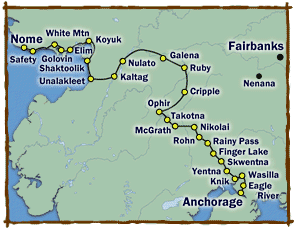
There are plenty of prizes that the mushers can pick up along the trail. The first one to the halfway mark at Cripple wins the prize of $3,000. The first one to arrive at Ruby receives $3,500. The first one to arrive at Unalakleet wins an Alaska Gold Coast Award. There are a lot more prizes. These were just a few of the prizes. |
| The Iditarod Race is a huge race so you need to
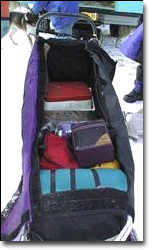
have required equipment to win. The following items are mandatory in this race: 1. Proper cold weather sleeping bag weighing a minimum
2. Ax, head weighing a minimum of 1 3/4 lbs... handle
at
3. One pair of snowshoes, with each snowshoe having
4. Any promotional material provided by the ITC (Iditarod Trail Committee). 5. 2 sets of booties for each dog in your team. 6. One operational cooker and pot capable of boiling
7. Veterinarian notebook, to be presented to the
|
 |
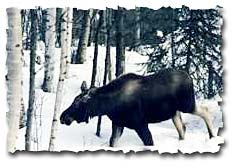 |
There are many rules for the Iditarod race. One of the rules are that you have to carry a gun at all times because one of the major concerns in Alaska is moose. If they think that you are going to hurt their calves they will trample you. If you carry a gun, you don't shoot the animal, you shoot the gun in the air to scare the animal away. If you have to shoot an animal you have to gut it out. No other mushers can pass you until you are done. They can pitch in and help, too. Tell ITC officials when you get to the next checkpoint. |
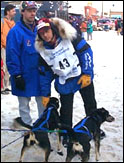
| Bibs are important to mushers and race officials.
When you pick your bib number out of a boot, that's what place you start in. When you are on the trail, if you try to cheat or abuse your dogs there are people who can tell race officials your bib number. Your bib number is also important in case you get hurt and can't talk. You are recognized by your number. You must wear your bib in a legible fashion. If you scratch you must hand your bib in to ITC officials. The musher my team followed was Martin Buser.
He is
|
 |
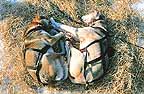 |
Mushers must take a 24 hour layover and (2) 8 hour layovers. In the race there are checkpoints and at them you can stop if you want. Three stops are mandatory. Your 24 hour layover is mandatory, but a musher can decide where to take it. The best places to stay are McGrath and Takotna. One of the 8 hour layovers must be taken in the Yukon and the other one must be taken in White Mountain. |
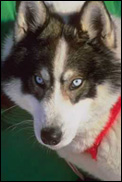
| The maximum and minimum dogs you can have on a team
at the start is 12 to16 dogs. You must have 5 dogs at the finish of the
race. If you do have less you will be disqualified. No dogs can be added
to the team during the race. All dogs must be either on the tow line or
hauled in the sled and cannot be led behind the sled
or allowed to run loose. You must keep your injured dog in the sled until the next checkpoint. |
 |
 |
The Good Samaritan rule is important to everyone during this race. The Good Samaritan rule is that you won't be disqualified if another musher helps you if there is an emergency. Incidents that occur will need to be explained to the race official at the next checkpoint. |
| A musher may receive outside assistance between checkpoints in certain instances. Mushers can be helped by snowmobiles or each other. If a musher is helped by snowmobiles to find their dogs, they must return to where they lost them. Care and feeding of dogs must be done by their own musher. No other assistance is allowed at all. Other mushers can not lend or borrow supplies. If a musher drops a dog, he or she can't borrow a dog from another musher. | 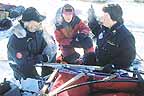 ` ` |