IDITAROD HISTORY
by:  Jimmy, Nick, Shea, Stephen, Dorothy, Kallianne, and Cierra
 
The Father of the Iditarod is a very important man. He 
is the creator of the Iditarod Dogsled Race. His friends called 
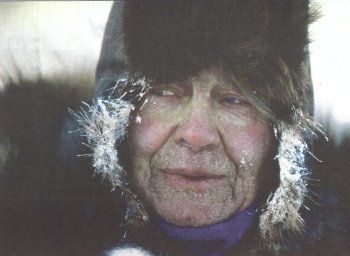
him, "Never say no, Joe". He was from Knik. 
He had a lot of land to run on and a lot of dogs 
to use on the trail. In the late 60's, the Redington's son 
Ramy and some neighbors started talking about commemorating
the 100th anniversary of the purchase of Alaska.  Dorothy Page wanted to preserve the historical Iditarod trail. Redington wanted to stimulate the dying sport of mushing.  Their discussion gave birth in 1967 to the Centennial Iditarod Sled Dog Race, a two day 50 mile race around Big Lake.  It was billed as the "World's Richest Race" with a purse of $25,000.  This year marks the 29th year of the Iditarod Race.  Joe died earlier this year and all the mushers stopped in Knik to honor him and his wife. 


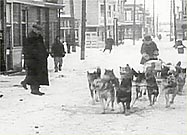
Back in 1925, there was a rush to get medication
to Nome.  The sickness that caused the rush was
called diphtheria (dip-theer-ee-ah). The town had a
meeting and they decided that they were going to get
the medicine to Nome by dog sled. The doctor at Nome
said it would be too slow but it was the only way.
There was an announcement on the radio and it said,
" We need the best dog sled teams to get medicine to the
sick people of Nome." They put the best dog sled teams
at every town from Anchorage to Nome until the sick
people got the medication. That was the Serum Run
of 1925.


 The Iditarod trail came about because of two things: illnesses and gold. The trail came about because gold miners had to get the gold from Iditarod to their homes. A lot of gold was in Alaska and much of it was in Iditarod. Most bonanzas in Alaska occurred in the late 1800's. Bonanzas are old-fashioned, frontier style gold rushes.  From Unalakleet the trail swept North then West.


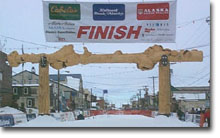
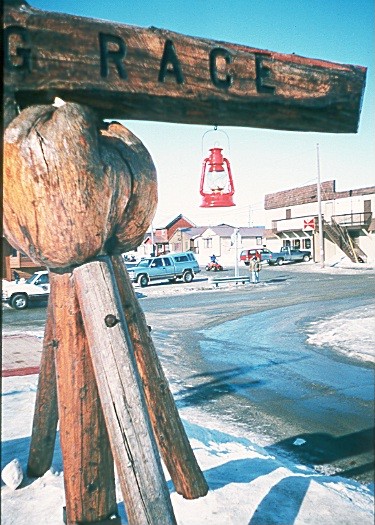
     Each racer passes under the Burled Arch at the end of the race.  The Arch has been deteriorating over the years. When they tried to put it away for the summer, the five thousand pound arch broke into many pieces.  The arch was constructed by a local Lion's Club as a permanent marker for the finish line.

     Red Olson was the person behind the construction.  He earned the Red Lantern as the last finisher of the Iditarod Dog Race in 1975.  The Arch reads, "End of Iditarod Dog Race."


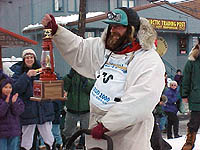
The Red Lantern is a lamp that the last musher who
finishes the race receives. It is lit when the race
starts and it burns until the race ends and then it is
blown out and handed to the last place musher. It
started because it is a tradition  that people made a
joke out of originally.


Everybody that has passed though the Burled
Arch is a winner in the Iditarod, but the real winner
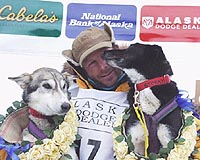
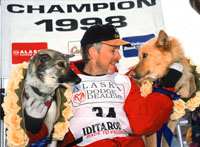
comes first. The people who won in the last three
years are Doug Swingley, Jeff King and Martin Buser. Doug
Swingley won in 1999 and again, this year, in 2000.
Jeff King won in 1998 and Martin Buser
won in 1997.


Sometimes people scratch during the Iditarod race because they get hurt or do not have enough dogs. To scratch means to choose to quit the race. In 1999 there were nine people who scratched. They were Linda Joy who scratched at Shaktoolik, Harry Caldwell who scratched at Eagle Island, DeeDee Jonroe at Grayling, John Barron at Iditarod ,
Steve Carrick at McGrath, Steve Crouch at McGrath, Ted English at Rainy Pass, Dan Dent at Skwentna ,and Robert Moore.
Hosted by www.Geocities.ws

1