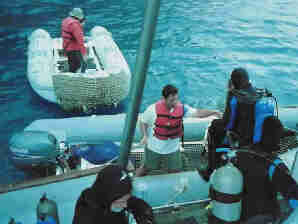
As we approach the entry point, the
engine and sputtered and died. Jacinto, the panga driver,
furiously tugs at the starter chord in an unsuccessful
attempt to coax the engine back to life. He then reverted
to checking the connections between the gas tank and the
engine before resuming his assault on the chord. Raphael,
our guide and naturalist, suggests that we abandon the
panga and swim to the drop in point. This idea is met
with stone-cold silence. Perhaps thinking we did not hear
the suggestion because of the cold water hoods that we
wear obstruct our ears, he repeats it, only to have it
met with a more strident silence...a kind of unspoken
"not only no, but hell no". Just then the
engine sputters to life, brought back from the dead by
the triage and aid rendered by Jacinto, and the mutiny on
the panga that would have inevitably followed the third
reading of the suggestion that we swim for it. Over the
next few days I would come to admire Jacinto’s
patience and creativity in dealing with the panga. Some
of these attempts included use of both hands and feet in
a contortionist’s stance to get the engine started
We are diving an area known as "The
Landslide" after the prominent feature that scars
the side of the island. The plan is to drop down to 60
feet, spread out about 10 to 15 feet apart, and wait for
the current to bring the hammerheads in to the wall. We
had a few sharks approach, but nothing in the great
numbers the photographers need to get the shots that they
have come to get. The second dive is nearly a carbon copy
of the first dive and we follow a nearly identical
strategy with similar results. But then the definition of
insanity is doing something the same way as before and
expecting a different outcome. So it was with the engine
on the panga.
The motor behaved like a temperamental prima donna,
working only when it wanted and after receiving a lot of
attention, for much of the trip. We fared little better
with the spare engine which served as backup and
understudy, taking its cue from the original engine. Our
frustration with mechanical things peaked the next day
when the fresh water maker decided to join its engine
brethren in the general strike and ceased making water
just as many of the divers were in their stateroom
showers lathered up with the end-of-the-dive day
cleansing and hose down. The water maker is eventually
restored to operation by the now-harried engineer.
Our concern regarding the reliability of the
panga’s engine is not a matter of mere delay and
inconvenience. These vessels are the only thing standing
between a successful pick up at the end of the dive and
the possibility of being lost as sea. I do not mean to
sound melodramatic, this area is known for strong
currents and prospective divers constantly reminded that
this is not a location for the novice or less-experienced
diver. Much of the activity involves drift diving in a
fairly strong current and ascending to a sea surface that
can have a pretty good swell running. Ideally, each panga
follows its divers, picking up each of us as we surface.
During a dive at Cape Marshall, the presence of small
pelagic jelly fish brought in by the current decreased
the already low visibility from the green water. The two
groups of divers started the dive apart but soon became
intermixed. By the end of the dive, which seemed to cover
a fair length of the island because of current, diver
pickup was random, we were picked up by whatever panga
was closest, with little regard for which panga we
started the dive from just a short time before.
But the engine was not the only concern we had about
the panga. Imagine sitting on a mechanical bull while
wearing full scuba gear and you have an idea as to what a
panga ride in rough seas can be like, you are going to
feel every bump and buck. Exacerbating the ride was the
lack of handholds on the side of the panga, which are
usually placed to give the diver something to hold on to
for stability in rough seas. With these missing, the
result can be a filling rattling, bone jarring, vertebrae
misaligning experience. Had we stayed much more than two
weeks, the resulting therapy would have paid for the
addition to my chiropractor’s house.
Rigid-hull inflatables are generally pretty seaworth
workhorses, but several in our party have expressed
reservations about the reliability of the powerplant
affixed to the craft’s transom and the tendency of
the craft to take on water during low speeds which
precludes self-bailing. We had to position ourselves far
to the rear to keep the boat from swamping.
Jacinto in our group’s boat and Marlo in the
other group’s boat, seem pretty adroit at handling
these small craft. Their seamanship is demonstrated
during a pickup from Suarez Point on Espinola Island.
Each vessel had to navigate a narrow channel with a rock
reef to seaward and a rapidly shoaling beach landward.
The sea broke over the rock reef making the channel
extraordinarily rough. Complicating the pickup were
several sea lion who blocked the normal extraction point,
necessitating that we scramble over the rocks like so many Sally Lightfoot crabs to get to a shallower extraction point.
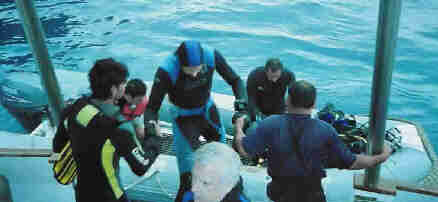
Besides seamanship, the panga skippers also haul our
gear into the panga at the end of the dive. The normal
procedure for exiting the panga is a simple back roll, a
maneuver most divers practice from a pool edge during
certification but seldom have the opportunity to use
again, since the normal entry from high freeboard boats
is the giant stride entry. Getting back into the panga
takes a bit more effort. On surfacing, the diver gives
the universal hands-in-a-semicircle-over-the-head
"O.K" signal to the boat operator who then
motors over to extract the diver. We hand up cameras,
remove our tank and buoyancy compensator which the
lower-back-weightlifter-belt-worn-under-the-lifejacket
panga driver then hauls into the boat, remove and hand up
our weight belt before doing a handstand press on the
panga’s air chamber to clamber over the side and
into the boat. People who have observe my technique for
getting back into the panga say it reminds them of
watching a bull sea lion haul out onto a floating dock in
Monterey and that it is more entertaining than the orca
show at Seaworld.
On rare occasion, I have had to signal my return to
the surface with the loud-almost-deafening screeeetch
from the air horn signaling device that fits inline
between my power inflator hose and the power inflator for
the buoyance compensator. This device has one purpose to
get the attention of the boat. In addition, each diver
has a dive tube or sausage that can be inflated and held
vertically to draw attention to a diver riding low in the
water who may be obscured by high seas. Some of us carry
strobe lights, signal mirrors, and dye markers, devices
that will increase the likelihood being spotted should
the sea decide to take us adrifting.
At a place that is little more than a small rock in a
big ocean, conditions seemed to be right for one or more
divers to go missing. The current was fast and the height
of the seas made it difficult to spot the divers. I was
the first one back to the panga. I could see the look of
concern in the face of Marlo, as if he was muttering a
silent prayer to "please don’t let me miss
spotting someone when they ascend." The language
barrier and probably cultural restraints kept him from
voicing concern. He didn’t need to verbalize the
situation, I recognized the look from my time working as
a divemaster on boats at the California Channel Islands.
And as for the prayer, I had muttered it myself on a
couple of occasions. Fortunately, all those prayers were
answered on this trip and the answer was "O.K."
|