Monitoring the Kelp Forest
I participated in the Channel Islands National Park (CINP) Kelp Forest Monitoring cruise aboard the vessel Pacific Ranger the week of July 17 to 21. The cruise participants, some of the finest people I have had the pleasure to dive with, collected data using a variety of established protocols. Researchers use this data to monitor the "health" of the kelp forest ecosystem at established points in the ocean waters of the Park. This effort is now in its 19th season. Eight divers joined the cruise. I made 14 dives during the five-day period. All operations were safety conducted.
Monday, July 17
We loaded Park Service vessel Pacific Ranger, cast off our mooring lines and departed Ventura harbor at 0930 bound for the "Yellowbanks" area on the south side of Santa Cruz Island. The trip to the area was uneventful. During transit, the more experienced members of the survey party (them) gave the less experienced members (me) a briefing on the research protocols that the monitoring project uses. Only a few Park Service employees make this survey. These cruises rely on well-qualified volunteer divers. I dive for my agency, Minerals Management Service, a sister agency of the National Park Service at the Department of the Interior. I am the only non-NPS "fed" on board. The rest of the divers affiliated with university diving programs or work for the state of California. Most have some formal marine biology background. I am the exception; I am a diving "social scientist" who got my start as a volunteer doing shipwreck surveys for the National Park Service. I realize that I am going to dive with a lot of different people and learn a lot on this trip. I have done one of these trips before, two years ago.
|
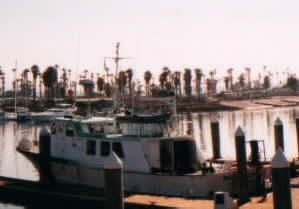
| The National Park Service vessel, Pacific Ranger |
We anchored at Yellowbanks at 1230. I have done a lot of diving over the last two decades at this spot. When we get to a site, two divers go over the side to locate the baseline, essentially a 100 meter steel cable permanently installed on the sea floor (or about as permanent as one can get in the ocean.) Pelican buoys are deployed to mark both ends of the line. Once the small yellow-green float pops to the surface, an empty, economy size, red laundry detergent bottle is attached to the line. This "buoy" is a little easier to see on the sea surface--an important feature when precisely anchoring over the line or for station keeping during live boating. The crew then places a tape measure along the baseline to provide numeric references for data collection.
As the first task, my buddy team conducted a fish survey. The survey uses a straightforward protocol. Basically, the diver swims along a transect line for thirty minutes noting the species and abundance of fish (that is, single, few, common, many). The survey begins on descent in order to cover the entire water column. While we record all species we can positively identify, the protocol calls for paying special attention to seventeen different species. Furthermore for some species we are asked to note the stage of their development--juvenile/adult, and their gender--male/female.
On the second dive, my buddy team task is to remove critters from two artificial recruitment modules or ARMs, essentially wire cages with filled with seven layers of 1/2 cinder block. The block provides the hard substrate for various organisms to take up residence. Recovering the critter consists of removing the top from the ARM, taking out each of 28, 1/2 cinder blocks, collecting the smallest to largest organism and placing them into a mesh bag, and restacking the bricks into the wire cage. We take care to detect the smallest of specimens and place them in a finer-mesh bag. Back on the boat, we identify and measure the critters by species. On the third dive, the critters are placed back into the ARM and the lid sealed. We reel in the tape measure and recover the Pelican buoys before returning to the vessel.
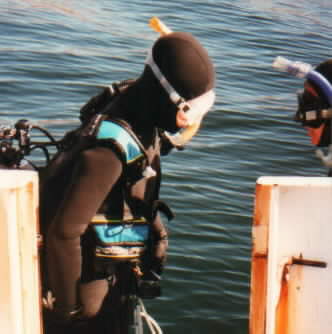 |
| Buddy team prepares to enter the water at Yellowbanks. |
My log book entries sparsely recorded over the years note that this once was a great spot for pink abalone. Not any more. There is nary an abalone of any color to be found. The reasons are several and complex, disease, overfishing, El Nino. Take your choice. While each is a necessary condition, no one is probably sufficient to explain the demise. It may be that the whole is greater than the sum of its parts or more accurately, the remainder is less than the result of the subtraction.
Tuesday, July 18
Shortly after first light, we motor west along the "backside" of Santa Cruz Island. The calm seas make the voyage very easy while in the "lee" side of the island. Soon we emerge into the "Potato Patch"-- an area of confused seas between Santa Cruz Island and Santa Rosa Island. This promises to be the roughest part of the passage. For an hour we make headway, but our progress in measured not in nautical miles per hour but in the pitching fore-and-aft and the rolling side-to-side of the vessel. No one has yet devised an amusement park ride that will replicate this sensation, probably because no one would go on a ride whose main purpose is not to terrify, but to produce mal-de-mare or seasickness. Sleeping through it is the best way to take the Patch, but this is an elusive a state of semi-consciousness few can achieve when anything that isn't nailed down (and a few things that are) are shifting, banging, clinking, and clanging from the movement. Enough time at sea, gaining your "sea legs," helps render the contrary motion tolerable. I have almost reached that state, but the Patch can put this immunity to the test. Doping oneself up on motion sickness medicine is not an option. The seas soon overwhelm any pill's ability to deaden the impulses from the middle ear that tell your brain one thing while vision tells it another. Experienced sea voyagers suggest that you watch a distant point of land as a way of helping resolve the dispute between sight and balance. In the Patch, all that advice does is let you know what an island jumping up and down looks like. Eventually, we cross the Patch and are in the lee of Santa Rosa Island. I recall one more adage that describes seasickness, "first you are afraid you are going to dive, then you are afraid you ain't."
We approach South Point. We plan to work two sites at Johnson's Lee just east of the point. The first site, Johnson's Lee South, is a deep site in about 50 feet of water. The second, more shallow site, Johnson's Lee North, is closer to the island in about 30 feet of water. For diving safety, the general practice is to make the deepest dive first and then make subsequent dives progressively shallower. We suspect that a strong current at the South site will prevent diving. The strong current is evident by the kelp plants, which should be thick on the surface, are nowhere to be seen. Our suspicion is further confirmed when we anchor. The boat should swing into the wind. Rather, she swings into the current and a wake appears aft of her stern caused by water movement against the hull, as if the boat is underway. It is essential that the vessel be anchored close to the transect since surface-supplied air diving is done under one of the protocols. We can't work under these conditions so we move in toward the island to do our work at SRI-north.
The first dive at this site replicates the initial dive at every site, we do a fish count. Each site has a slightly different distribution of fish. Each night, members of the survey crew examine the various species identification books brought aboard in the "KFM library" a blue ice chest filled with a variety of references on marine life in the area. The boat becomes a floating classroom with divers talking about various critters, their characteristics, and behaviors. I find myself referring to these documents from time-to-time. After diving in these waters for nearly 20 years, I am familiar with all common species of marine life, but a refresher is in order every year, so I bury my nose in the books between dives. Most divers recognize the charismatic macrofauna. You know, those big fish that we attribute mystical powers to or are especially enamored by; the rest of the ecosystem be damned. These include whales, dolphins (of whom many impart a great spiritual significance), sharks, lobsters, halibut, sheepshead, and so on. But, if these are all you know, lumping all other species together as "fish" during the fish count doesn’t quite yield the precision in the data that we require to do monitoring.
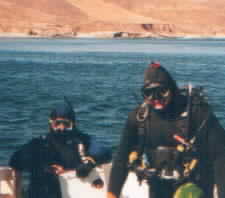 |
| Author (right) and buddy prepare to enter water at Johnson's Lee. Note the calm water. |
On the second dive my buddy and I conduct a census of the macrocystis (kelp) plants one meter from the baseline. He works one side of the line. I work the other. We manage to stay within "buddy distance" of each other, despite the fact that the plants are not always spaced out in "buddy-friendly" patterns. This type of diving requires a certain amount of self-sufficiency and solo skills, but the integrity of the buddy system is maintained.
The third dive involves measuring knobby stars and recording their measurements on slates for later transcription on to data sheets. The dive is fairly routine. Distribution of knobby stars seems as random as it is for the kelp plants. Like teenagers, the stars seem to be where the food is. In fact, I seem to interrupt the feeding of several stars. It would be the same if aliens invaded my dining room at suppertime, pulled me away from the table, measured my longest appendage, and then put me back in my chair. It kind of adds a new dimension to the dining experience.
At the end of the dive, we return to the boat and hang in 15 feet of water breathing oxygen as a preventative measure for decompression sickness. Ascending to the swim platform on the stern of the boat, we break the surface and are greeted by seas whipped by what has to be a 20 to 30 knot wind from off the island.
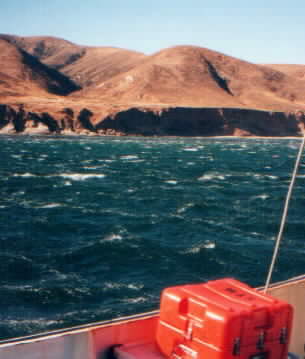 |
| The seas that greeted us on our return less than one hour later. |
Getting back onto the boat is a matter of timing and represents a combination of a "spy hop" done by whales and a "haul out" done by sea lions. First, we remove our weight belts or weight packs to lighten the effort and take off any gear bags or equipment clipped to our gear to prevent snags. Both hands are placed on teak swim platform and the diver raises him or herself onto the platform. Imagine a gymnast in a wetsuit and full dive gear (sans weight belt) mounting a pommel horse and you kind of got the picture. This is the "spy hop" portion of the maneuver. The diver is half out of the water with arms fully extended. He or she then kicks and rolls their legs onto the platform to do the "haul out" and complete the move. Imagine aforementioned gymnast staring the routine on the horse and you kind of got the picture. Now, to make things really interesting for the gymnast, start rocking the horse fore and aft. In a swell, the stern dips slightly. The dropping stern also provides a bit of leverage as it rises. While dropping only a few inches at most, those inches can seem like miles at the end of the dive, especially if the maneuver is mistimed and started as the stern is rising. We then kneel as if in prayer, thanking the deity for our safe return from the dive. We then grab the top of the rail and pull ourselves upright, remove our fins, and waddle onto the deck, completing in a few seconds that which took our forebearers millions of years to achieve through evolution.
Getting back on the boat sometimes takes a try or two, or three. No one thinks to shout an encouraging "alley oops." The older and fatter I get (also part of evolutionary progression), the more tries it might take or the more groaning there may be if the try is successful on the first attempt. All those push-ups during the year mitigate, but do not eliminate, the effect of progressing years.
As the sun heads behind the hills of the island, diving operations end for the day. Its time to get warm. The water seems cold, but a hot water hose is always available. Appendages, such as feet, are warmed by direct application of hot water. Gee, it feels great.
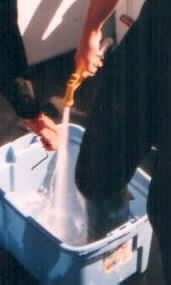 |
| Warming up the extremities. |
Wednesday, July 19
All the gear on the deck is caked with salt this morning—the residue of last night’s wind whipped seas. All the equipment is cleaned off and checked as we prepare for the first dive of the day.
The first dive of the day is at the SRI-north site. I descend very slowly in and constantly equalize the pressure using the "Valsalva maneuver" which sound like a German military tactic, but simply means, "pinch the nose and blow." Look it up, it's in the dictionary stuck between valor and valuable, as in if you have the valor to do the survey, you had better to be able to valsalva, in order to remain valuable. I have had a little difficulty equalizing, not enough to keep from diving but enough to keep me from descending head-straight-down. My buddy and I spend part of the dive looking for a wayward ARM that has yet to be located. The search proves fruitless; the module cannot be located, part of the rare but not unknown attrition of these structures over time.
We spend the remainder of the dive collecting red and purple urchins at various places along the transect. My partner is a bit more experienced and adept at collecting the critters. His bag is full before mine, but I finish the task before a diminishing air supply causes me to surface. We secure the mesh bags containing the urchins to lines hanging from the boat. This keeps the urchins submerged until we bring them aboard to measure them.
We bring each bag aboard, segregate the urchins by species, and measure them with calipers. We callout the measurements which are recorded on a tally sheet for later entry into the database. The recorder calls back our measurement to make sure it is correct. "43…43, 56…56, 23…23" for a couple hundred measurements. I expect someone to say "hike" at the end of the string or stand up and yell "bingo." As we finish with each creature, we toss it over the side of the boat, returning it to its environment. A diver on the bottom under the boat might experience this "urchin hail" until all the critters are measured. After we finish, I us a pair of sharp tweezers to remove a few urchin spines from my paws. Urchins are the porcupines of the sea. Pick them up and play with them but, if they don’t like being disturbed, you will be skewered.
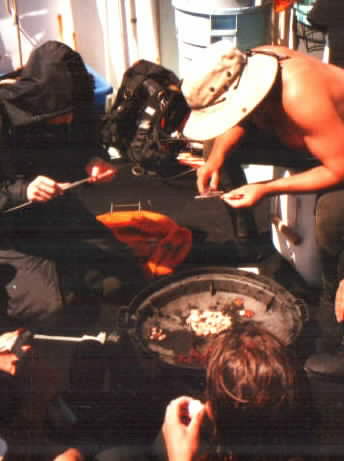 |
| Measuring the urchins. |
On the second dive, each diver in my team measures 60 puffball sponges at various locations along the baseline. This measuring is done in situ (a term, which in this case means, "as they sit on the bottom") using calipers and recording the measurement on a slate. We are warned not to come back without our calipers. It seems that in the past these devices have been lost. I put both calipers and slate in a mesh bag, which will clip to my harness at the beginning and end of the dive. The surge on the bottom makes lining up to measure the orange colonial a real test of buoyancy control. Even though items under water appear 25 percent larger because of the magnification effect of water, I wish I had bifocals installed in my mask to read the increments on the scale a bit faster.
Between dives, we are invited to snack on various victuals place in the galley—chocolate, trail mix, dried fruit, fresh fruit, potato chips which are the hors d’ oeuvre before a fully lunch and dinner. Come to think of it, we are not invited to "snack" as much as we are invited to "graze" or "mow." Scientific diving is much more strenuous than sport diving under the same conditions. It is both physical and mental. It is also more arduous, even if one has the sedentary, or rather sessile, task of emptying, inventorying, and reassembling recruitment modules. Immobility is achieved by station keeping which requires a large expenditure of energy. Paradoxically, because the diver is motionless, he or she seems more susceptible to getting cold. These between dive snacks provide energy that compensates for the expenditure of energy. We are diving machines, but not perpetual motion machines. At least it provides a great rationalization for scarfing down trail mix laced with plain M&Ms. Yum.
On the third dive, we move to SRI-south to do a thirty-minute fish count. We take a long surface interval and check our dive profile as insurance that this slightly deeper dive will be well within the safe diving envelope. I am getting pretty good at these fish counts. Repetition makes for reliability. After dive operations are done for the day, the data is methodically recorded and checked before the slates are cleaned in preparation for the next day’s activity.
This isn’t a cruise liner; we just eat like it is. We might even be able to play shuffleboard if it weren’t for all the dive gear on the fantail. But, after all is done for the day, after the gear is stowed, the meal prepared, and the dishes done, the "card room" opens as some of the crew plays a game of hearts on one of the galley tables while the other table becomes the library or salon where we can enjoy our novels or engage in conversation. It doesn’t last long. Soon the library empties as people say their "g’nights" and retire to their berths below decks. Brushing of teeth on the stern becomes a group activity. There is no formal "lights out" but somewhere between 9 and 10 p.m. the cabins go dark and sleep comes quickly. As the cruise progresses, the "lights off" time seems to come earlier and earlier.
Thursday, July 20
The morning, still at SRI-south, we hit the water before 8:00 a.m. in order to beat the current that will surely quickly build. My partner and I descend the stern anchor line to one end of the transect. We are counting the number of stipes or strands on the kelp plants and measuring the diameter of the holdfasts that anchor the kelp plant to the seafloor. My partner finds a juvenile wolf eel at the beginning of the dive, a critter that I have never seen before. True to prediction, the current begins to pick up just as we finish our data collection at the site.
We pull anchor and head for Fry’s Harbor on the front, or north or "front" side of Santa Cruz Island, which means another trip across the Potato Patch. As soon as we get underway, the skipper heaves to and shuts the engine down. The impeller on the engine exhaust cooing system needs to be replaced. We are well off the island. I am asked to keep watch and notify the skipper if we get close to the island. Visibility is unlimited. Still, I recall all the vessels that stranded or grounded on the islands when the Captain left the bridge with explicit instructions to be notified if land was sighted. One such vessel is Goldenhorne that has lain for more than a century in the waters just upcoast of South Point. She was engaged in the transpacific trade, coal from Australia to Los Angeles for the railroad line that would eventually end coastwise shipping. She and her two sister ships the Matterhorne and the Silverhorne all came to grief, one at Santa Rosa Island, another off northern California, and the third just disappeared off the surface of the sea, never to be heard from again. Luckily, history is not to be repeated. Repairs are quickly made and we are soon underway for our appointment with the Patch. Today, the area really lives up to its reputation, making the passage a few days ago seem tranquil by comparison.
We arrive at Fry’s Harbor. Although we are relatively close to the island, the dives will be relatively deep. The profile of the sea floor here is nearly vertical--it gets very deep, very quick, very close to shore. We do the Fish Count. We come to the surface, deposit our slates for later tallying, switch out our tanks and hit the water for our third dive of the day. Recruitment modules need to be taken apart, he critters bagged for tallying, and the bricks reassembled. Marine growth on the bricks acts as cement between the blocks. We need to apply enough force to overcome the adhesion, but not so much as to disturb the smallest of the critters attached to the blocks. Fitting the bricks back together is a challenge, but one that does not require the finesse of the disassembly. I seem to recall a line from the original Star Trek series where ship’s surgeon McCoy states "I’m a doctor, not a bricklayer" when ordered to mend a creature who is essentially a living rock. Well, today I am a bricklayer, not a doctor.
Friday, July 21
We will finish up this spot and head back to port. On the first dive, my partner and I swim parallel to the baseline and take a census of two species of sea stars. The water is murky and we have to work a bit harder to maintain buddy contact. The water seems a bit colder. The sky this morning was overcast, and while the wind was light, I missed the warmth of the sun.
On the second dive, we swim along the baseline, doing a census of a species of sea star and keyhole limpet. The limpet has an internal shell covered by the mantle so we have to be very careful to feel for the limits of the shell to ensure an accurate measurement.
The trip back is uneventful. We busy ourselves cleaning the ship and preparing for disembarking at Park headquarters at Ventura. Remarkably, not all of the consumables have been. These will be removed and used for the next trip in another week. All other gear that was brought down to the boat from the loading area by small handcarts must now be taken from the boat up to the loading area. But, the tide is in and the ramp from the floating dock to the loading area is not a steep as it might be at low tide. Normally one would not notice the differential, but at the end of a five-day working cruise, we are pleased by the condition that is a bit easier.