 |
Galapagos Journal--Encounter with Whale Sharks at Darwin Island
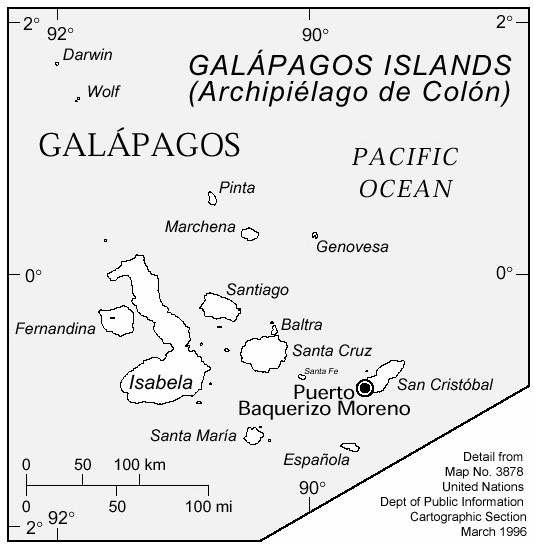
| Up-down, left-right, repeat...or more accurately, pitch fore and aft, roll port to starboard, repeat. M/V Mistral, our home for the last four and the next seven days, wallowed her way through confused seas after leaving Wolf Island at "o dark hundred" or about 2:30 a.m. I awoke not to calls of "land ho" signaling our approach to the island in the northwestern reaches of this far flung-island chain that straddles the equator, but to a shift in engine noise, as if the skipper had moved the engine telegraph from "deafening growl" to a "dull roar". |
| Upon first sight, Darwin Island in the
Galapagos archipelago evokes any number of reactions,
"desolate", "remote", and
"foreboding" being the first three that leapt
into my mind in the grey of the tropical sunrise.
"If the locals named this place to honor Charles
Darwin, they must not thought too much of him, wonder
what he did to tick them off" I thought to myself as
I scanned the island. She’s basically, a big,
high-sided volcanic rock sticking out of the ocean,
crowned by arthritic-looking vegetation. Certainly not
the kind of place one would want to be marooned or
castaway, so I resolved to stay in good stead with the
crew and the company of photographers and pray that the
boat doesn’t sink. Even at this isolated speck of
real estate on the outer limits of the middle of nowhere
we have company, another dive boat moored nearby.
She’s getting ready to disgorge her divers into
three diving tenders or pangas. Diving is the reason people come here, access to the island is prohibited, so for the next two days we would be boat bound, relying on the two pangas to shuttle us to and from the dive site. Specifically, we have come to see big critters--hammerhead sharks, Galapagos sharks, and whale sharks--species that are becoming ever increasingly rare as they are harvested, primarily for their fins and little more. This march of the threatened towards endangered or extinction makes seeing them even more imperative. Hopefully, if enough people see them, either in person or in the images we hope to capture, they will be motivated to demand protection of these species of the open ocean--a place where none one has the authority to lead and no one has the obligation to follow. |
|
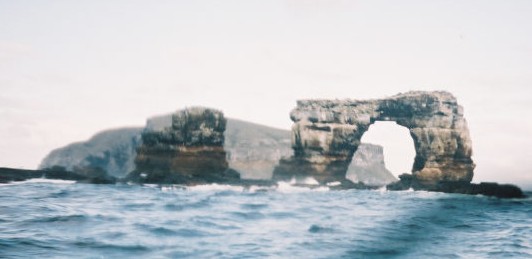
| Our dive site is The Arch, an above
water feature that crowns a wall that plummets to the
deep sea floor. We time our entry into our pangas for the
short trip to the arch so we arrive about the same time
the other groups are leaving. After donning my wetsuit, I
climb down the lower deck on the stern of Mistral where I
slip into my dive tank and buoyancy compensator (what
some people call the "dive vest"). I grab my
fins and, steadied by two deck hands step from the stern
onto the panga--a rigid hull inflatable driven by an
outboard engine. Imagine stepping from a teeter-totter onto a trampoline and you get the idea of what the transfer is like. I wedge myself into the panga nestling in among my four companions, Brandon, Melissa, Ken and Jim and dive master and park naturalist, Raphael. We cast off from the mother ship and motor off toward the entry point. We move shifting to the rear of the panga to raise the bow making it easier for the boat to track into the swell. The outboard engine is behaving today, running without so much as a cough or a sputter, a change from yesterday when the engine completely died before being coaxed back to life by the panga driver, Jacinto, but not before his usually stoic demeanor was replaced by exasperation. I am reminded about the problems that John Steinbeck and Doc Ricketts had with their outboard so wonderfully described in the Log of the Sea of Cortez. After cruising for a few minutes we arrive at the drop in point near the arch. A small swell is running. We sit on the side of the panga facing inward. Raphael counts "one...two...three" and we back roll somersault into the water. The panga driver hands our cameras over the side and we quickly descend to the wall below. Visibility is good, we can see a good distance. The other boats have picked up their divers so we will have the place to ourselves for a while. We drop down to about 45 feet and swim along the wall looking for places that will conceal us while giving us a clear view of the blue water beyond the wall. The large critters we ache to see will come from that direction. |
| I find a nice cleft in the
rocks that forms a natural bench. I check the area to
make sure I am not intruding on an eel that might not
take my intrusion too kindly. Not that it mattered,
because after settling into my hidey hole two eels came
swimming along the wall. The divers form a picket line. I
am about 20 feet from my buddy. A couple of the
photographers drop down to about 60 feet to check out the
deeper part of the reef. All of a sudden, Brandon swims
out into the blue water. Did he see something? We all
follow, straining to see what the diver might have been
pursuing. But it’s a false start. There might have
been something, maybe a shadow moving just beyond the
point where light fades and the water turns to a blue
twilight. We turn back and return to the wall. I scan the blue, like a coast watcher waiting to catch first glimpse of a returning ship. After a while, nothing comes by, so we move down the wall. We soon settle into a routine--hide, wait, watch, move. So far we see nothing the size of a whale shark. I see a few hammerheads just on the edge of our visibility and a dolphin swims with them. A turtle comes into view, surrounded by a ball of steel pompano part of the promenade of fish that passes by, including a bright yellow grouper. And there are uncountable hundreds of the omnipresent creole fish, which Santiago calls "gringo fish" because "they are everywhere you turn". |
 |
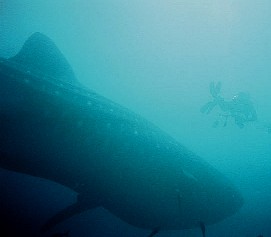 |
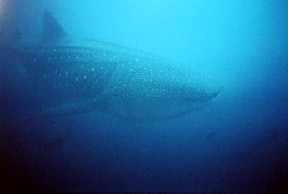
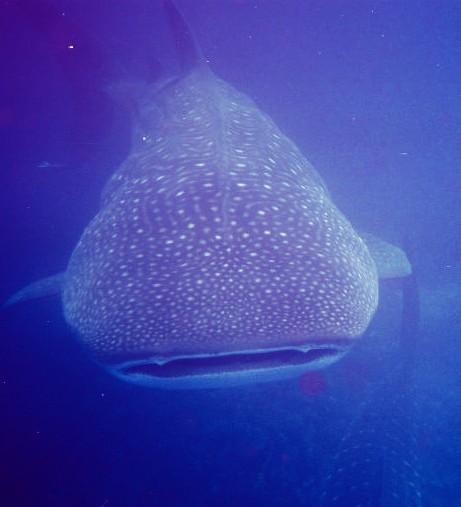
| Suddenly, I sense a moving darkness. As I am deciding what it might be, Brandon rockets into the blue from his spot on the wall, with other divers close on his heels. Almost simultaneously, the shadow materializes into the shape of a whale shark. We have found what we have come to see. Its chisel point head is coming toward me as I shoot pictures as fast as I can press the shutter release. The shark soon fills the view finder and I decide to stop shooting as this city bus-sized creature comes by, propelled by a what looks like a two storey tall tail slowly sweeping back and forth. What a glorious sight to behold! The creatures white speckled skin moves past me as I begin to swim parallel to its path. I turn to face the critter head on just in time to see Melissa duck under its tail like a boxer slipping an opponent’s wide right hook. I look up to see the photographers approaching the critter for close up shots. I shoot a picture because the diver’s silhouette provides a scale of the critter’s size. The behemoth seems oblivious to our presence. Watching it approach from the blue, swim by, and turn back to where it came from, I am awestruck by its size, thinking as I faced it head on, this is what Jonah must have felt like just before being swallowed by the whale. |
 |