 |
Cozumel Confidential |
Prelude
The trip to Cozumel was organized by Scott Anderson and the folks at Last Frontier Dive Shop in Anchorage, Alaska, while I was flying recon for bowhead whales and other marine mammals in the Beaufort Sea out of Deadhorse near the Prudhoe Bay oil fields. I learned about the trip from a fellow diver at work. The three weeks in Deadhorse in late September and early October gave me a preview of the Alaskan winter--cold, short days, snow. I decided that I needed to get some diving in before we got into the throes of a full blown great northern winter. I signed up for the trip the day after I got back into town. Winter came late to Anchorage by Alaskan standards. It didn't start snowing until mid-November. The trouble is that it didn't stop snowing for any appreciable period of time until the day before Christmas.
Day 1--In Transit
Like many flights from Anchorage, our flight to Cancun originated in the wee hours of Thursday, December 11. The routing took us from Anchorage to Seattle for a plane change, on to Los Angeles to pick up more passengers, and on to Cancun. The plane was full on the first and third legs of the flight. We quickly cleared Immigration and Customs in Cancun.
After straightening out some confusion over ground transportation, we were on our way to Playa Del Carmen where we would catch the 7:00 p.m. ferry for the half hour trip to Cozumel. The ferry terminal is about three blocks from the taxi drop off point. We availed ourselves of the local baggage transfer service, a bicycle with flat bed platform on the front, remembering that in Mexico there is no set fee, all transactions must be negotiated before proceeding and any deviation from the agreed-to service is going to be grounds for reopening price negotiations. The price was inexpensive and more than fair.
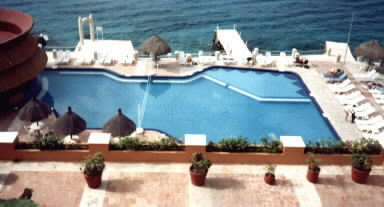
The trip to Cozumel was uneventful, and with after a short trip by taxi, we arrived at our destination, the Plaza Las Glorias. The guide book tells us that this hotel has a unique-for-the-island Mediterranean architecture. The hotel is excellent, constructed from native and imported marble. A good thing considering the tracks that scuba divers leave on carpeted floors. From our room, we have a great view of the pool, ocean, and the mainland beyond. The large sliding glass door opening to the balcony ensure we will be refreshed by the constant sea breezes which will build to a small gale twice during the coming week.
|
Day 2--Orientation and Shore Diving
The next morning, we took breakfast in the restaurant near the pool. The pool area, which fronts the seawall, seems to be a very popular area, with many of the reclining chaise lounges occupied by 10 a.m.
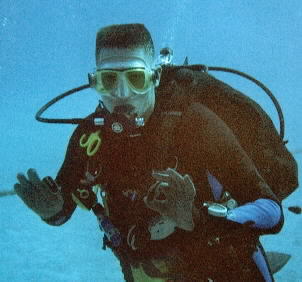
The trip package included boat diving and drift diving specialty certification. After nearly 1,000 dives, many from small boats around the world, there isn’t much new that the certification will reveal to me, so I approach it like it was a review or extended dive briefing. The "merit badge mentality"of the certification agencies never really infected me. I travel on my expired SSI Dive Control Specialist Card since my basic certification issued two decades ago is no longer recognized as "valid" since the open water certification is now considered the minimum acceptable. Thus, my delaminating basic certification card with a picture that shows me with more hair and less weight, has been relegated to the status of "relic" suitable for donation to a diving exhibit at a maritime museum. I'm do have certification for some real skills, such as dry suit diving, cave diving, and Nitrox.
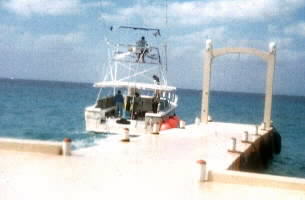
After the discussion, we walk three blocks to the dive shop to set up our diving for the week. We are using Paradise Diving. A peculiarity of Cozumel is that each of the dozens of hotels seems to have a dive shop on the premises. The dive shop that we used, Dive Paradise, is present in at least two hotels, but not the Plaza Las Glorias, which hosts Aqua Safaris. The trip leader wanted to use a particular divemaster, Antonio, to make each dive with the group and Antonio works for Dive Paradise. It doesn’t really matter since each hotel has a pier and divers are picked up by each shop's boat at the hotel pier. For example, on the first morning we did boat diving (the second day of the trip) a total of four boats picked up passengers from the Plaza Las Glorias.
 |
At the dive shop, they check our C-cards and see if we want to dive with air or Nitrox. I opt for the Nitrox, which some refer to a geezer gas, for the advantage that it offers in reduction of nitrogen uptake during the dive. While the package includes air tanks for each dive, Nitrox is extra, $10 per tank, which is worth the expense. Still, I have had a terrible head cold for four days and chose to put my order for Nitrox in every day, rather than placing a standing order for the week. It seems that on Cozumel, none of the dozens of dive shops have their own compressors. Rather, tanks are filled at one of two filling stations on the island and delivered the next day to the various locations. I never did find out the reason for this complicated logistical arrangement, although I suspect it has something to do with the cost of a compressor and the economy of scale offered by having two large fill stations.
After the paperwork is taken care of at the diveshop, we proceed the Barracuda Hotel, half way between our hotel and the dive shop, to do our orientation dive. The Dive Paradise shop at the hotel gives us our tanks and weights. We dive in the shallows in front of the hotel, where a number of structures attract fish. The dive affords us the chance to get used to diving in the warmer waters and to check our weight and equipment before going out on the boat. The dive is interesting if uneventful, although we are warned not to enter the restricted waters next to the hotel which fronts the adjoining Mexican Naval Station. The shop staff intimates that we could be shot at if we cross the underwater boundary separating the two establishments. As far as I can tell, the underwater boundary is unmarked. At the end of the first dive, the tank slips from the tank band. This is the first of a minor errors that will plague my first few dives.
We do a second dive at the area in front of our hotel. The artificial reef there is quite interesting, constructed out of old cannons. Given these objects, a diver can easily fantasize about finding a gold-laden wreck.
 |
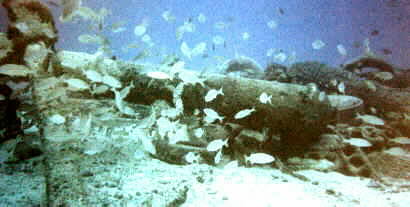 |
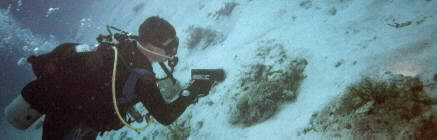
I swim around the area taking a few pictures with my Bonica Sea King II which has not been in the water since the trip to the Cocos Islands last summer. As I approach the exit point, the stairs carved into the sea wall, the water suddenly fills with ink. I must have spooked on octopus with my approach. The daylight is rapidly fading and the sun sets right after 5:00 p.m. Still we have a full day of sunlight, quite a change from the 5 1/2 hours of daylight that Anchorage had when we left.
 |
That evening, some in the group decide to go for a night dive in front of the hotel. I pass on the dive. So far my head cold is in check, but I don't want to take the chance of inducing a blockage by diving. My two shore dives today were pretty good and the boat diving starts tomorrow. |
Day 3 and Beyond--the Boat Diving
Our dive schedule called for three dives a day. We were picked up at the dock for a two tank dive in the morning about 8:15 a.m., brought back about noon and picked up at 3 p.m. for a single tank dive. Our first boat dive is at a location called Plancar Horseshoe. Our boat makes four stops to pick up the 16 divers who make up the two groups that day, each under the supervision of a divemaster. On the way to the divesite, in what becomes a daily ritual, we assemble our gear checking the contents of the tanks with an analyzer to ensure the Nitrox mix we ordered is the mix we get.
The Alaskan contingent dives as a group and the divemaster cautions us not to get too spread out. As with all boat diving on Cozumel, this is a drift dive with a fast current along the wall with a number of swim throughs. After one group enters the water and descends, the boat motors away to deposit the other group. Ideally, the groups remain separated by this distance through the dive. At the end of the dive, which is indicated by 700 psi tank pressure, we ascend to a 15-foot safety stop.
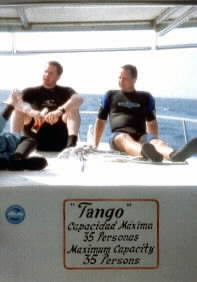 |
On surfacing, the boat should pick us up. At least, that's the plan. There are several boats in the area. During the pre-dive briefing we are advised to remember the name of the boat and that it monitors Channel 88 on the marine radio. If a different boat comes by to pick us up, they will radio the boat that we came from. While we were picked up by our boat each time, veteran Cozumel divers love to relate incidents where a group of divers got caught in a current and got picked up by a different boat some distance away. There are also stories about divers being left in the water when their boat goes leaves the site unaware that not all are on board! |
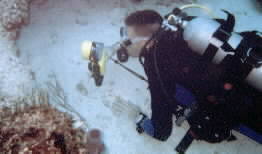
Using a 2-mm shortie wetsuit in the 81 degree temperature, I have about 9 pounds in each of the two integrated weight pockets on my B.C. The dive has some great scenery. As I begin to ascend at the end of the dive, one of the weight pockets separates from the b.c. and plummets to the sand below, narrowly missing one of the other divers, Justin. He retrieves the pack for me. Apparently, the velcro which holds the pockets is losing its holding power and I switch to my weight belt for the rest of the dives.
 |
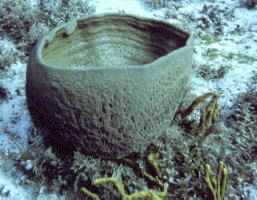
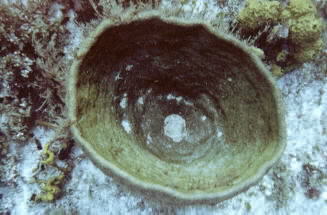
The reefs seem relatively healthy, although you can see where portions have been stressed. Also, the sheer number of divers contributes to stress on the habitat. These are not cattle boat operations, but when dozens of small boats use the same reefs, well you begin to get the picture. This was especially true when high winds and seas limited the reefs that were accessible and all the boats seemed to head to the same place. The groups of divers seemed to merge underwater into a big bait ball and the groups did not emerge from the ball intact, much to the consternation of the divemasters.
|
|
 |
 |
 |
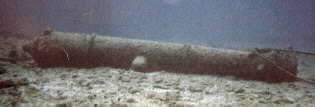
| We did have a chance to do a wreck dive, a former Mexican Navy patrol vessel, C-53, engineered in a way that it is not considered a penetration dive. Compartments have been opened to allow divers easy entry and exit. I am paired with a newly-certified diver who related that he did not feel comfortable swimming through the wreck. So he and I swam about the exterior wreck as the group wandered around the interior. The combination of the wreck and water makes for framing some great photos. |  |
The current was really ripping across the wreck stern to bow. My partner ran low on air (700 psi) before the divemaster was out of the wreck. There were two ascent lines to the mooring buoys that the boats tied off to while waiting for their divers. Both were occupied, but I didn’t know which one was ours. We were amidships when Ted signaled it was time to go to the surface. I figured we had a 50-50 chance of coming up on the right boat. I swam Ted to the stern mooring line against the current. If we surfaced on the wrong boat we could drift back to the correct boat. Whereas, if we came up on the boat moored to the bow, we would have had an impossible kick against the current. Also, if we had to let go of the line during the safety stop we would come up down current of the moored boat with no guarantee that it would slip the mooring before it had retrieved all the other divers, which means we would be in for one hell of a drift. As it turned out, we came up on the wrong boat and drift back to the right boat.
We went diving on a number of reefs and walls through the week. While any number of guide books are available, I found the Cozumel: Dive Guide and Log Book to be very useful, thoroughly readable, and richly illustrated.
Island Life
Three days into the trip I decided to offgas and skip the afternoon dive. High winds were going to limit the choice of dive locations. I wandered around town with another diver from our group. Cozumel has four sectors. The only city on the island, San Miguel de Cozumel, and her beach area houses the hotels, while the center city caters to tourists with hundreds of small establishments that seem to sell the same things at the same prices, the residential areas, and the rest of the island. We visited two churches and wandered around the residential sector with its colorful houses that bordered the tourist area.
The city’s Christmas pageant was planned for that evening in the central plaza which borders the ocean and bisects the commercial section. The plaza does attract performers and artisans. Its interesting to see American tourists taking pictures of themselves in front of the waterfront monument not realizing it is a memorial to those who fought the American invasion of 1847. I guess the current invasion is a good invasion and the monuments are the shops that cater to it. Cozumel, much like other islands was a diver-driven tourist economy. But a constant stream of cruise ships seems to be changing the economy to one that caters to a mix with an upscale emerging sector leaning towards servicing the cruise ship passenger. One night there were seven cruise ships at the port. Globalization is seen in the chain night clubs that have taken root including Senior Frogs, TGI Friday, the Hardrock Cafe (smallest one in the chain), and so on.
| Pizza Hut delivers, but from boxes bolted to the back of motor scooters rather than from cars. McDonalds completes the branding of the tourist area | 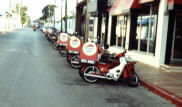 |
 |
We got blown out of diving on our
last day on the island. We took advantage of the
cancellation to do "island stuff" wander around
town, rent motor scooters for ride around the island, or
just hang out. The bottom line is that it was a great trip. |
We left the island on Thursday morning and went diving in the cenotes on the mainland that have been developed for diving (that is, with permanent guide lines installed and ladders down into the cenote to reach the water). We went to Hidden Worlds Jungle Adventures. This freshwater diving was fascinating. We did two tanks. The shorter dive lasted about 40 minutes the longer dive lasted about 50 minutes. It is much more interesting than cave diving in Florida because of the stalagmites and stalactites. These are guided tours, more a matter of keeping the small group (four divers per guide max) from getting lost. I found this diving most intriguing, not having done anything like it before.
Aftermath
We left Cancun on Friday, getting into Anchorage early Saturday morning. Apparently, it had snowed every day we were gone. The morning’s paper indicates that the storm that dumped up to 10 inches was unexpected. Luckily, I managed to avoid must of the recent activity. On my way home from the airport as I drove up the street toward my house past the mounds of plowed snow I wondered "how much higher can they pile it before it has to be hauled away?" I fear we will soon find out.
Return to Cove Diver's home page