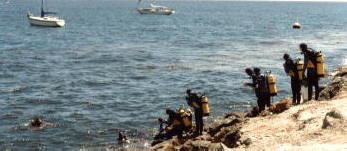
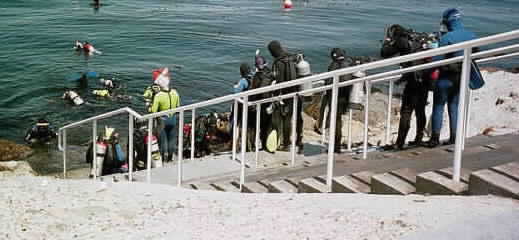
| Before the Staircase (Circa 1985) | After the Staircase (Circa 2001) |
 |
 |
 |
 |
Hello Little Friend and Mrs. Little Friend:
One of the changes at Casino Point is the staircase that now leads from the rallying area down the breakwater and into the ocean. Upon seeing this engineering wonder, I recalled the verse in the Sailor’s Prayer, Psalm 107, "they that go down to the sea in ships, that do business in great waters; these see the works of the Lord, and his wonders in the deep." I always thought this was especially true of divers, who see His wonders first hand. Now at Catalina, we can have the Diver’s Psalm, which can start " they that go down to the sea on steps..."
Some say the Casino stairs are an improvement, some say they aren’t. I guess it all depends on whether you think that learning to do difficult entries and exits makes you a better diver. Getting in and out of the water with the stairs is relatively easy or at least as easy as it can be without making the staircase an escalator. (Remember, for the most part people diving at the Casino are "LA Divers", their assembly line training regimen means that nothing is easy, only progressively more difficult. But with their high end gear that their salesman-cum-instructor recommended, they will look cool while foundering, which to an LA Diver is all that really matters.)
I think climbing onto or off rocks to make an entry or exit in a surge while avoiding entanglement in kelp does make you a better diver because it forces you to think and act on the ocean’s terms and not your terms. The earlier that lesson is learned, the better off everyone is. Still, I must admit that scrambling over rocks while huffing and puffing like some asthmatic sea lion trying to haul out becomes less appealing as I grow older. I have proven myself at Catalina. I deserve a break! And yes, I was a hypocrite. While I could have chosen a more difficult, non-stairs entry and exit, I did not. By eliminating the free ascent/descent rock climbing aspects of moving up and down the breakwater, the staircase does make things safer. So I guess its for the better. Besides, had this been Monterey, they would still be debating whether the stairs should be the more aesthetically pleasing spiral design.
| Before the Staircase (Circa 1985) | After the Staircase (Circa 2001) |
|
|
|
|
Consequentially, the portal funnels all the traffic to a specific point rather than spreading it across the three or four previously used entry/exit points. This being California, that means we need to adopt a set of rules to make things work. All it takes to really gum things up is a couple of folks to ignore the protocol, which happens with frightening regularity, this being California. In brevity that is uncommon when directing divers what to do, the protocol has been boiled down to the five essential elements shown in the photograph. Much to my pleasant surprise, the list did not include the standard Southland admonishment, "no skateboards, roller blades, bicycles or scooters allowed" that seems to appear anytime there is a wall, stairs, and handrail. I was shocked when not a single person tried those stunts, which in dive gear would have proven difficult with the price of crashing during a grind on the hand rail a bit more serious than just a case of cracked nuts or smashed scrotum. But it won’t be too long before Baywatch has to respond to a call of a drowning skateboarder at Casino Point. Of course, given your past history as one of the original buzz cut skateboard terrorists on tour, I would not be surprised if that person is you.
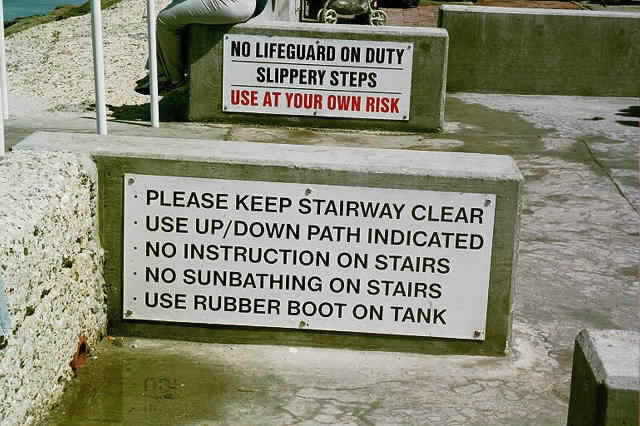 |
The first rule, "Please Keep Stairway Clear," isn’t a rule. Its more of a plea in broken English. Dropping (an) article is acceptable in technical writing and sign painting. Using the civil form, "please," transforms the command into a request or suggestion. As such, people can say "no" which many seemed to do on this weekend. This being LA, most people are conditioned to see most signs as suggestions for someone else to observe. This applies equally to suggested maximum speed limit posed on the highway and, if the appearance of our beaches is any indication, "No Littering" is the ignored sign de jure of environmentally-conscious, coast-loving Californians.
I did not see any sunbathing on the stairs, despite the sun being out and bathers present. I guess lack of people on the stairs has to do more with human anatomy than the rule. Would you rather lie on a warm rock whose curvature your body can somewhat conform to, or would you rather lie on a staircase with a curve that approximates a "stair step"? Is the slope calculated as rise over run or run over rise? I agree with Jimmy Buffet’s song from the "Beach House on the Moon" CD--Math sucks.
That leaves three rules that really matter. Still a majority. Being young and from LA, the neophyte diver knows that achieving 3 out of 5 yields a grade of 60 percent which will result in his or her social promotion to the next grade or certification as a diver, whatever the case may be.
Of course, a "warning label" on the other buttress accompanies the list of rules. Actually, two warnings and a disclaimer. These fairly innocuous warnings are shorter than the law-book detailed warnings that now accompany dive gear. Have you read the warnings on your BC lately? At Casino Point, one warning clearly states the obvious, that wet steps will be slippery. As far as the disclaimer that the diver uses the steps at his or her own risk, I thought that risk is what the steps had been designed to eliminate, or at least minimize.
But back to the rules. The rubber-boot-on-the-tank rule seeks to mitigate the dive-tank-as-sledge-hammer effect that thousands of impacts per weekend will have on the cement walkway. As a diver sits to enter the water, the tank will make contact with the concrete. I guess using a boot has the same effect as putting a rubber face on a steel mallet or a boxing glove on a fist. It lessens the blow, but the best strategy remains to avoid the impact. Of course, as a boxer I learned to bob and weave to avoid the impact. It is not a maneuver I would recommend for someone with dive gear and weights on slippery steps.
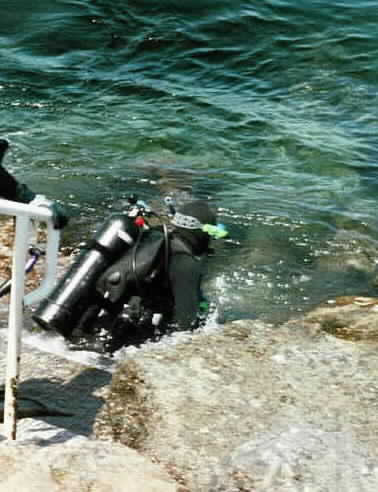
As far a using the right side to go down and the left side to go up, that convention only works if you specify whether the point of reference is at the top of the staircase looking down or the bottom of the staircase looking up. What we had at the Point was the high school equivalent of "Up the Down Staircase." Now, this is not a problem if only a few divers are trying to get in or out. But when you have an instructor lead his phalanx of divers to the water like a mother mallard leading so many ducklings for their first dip and a school of student divers trying to get out, the result is gridlock. Now, for LA divers, gridlock is the norm in their daily lives, so why not when you are trying to get in or out of the ocean?
Now the mask-to-tank congestion provides instructors with an opportunity to instruct. After all, everyone is in a line standing around doing nothing. Why not give a lecture? The fact that the divers have on hoods and can’t hear doesn’t matter since most don’t listen anyway. I wouldn’t mind if the lecture concerned the problem at hand, like how to make the specific entry from the stairs at low tide. One instructor was lecturing about the finer points of night diving, at high noon on a Saturday. Another was pontificating on the merits of signing up for an advanced course that started the following weekend. A third was bagging on the other two. Of course, a thinking instructor who has the students’ welfare in mind would move up the line doing a gear check so entry into the water by the diver column could proceed expeditiously. One day I hope to find an instructor from one of the certification factories who does both at the same time. Until then, I will pray that somewhere along the lines the students get exposed to a teacher like Ed or Dennis who can do damage control.
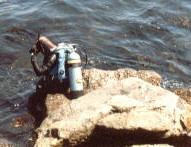
| Of course, you can avoid congestion by flinging yourself into the ocean from the breakwater as the diver in this photograph did many years ago. Its kind of a scuba equivalent of the cliff diver of Acapulco, sans the speedo swimsuit but with dive gear. The concept is basically the same. Time the swell correctly and make a successful entry. Time the swell incorrectly and you become that afternoon’s sacrifice to Poseidon and that evening’s dinner for the crabs that populate the break water. | 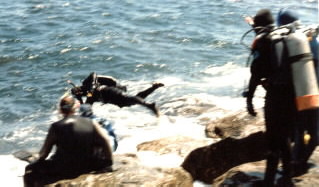 |
The stairway also seems to have caused the demise of the slightly used dive gear that people would lose in the boulders as they crawled out of the water. I recall people finding dive watches, gages, knives, lights, and an odd assortment of clips and webbing with an occasional weight belt thrown in for good measure. On past trips, some enterprising members of our party salvaged enough equipment to put a sizeable dent in their expenses for the weekend. The best booty I ever recall anyone finding was a brand new dive computer at a time when these objects were still rare enough to be considered a novelty and engender a fair amount of interest from other divers. This was in the days of plastic repetitive dive tables when someone who had a computer was an exotic tech diver. Only trouble is that the person who lost the computer neglected to lose the operating manual at the same time. Eventually, the owner was located and gave the diver a very generous reward. In all the years of diving the Casino, there was never a case where salvaged gear was not immediately returned when its owner came forward.
The camaraderie among safety divers that once existed on the wall seems to have left with the installation of the stairs. I recall times when a student exiting the water would end up on their back rolling to and fro on their tank as the swell just hammered them. In these cases, the safety diver or dive master didn’t care whether or not the diver was one of theirs or belonged to some other party. A diver in distress demanded a response. We looked after each other’s divers and watched each other’s ocean. No more. It is as if every diver in a party is imprinted with a scent that allows dive masters to tell which ones belongs to them. I did see a few exceptions. Dive masters from our group convinced a 155-pound diver from another group that if he couldn’t get down with a 20 pound weight belt, renting another 20 pound weight belt to double the weight to 40 pounds probably was not a good idea. They led him to conclude that 40 pounds of weight might overwhelm the bc which provides 25 pounds of lift. Amazing what can be done when you treat someone like an adult.