| Before heading out
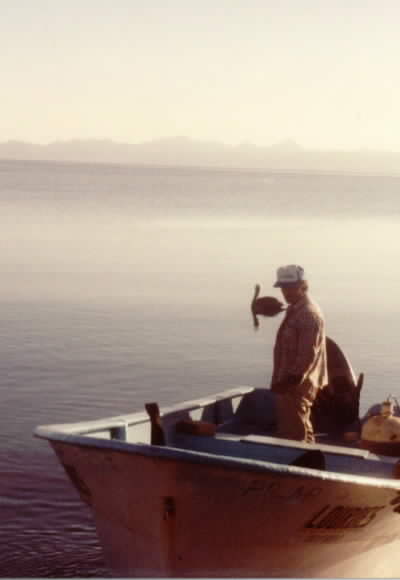
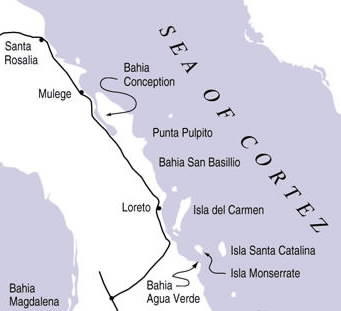
for Coronado Island, we stopped at the town’s
breakwater to take on refreshments for our time between
dives. The skipper warned that he might have to fuel on
the way back, but that was not necessary. We ran out to
our first dive at La Piedra Blanca or "the white
rock." The area drops off rapidly, forming a very
large and lengthy wall. We dropped down at about 11:00
a.m. and had a maximum depth of 85 feet coming up slowly
for a total bottom time of 20 minutes. The second dive
was at another nearby location, Punta de la Fajas. Both
dives were good, although our divemaster seemed to want
to set a barracuda’s pace on the first dive. We had
other ideas. I remember from
my time leading dives at the now-defunct Club Med at
Playa Blanca in Mexico that the divemaster’s main
task was to keep the group moving as a unit. If one
dawdled, the group would spread out as the stronger
divers raced ahead and the weaker divers lagged behind.
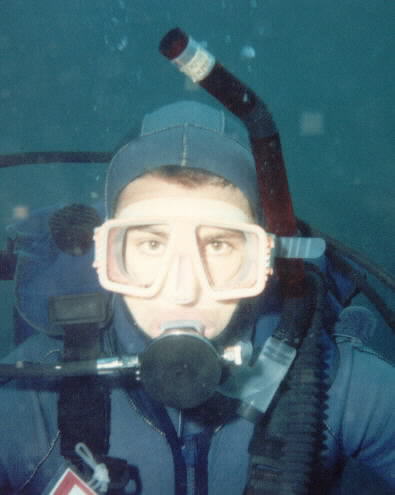
As it was, Brandon was taking pictures, patiently waiting
for just the right moment to trip the shutter. Andy and I
seemed less inclined to concentrate on a single spot and
moved about. Soon, we were spread out and well behind the
divemaster. But that’s the way we wanted to dive.
The 50+ foot visibility allowed us to maintain visual
contact and mitigated our failure to keep close proximity
to each other. I was the first to reach 500 p.s.i. and
signaled my intention to go up leaving Andy paired up
with Brandon.
The dives were great. The reef
abounded with sea scallops and the fish were colorful,
what I term the "tropical aquarium" variety.
The eels are smaller than the ones I encounter at the
Channel Islands, which is surprising because I had always
assumed that the tropical eels would be much larger than
their colder water counterparts. Between dives, Brandon
explained the differences in the sea life compared to
that of the Santa Barbara Channel. Like Doc Ricketts, he
has an unquenchable curiosity about the critters and a
very methodical technique for finding them. For each
habitat, he seems to know what critters should be there
and then he meticulously examines the area until he finds
them, definitely a macro approach to discovering the
underwater world. I am more inclined to explore, scout,
or reconnoiter an area to randomly see the big picture.
Anything interesting I find, like the blue lobster on the
second dive, gets found via serendipity rather than by
any structured search. Andy seems inclined to go with the
flow, taking up a middle position between me in the lead
and Brandon in the rear. We get separated sometimes, but
with 50-foot-plus visibility, keeping in visual contact
is not a problem. As is my habit, I circle back every so
often just to see how things are going.
|